

Heather Mac Donald has written an astonishingly good piece over at The Wall Street Journal called “The Humanities Have Forgotten Their Humanity“. It details the academic coup that occurred in one of America’s premier English departments a few years ago when the junior faculty at UCLA overthrew the core curriculum. These misguided fools threw out the old requirements, which required English majors to master their discipline by taking courses on Shakespeare, Milton, and Chaucer, replacing it with classes like “Feminist and Queer Theory” or “Women and Gender in the Caribbean” for the sake of exposing students to “alternative rubrics of gender, sexuality, race, and class.”
This is something very close to my own heart. It is no secret both Aaron and I made a decision to spend our four years at university as liberal arts majors with an emphasis on classical music. We took the advice of men like Peter Lynch and Charles Munger, who often spoke about the importance of learning how the world works; how to learn lessons from the great thinkers, artists, and writers of the past, then integrate that into a working system that allowed us to achieve whatever it is we wanted while improving the civilization.
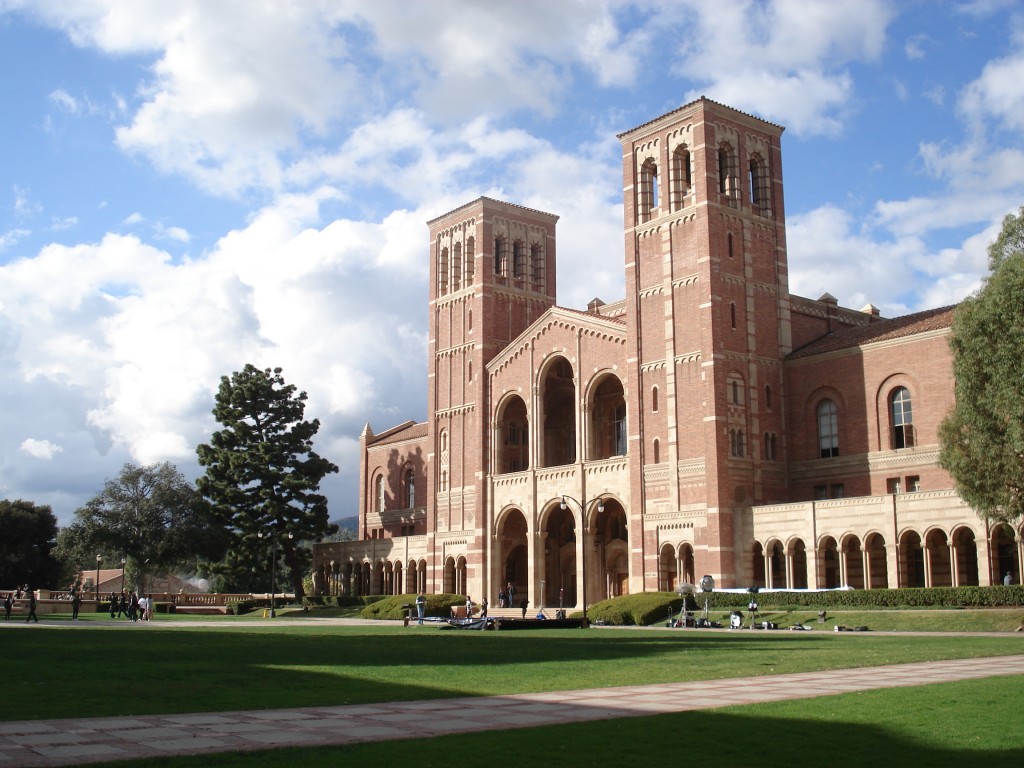
The UCLA humanities department has been hijacked. English majors are no longer required to take as many courses studying the great writers of the past, and now must spend their time talking amongst themselves on gender, sexuality, race, and class.
Image used under Creative Commons Attribution-Share Alike 3.0 Unported by Alton. From Wikipedia
My Humanities Education Was the Most Valuable Period In Shaping My Life
Those years were spent immersed in literature, philosophy, accounting, history, music theory, painting, acting, genetics, writing, management, piano, finance, art song, ethics, economics, German, and diction. Our days were a blur of going from classes looking at the underlying numerical structure of Schubert string quartets to debating the socioeconomic forces that shaped Irish history; practicing Bach harpsichord arrangements to learning the intricacies of pension accounting. We read Dumas and Dostoyevsky along with Ben Graham. At night, we’d retreat to the dorm, where we played Final Fantasy IX and Kingdom Hearts with friends, while working on our first online businesses.
[mainbodyad]The objective was to break apart, study, absorb, and reach fluency with the best in every field – those who had mastered their art or science – and learn how it all fit together, stripped of politics or ideology. This allowed us to start our adult lives and careers with the accumulation of millennia of human thought and discovery, standing, as the saying goes, on the shoulders of giants. It helped forge a strength of character when it came to ethical dilemmas, having pondered some of the toughest questions humanity has faced, sometimes for years on end in back-and-forth debates with professors and friends. It helped us learn to identify problems, make effective decisions, and craft workable solutions. More than any other period in my life, it was transformative in mind, body, and spirit. We were compiling the software program that would run our worldview, in a sense, adding as many modules as we could so there were larger data sets from which to draw.
When friends and family would lament, “Yes, but how are you going to earn a living? What are you going to do?” I was evasive. “I’m learning to think at the moment; money won’t be hard as it’s just another applied problem.” It was a lesson drawn from Voltaire and I was confident enough in my abilities to know I could pull it off without having to sell my time to someone else. We were already having success from our side projects, done in between rehearsals for our performance of the Brahms Requiem at Avery Fisher Hall in Lincoln Center or writing the manuscript for the book deal I signed that year, most of which I kept secret for the sake of information asymmetry.
The idea that somehow supporting yourself and seeking wisdom were mutually exclusive was a false distinction, something that one of the smartest men in history acknowledged when he wrote, “There is precious treasure and oil in the dwelling of the wise; But a foolish man swalloweth it up.” As Thales himself learned, wisdom is one of those friends that has a habit of putting food on your table and showering you with blessings, financial and otherwise. Like alchemy, it transmutes cotton into cashmere and grain into gold.
The Dangers of the Modern Hijacking of Humanities Departments By Irrational Ideologues
In her piece, Ms. Mac Donald illustrates exactly what is wrong with a world in which an English major no longer has to study the great English writers in order to get a degree. She says:
The UCLA coup represents the characteristic academic traits of our time: narcissism, an obsession with victimhood, and a relentless determination to reduce the stunning complexity of the past to the shallow categories of identity and class politics. Sitting atop an entire civilization of aesthetic wonders, the contemporary academic wants only to study oppression, preferably his or her own, defined reductively according to gonads and melanin.
There is nothing inherently wrong with studying gender, sexuality, race, and class. In fact, we spend a large amount of time talking about those very topics right here on this blog. The problem is when they are substituted for the foundational knowledge necessary to reach good conclusions about their implications. It would be like giving a teenager a drill and a hammer, expecting them to construct a skyscraper. The tools are not sufficient for the task. These are not core courses; they are electives suitable only to upperclassmen who have demonstrated the requisite combination of mastery of their field and familiarity beyond.
How, for example, can an English major seriously discuss complex issues such as the wage gap between men and women without at least a sophomore level understanding of microeconomics? Anyone with even the most rudimentary grasp of the field knows that the wage gap is an illusion caused by a variety of factors. Such a gap simply does not exist for comparably situated people; a fact now settled beyond any rational dispute for decades. How can an English major seriously understand issues such as gender non-conformity without an intermediate comfort with both neurology and behavioral psychology? Even a below average student exposed to those areas won’t fall into the stupidity of thinking, as some of the self-identified radical “feminists and queer theorists” do (a disgustingly offensive term as the word “queer” is still very much a popular slur in a huge portion of the United States outside a handful of insular academic or geographic networks mostly on the coasts), that gender is nothing more than a social construct. There is a very powerful, evolutionary reason that most boys migrate towards rough play, Tonka trucks, and soldiers, while most girls opt for tea parties, baby dolls, and tiaras. The existence of outliers does not mitigate this reality (but, without studying statistics and Gaussian distribution, how would they know that?).
A 22-year old English major who has read the works of Jane Austen, augmented by courses in engineering, probability, and psychology, is in an enormously powerful place to change the world for the better that her less informed peers can never understand. In her heart, she learned the moral of works like Emma; about the dangers of hubris and overly complex plots. In her mind, she knows the reasons these complex plots fail are due to the engineering concept of “breakpoints”, which introduce ever increasing probabilities of a poor outcome with every subsequent variable, and the reason there are poor social ramifications have to do with people feeling like they were manipulated and disempowered. And in her soul, she knows that, despite her superior grasp of these things, thinking it makes her immune to such mistakes is a folly likely to cause her to stumble; or, as one of the great works of literature put it, “Pride goeth before a fall.”
A 22-year old English major without those other inputs, sitting around all day mindlessly clucking away about patriarchy and non-binary gender acceptance in the LGBT movement without any understanding of those other disciplines or a mastery in the core material of their own discipline (ironically spouting off about intersectionality), is not only useless, he is dangerous. Unlike John Stuart Mill, who looked for “scattered particles of truth … buried and lost in the ruins of exploded error”, they reject that which doesn’t perfectly conform to their doctrine. It’s people like that who, when getting their hands on the levers of power, implement disastrous policies that cause monumental declines in standards of living, human rights, and individual freedoms because they ignore real world experience. To them, second and third order effects don’t even enter the equation because they aren’t aware of what they are in the first place. They don’t understand that good intentions are never sufficient, plowing ahead with their stupidity as they shift the opportunity cost trade-off curve of millions of people, then act baffled when their plans go awry.
The Civilization Pays the Price for the Loss of Interdisciplinary and Rational Humanities
In many universities, the humanities have been hijacked to the point that enrollment is significantly declined as more intelligent students migrate to other departments. This now shows up in the employment figures. While liberal arts majors were once the cream of the crop in terms of selecting folks for running the civilization, from Goldman Sachs to General Electric, they now find themselves largely unable to earn enough to cover the interest on their student loan debt.
[mainbodyad]The truly talented will still thrive, as they always do. Nevertheless, the moment the phrase “liberal arts major” stops evoking images of the Enlightment – a brilliant Thomas Jefferson writing letters on his farm, a Benjamin Franklin, up studying by candlelight, a Madame Curie excitedly unlocking the secrets of radiation, a John Locke working out the nature of a fair society, or a Steve Jobs using his obsession with calligraphy to design better technology – and starts becoming inextricably linked to the picture of whiny, privileged children living in extended adolescence without any real world skills, inventions, accomplishments, or resources, the civilization has paid a severe price that will take generations to recoup.
At some point, I expect it to come full circle, just as the economics departments were a couple decades ago with the “efficient market” nonsense that finally gave way to a much more rational “behavioral finance” approach. Still, it’s an absolute tragedy.
If you haven’t, do yourself a favor and read the piece. It’s worth your time.
Reader Comments (17)
Comments are presented chronologically, with replies indented beneath the comments to which they respond.
Rob
January 4, 2014
Great article, I'm glad you referenced the WSJ piece as when I heard read it, I was infuriated. As my parents told my brothers and I growing up, 'just because you are the loudest it does not make you correct.' I really wish UCLA, as well as other institutions, had more backbone in these cases. It is unfortunate.
Drew
January 5, 2014
Replying to Rob
"Just because you are the loudest it does not make you correct"
The squeaky wheel always gets the grease. Unfortunate, but true.
Anon
January 5, 2014
"A little knowledge is a dangerous thing." They know, and are looking forward to, the results.
Aditya
January 5, 2014
My own caveats: I didn't read the WSJ article; I'm more of an FT guy, which means one paywall versus the other. 🙂
I'm glad to see you're writing about more metaphysical articles. I find that in general universities today are providing freedom of opportunity in determining one's own degree, and to this, I have no problem - like always, smart people will use it to their advantage. What I take offense to is the structure of the education system overall - the collegiate structure and our western cultural exception/esteem of it is a major problem.
Rather than focusing on what might be considered "core curriculum," I personally would like to see learning to be more about "how do I learn as an individual?" To take myself as an example, I fared poorly in college lectures but excelled in hands-on project work and by learning on my own, discovering I had autodidact qualities. Do I think the skills I picked up at university are useful to me even today? Absolutely, and they all translate rather nicely as I've described in articles I've written about in the past. Perhaps in the big picture, as a society how can we create beings of critical and reflective thought while still being ready to participate in any economic system that exists. We often say that learning is a life-long process; well, if that's the case, why don't we invest our resources in training that particular aspect?
On a lighter note, 'queer theorists' is my new catchphrase of the day!
Dheeraj
January 5, 2014
nicely written mr kennon
joe pierson
January 6, 2014
To be fair they added interdisciplinary studies and critical theory as a requirement.
Gilvus
January 6, 2014
You can circumvent the WSJ paywall with Google's cache. In your address bar, type in:
http://webcache.googleusercontent.com/search?q=cache:[URL OF PAYWALLED ARTICLE HERE]
It's worked for me as long as I can remember, and sometimes comes in handy for retrieving recently moved pages or data from overloaded servers.
Anon
January 7, 2014
Replying to Gilvus
I find it easier to just Google the news article title. However, you musn't click on the WSJ article from the home page! My precious!!!
Odai
January 6, 2014
As an avid Dilbert reader, "liberal arts" has had a negative connotation in my mind for years: http://dilbert.com/strips/comic/2004-05-25/
lokgp
January 6, 2014
I think Joshua is saying something important, but I am finding that WSJ article difficult to grasp and understand. So maybe someone can help make it simpler for my simple mind to understand, please.
It is true though, that the language used by Shakespeare can be daunting and hard to understand. Eventually, people just give up reading it. I am not saying the ideas and concept is incorrect, but my lack of ability to understand their language is deterring me. The language is only a tool to understand the experience, knowledge, and meaning behind it. In my opinion, if these classical text are re-tooled to better mimic current language styles, it would make the lessons eternal and more easily read.
I still find lessons from The Tortoise and The Hare these days.
Kevin
January 7, 2014
Replying to lokgp
The WSJ article is talking about how the traditional aim of a humanities degree (essentially to guide students through the works of the great thinkers of history) is being replaced by modern identity and class politics. It gives the example of changes in the course requirements at UCLA, apparently one of the last major American colleges to go down this route. It says that Shakespeare, Milton and Chaucer are no longer part of the core curriculum for an English degree, whereas things like Gender, Race, Ethnicity, Disability and Sexuality Studies are. Essentially, instead of passing down the accumulated culture and knowledge of our civilisation, it's throwing that out in favour of focusing on more political issues. These issues may well be relevant and interesting to study, but how can a student understand these issues without understanding the background to them?
By the way, if you look here: http://nfs.sparknotes.com/ you can find modern English versions of Shakespeare, along with the original. It's also easy to find annotated versions which explain the meaning of old words and phrases in the originals. Finally, remember that he wrote plays and poems, not novels - if you try and read it like a book you're missing the effect of the rhyme and rhythm, which makes it much more enjoyable and easier to follow.
lokgp
January 13, 2014
Replying to Kevin
Hey, Kevin. This is excellent modern English Shakespeare! Thanks a whole bunch!
And I really appreciate your translating the WSJ essay into a much simpler text, summarising the main points.
Magazines like Newsweek makes me so drowsy and sleepy. I wish they could just say it in a simpler manner. It is very different from the english used in blogs etc.
Fantastic work, Kevin!
joe pierson
January 7, 2014
Replying to lokgp
I agree with your general conclusion and modern authors like Munger, with knowledge of more recent scientific methods (double blind tests for instance) are superior.
Part of the problem is the author has degrees in English, and she believes, at least in part, that her years of studies with difficult languages and authors have become obsolete. That is not a pleasant experience, it's commitment bias at work.
VR
January 6, 2014
Interesting topic. IMHO, there is a happy medium somewhere. At one extreme, a very generic degree may make it hard for most people (with a few talented outliers who can do it with any or no formal degree) to earn a living after. I got my first degree in a European school where it was more focused on concrete professional disciplines. In my view, some of the graduates of liberal arts programs in US are not well prepared for what awaits them upon graduation.
On the other hand, would agree that a healthy dose of exposure to the "softer" disciplines of history, philosophy, psychology, etc is helpful (or perhaps necessary) for most of the people who work outside of those fields later on.
I'm a bit skeptical though when we use Munger, Jobs, or Joshua (all clearly outliers :)) to prove a point. Would rather rely on statistical evidence on the full population...
Derek
January 8, 2014
This was exactly my experience at Loyola University Chicago. My 'Ethics and Society' class consisted of reading Guy Debord, Jean Baudrillard, Karl Marx and Nietzsche. Essentially, these men all said ethical norms are either subjective or about domination. I was really excited for this class, but in the end, I walked out having learned nothing about "social ethics". I'm glad to see the WSJ is sounding the alarm bell on this postmodern (post-postmodern?) trend.
Victor H.
January 10, 2014
"It’s people like that who, when getting their hands on the levers of power, implement disastrous policies that cause monumental declines in standards of living, human rights, and individual freedoms because they ignore real world experience."
And they are more likely to "get their hands on the levers of power" as the uneducated masses prefer to buy their utopian idiologies and propositions than hearing the people who actually know what to do to improve the life of everyone.
undercover
March 8, 2016
It's been two years since you wrote this and it's only getting worst and worst.
I don't see going to liberal arts colleges today as anything other than visiting adult day-care centers.
You're much better off just spending your money on books and studying at home.
https://www.youtube.com/watch?v=6Sxttk5REkM