

How We Made $100,000 a Year as Full-Time College Students
This is one of those posts that I am writing because I know that some of you, especially the younger ones, will benefit from seeing tangible proof that the ideas I write about are completely do-able and I speak from experience. My family hates it when I write stuff about my own life but this is so far in the past, surely it falls under some grandfather rule, right? Even though I sometimes worry about the privacy aspect, I release this type of essay from time to time because I appreciate those who were intellectually generous and allowed me to study their accomplishments. This is my way of paying it forward.
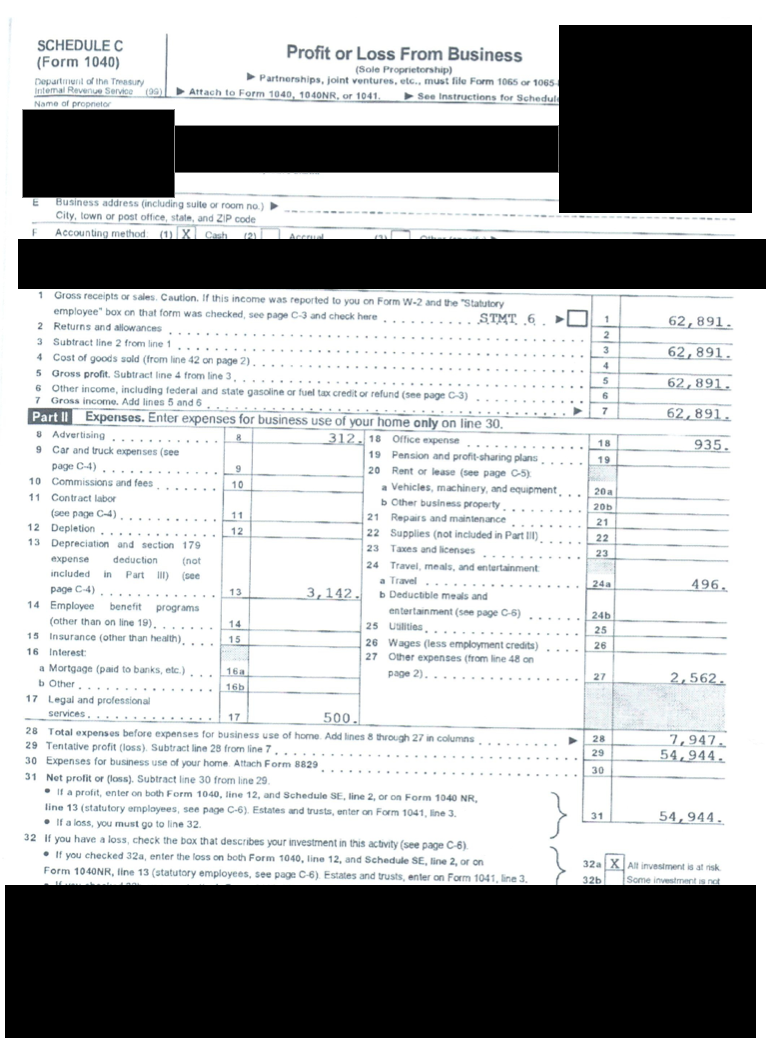
This is one page from the middle of one of my tax filings last decade when I was a full-time college student. Aaron and I had a household income of between $80,000 to $100,000 with no full-time jobs. This page illustrates my income from side-projects that I did with nothing but a computer and an Internet connection. It doesn’t include any of our investment gains, interest income, dividends, or any of my other income, or Aaron’s. We didn’t even own any operating businesses at this time! The point is, making money isn’t hard. It is revenue – costs = expense. You don’t have to wait for someone to create a job for you – provide a service or product the world wants and it will trade you money for it.
I found some of our old tax filings from last decade! It turns out that around our college days, living together in the apartment complex next to the Quakerbridge Mall in Princeton, New Jersey, our combined household income was somewhere between $80,000 and $100,000 even though neither of us had full-time jobs and we were both students attending school on music scholarships. (This is the same apartment that I showed you a few months ago.) The difference between the two figures depends on whether you count unrealized capital gains as “income” since our net worth was increasing but it didn’t reflect in our taxes at the time.
This money was generated from a variety of things and we saved almost all of it in brokerage accounts, retirement accounts, and plain vanilla bank accounts. This was when Aaron was still driving a 1993 Ford Escort that had no heating or air conditioning in it because he wanted to use his cash to buy more shares of U.S. Bancorp, Wal-Mart and Home Depot, which he believed to be undervalued.
If I recall, this was around the time I was going through tiny insurance group filings with the NAIC and comparing the loss development tables to the reported net income figures in the 10K’s, which used GAAP earnings (a nice trick I learned from my internship at one of the greatest insurance companies in the world by the amazing and generous people there). There were a handful of small firms that were consistently more profitable than the reported net income would indicate, leading me to believe management was understating profits so I would buy all the shares I could afford without risking too heavy of exposure. That operation added tens of thousands of dollars to my income over the years that followed as my holdings were bought out in mergers, acquisitions or just hit their intrinsic value calculations and I decided to sell them in the open market. It was another stream of cash that made the start-up days of our first online business much more comfortable.
Making Money Is Simple
This is why I say that making money is simple: It is: Revenue – Costs = Profit. That is it. I also have talked to you about the importance of the DuPont Return on Equity analysis. In my case, since I had to be self-made, I decided to rely heavily on the profit margin component of ROE because I don’t like leverage (debt). That is why my side projects showed a $54,944 profit on $62,891 in sales, which are operating margins of 87.36%. And the expenses of $7,947 consisted of really nice computer systems, software, furniture, and other things that made my life better that were a real benefit to me. That means if I bought a $3,000 computer, the government was subsidizing it through the tax deduction I received.
This is why I seem to get hostile when I hear people talk about it being the government or the President’s responsibility to “create jobs”. That is a victim mentality. The $80,000 to $100,000 we were earning was done in our spare time – we didn’t even have full-time jobs! If we had worked 40 hours a week at a gas station, we could have easily added considerably more to our household income figures. But we wanted to focus on being students. There were no employees, no staff, no fancy buildings … just ideas and the willingness to execute them. (Napoleon Hill was right – all wealth flows from ideas made manifest in the physical world.)
Besides, as I explained in my article over at About.com about the importance of utilizing the Berkshire Hathaway model, I couldn’t stand to have my household income consist of a single source because, if it ever disappeared, it could spell disaster for me and my family. Job security is an illusion; something people tell themselves exist to delude their minds into feeling secure. It is much better to have cash pouring in from a variety of diversified sources so that if one goes down or gets impaired, your standard of living isn’t in peril. In the early part of your career, I think it is prudent to keep costs low and use your paycheck to start building up those cash generating assets so that you always know, in the back of your mind, you are financially independent and will never have to do something you don’t want to do.
Opportunity for Making Money Is All Around You
The United States of America has been richly blessed. There is opportunity dripping from the lamp posts and the street signs. It’s in the water we drink and the air we breathe.
You don’t have to wait for someone else to give it to you. All you have to do is provide a product or service that people want, at a price that earns you a profit. Wash. Rinse. Repeat. That is how you make money. That is how you get rich. Ray Kroc sold cheeseburgers, Sam Walton sold laundry detergent, Bill Gates sold software, John D. Rockefeller sold refined oil, and Andrew Carnegie sold steel. Figure out what you can sell to the world that provides value and you can reap the riches of doing it. If you can’t earn a profit at current market rates, search for another opportunity instead of clinging to dead ideas.
Once you’ve done that, your success will be determined, in large part, by the choices you make. Sure, luck plays a role. What if Thomas Edison had been hit by a street car before he perfected the light bulb and founded General Electric? Focus on the things you can control, don’t self-destruct, and let compounding do the heavy lifting. And above all, have fun. Don’t do anything you hate regardless of the money you are offered. Life is too short to be miserable.
Update: On July 11, 2020, I released this post from the private archives as part of a special project after receiving an email request do to so from a member of the community. This piece, which was originally published on February 8th, 2011, is something that I wouldn’t write today – at least not in the same tone it is here – for a number of reasons that I won’t get into at the moment. Nevertheless, because some of you feel it might be useful to you, I am restoring it without inflation adjustments so you can see it in its original context as it was written back then. For economic comparison, in mid-2020 when I posted this update, this means Aaron and I were earning between $107,600 and $134,500 in inflation-adjusted purchasing power equivalent while full time college students studying classical music.
These original cash generators were instrumental to our story. They gave us the freedom to pursue other opportunities which led to the e-commerce holdings we founded. Those, in turn, produced cash and funded our lives for the better part of a decade-and-a-half when we returned to Missouri, bought a house, and essentially lived as if we were semi-retired, spending a lot of our days analyzing investments, learning to cook, playing video games, and enjoying our time. This ultimately led to the launch Kennon-Green & Co.®, a fiduciary global asset management company through which we manage money for other successful individuals and families, including doctors, engineers, entrepreneurs, academics, and executives which brought us out of retirement and, in conjunction with our relocation from the Midwest to Newport Beach, California in order to have kids through gestational surrogacy, is how we now find ourselves entrusted with the life savings of so many other people who want us to watch after their money the same way we protected our own family’s funds. While entirely separate operations, the underlying thread of all of these things was a desire to find ways to provide real value – actual goods and services that made other peoples’ lives better – in a way that was both scalable and sufficiently efficient to generate surplus funds for us to accumulate even more productive assets, growing our collection the same way an art lover might amass paintings.
The key point – the main takeaway that I hope sticks with you – is that you do not have to think of a “job” as being the sole or even primary economic engine in your life. It might be, and it might be a great one, but it is not the only tool in your tool belt. Many of these early cash generators are now gone – sold / divested or wound down in some way, shape, or form – but the capital they produced helped build a foundation that got us where we are now. The goal is to get enough money under your belt that it can be put to work in better, bigger, and more lucrative opportunities. A business or operation does not have to be permanent to make a permanent improvement in the trajectory and conditions of your life. Never forget that truth.
Second Update in September 2023: Inflation has kicked up so much in recent years, for economic comparison, this means Aaron and I were earning somewhere between $128,800 and $161,000 as college students. It’s wild seeing these numbers adjust to shifts in the purchasing power of money.
Reader Comments (26)
Comments are presented chronologically, with replies indented beneath the comments to which they respond.
Gilvus
February 9, 2011
Inspirational article. One thing I'd like to know, though: did you and Aaron earn all that entirely through investing? You mentioned "side projects," but I think of investing as a continuous, nonstop process instead of discrete projects.
Also, I like the new layout. The pages load much faster, and the increased contrast makes the site more readable.
Joshua Kennon
February 9, 2011
Replying to Gilvus
Gilvus, you can read my response to the financial question here in an essay about synthetic equity I wrote this morning to explain further the type of projects we were doing back then to provide the investment capital we needed to get started.
Also, thank you - I was wondering what people thought of the new layout. I'm still tweaking the CSS formatting (the orange color might change as well as some small font refinements), but as the site grows larger, I want it to look more professional so that it grows into itself. I'm going to try and chip away at it little by little over the next six months until it is where I want it to be. What started (and mostly continues) to be a venue for me to keep one of my older, retired aunts updated about my life (she is probably reading this right now) has grown into something a bit bigger than I anticipated or intended so I think it's time the image reflected that.
Gilvus
February 10, 2011
Replying to Joshua Kennon
I thought the orange color was a great touch - maybe not as links, but it went very well with the dominant blue throughout your site. One thing I suggest is experimenting with different fonts - Palatino Linotype looks wonderful for body text, but I think sans serif fonts (e.g. Myriad or Helvetica) look "cleaner" for titles, headers, and other large-size, free-floating text. A different font for the comments section might spice things up too.
jdanielwright
February 9, 2011
"our combined household income was somewhere between $80,000 and $100,000"
One question that I have, and it may be too personal, is: what was your capital base that allowed you to earn between $80 and $100 thousand while in college? It must have been pretty large even if you were earning phenomenal, rockstar returns. Follow-up question: how did you acquire such a large capital base so young?
Joshua Kennon
February 9, 2011
Replying to jdanielwright
jdanielwright, I wrote an essay about synthetic equity this morning in order to explain how we were generating that kind of money. Also, realize that we were toying around with some fairly successful blogs and websites at the time and would occassionally do freelance work if we knew we could hammer it out in a short amount of time, providing us more cash, meaning more money got put away into our retirement and investment accounts. It was sort of everything working at once but the main thing to understand is synthetic equity. Start there. It was the key.
Frat Man
February 9, 2011
Joshua, I just read an article about the Germans buying the New York Stock Exchange. Is this something to freak out about?
I know this is something we might tend to disagree on, but I find the long-term trend of foreigners buying bastions of American enterprise disconcerting, and well, sad.
Joshua Kennon
February 23, 2011
Replying to Frat Man
I don't like it. I don't like it one bit.
Freak out? No. But I still don't like it. I love globalization. I love the fact that individual wealth and health have risen almost uninterrupted for 200 years. I love that China is becoming equal to the United States even though average income is still 1/10th of what it is here. But, dammit, somethings should still be locally owned like the stock exchange or the baseball team. But that is entirely because I have a romantic notion of certain institutions. Philosophically, I can't argue with the purchase. If they had the cash, the seller is willing to part with it on those terms, ... it's a fair exchange and as long as national security isn't threatened, it is what it is.
ALFREDO A ATWATER
April 14, 2013
Replying to Joshua Kennon
Joshua, who owns the stock market ?
Joshua Kennon
April 14, 2013
Replying to ALFREDO A ATWATER
By definition, and this is going to sound like I'm being flippant but I'm not, the answer is: People.
All stocks and businesses must be owned by or benefit someone. That is the nature of ownership. Even abandoned property is escheated to the state, which then goes into the general treasury to use for schools, roads, and food stamps.
Even a little old lady, who has never owned a single share of stock in her life but collects $3,000 a month in pension income, really indirectly benefits from a lot of stock. That $36,000 in annual income would require around $1,000,000 in blue chip stocks to produce. Those investments are sitting in a pension portfolio, put aside by her employer. The only difference is, when she passes away, she can't bequeath the money to anyone, instead the pension plan can use the income stream to pay other retirees' benefits.
The last time I checked (5+ years ago), something like 15% of the stock market belonged to private pension plans (e.g., AT&T sending checks to retirees who worked as telephone operators), and 9% was owned by public pension plans (e.g., firefighters getting checks in retirement). That is 26% of all stock market assets belonging to people who probably don't think they own stock in anything - firefighters, police officers, teachers.
As of a few years ago, the top 10% of wealth in the United States owned 80% of the financial assets. The thing that makes this non-concerning is that in the United States, a vast majority of wealth is first-generation made (and subsequently lost by the third generation). So even though "the rich" control a lot of the nation, who constitutes "the rich" is constantly changing from decade to decade.
It's a shocking thing, really. I wrote about the Survey of Consumer Finances the Federal Reserve published, showing that the median net worth for those 35 and younger was only $9,300 as of 2010. Any reasonably intelligent teenager could get a job at McDonald's and in less than 24 months, have that amount shoved aside in the employee stock purchase plan and direct stock purchase plan, which would then be churning out more than $300 in cash dividends per year. That's how the cycle of building wealth starts.
Instead, people get a job, then immediately borrow money - paying interest to savers through a bank - to buy a depreciating asset that gets less valuable with each day (a car) that requires gasoline and oil to operate, maintenance, taxes, insurance, etc. I'm convinced that is what locks most young people into a cycle of always being behind to pay the bank.
ALFREDO A ATWATER
May 8, 2013
Replying to Joshua Kennon
Your'e research fascinates me.
Thanks J.
ALFREDO A ATWATER
May 8, 2013
Replying to ALFREDO A ATWATER
Thank You Joshua. Then it is flippant of any government or enterprise buying the NYSE. They would need trillions of U.S. currency and they would be sold forever to our mighty green one.
I feel good speaking to a financial specialist.
Mary Buffett
August 7, 2013
Replying to ALFREDO A ATWATER
Alfredo, you are infringing on my registered trademark of Buffettology. Please stop immediately. I will now turn this over to my attorneys. We will find you. You are hard to get to although you say you have started a school, which will be Federally funded!
Mary Buffett
Frat Man
February 13, 2011
Also, think about how nationalist/racist we are regarding the country conducting the purchase. I guarantee that the popular reaction to China buying the NYSE would be much different from England buying the NYSE.
Joshua Kennon
February 23, 2011
Replying to Frat Man
You make a good point. I've thought about that for some time and, to be honest, I am almost to the point of concluding that it has less to do with race and more to do with shared language. The United States is far more comfortable dealing with Australia, Canada, and Great Britain than it is almost any other nation. A shared language makes cultural barriers much lower. You can reflect nuance such as sarcasm. Think about it: Say you were white, male, protestant and American (so-called "Middle America" as the media puts) and spoke English only. If you were lost in a crowded market in Denmark and couldn't understand anything that was happening, but you suddenly heard an Australian (who was Chinese) and a Brit (who was Black), you are going to run to them and stick together.
Don't misunderstand me - race DOES play a role, especially in some areas of the country. A tall, blond Nordic woman isn't going to have trouble fitting in anywhere in the United States. But to ascribe all opposition to immigration as "racist" is, I think, missing a bigger part of the complex puzzle of humanity.
(On a random note, I never understood classifying latinos and latinas as a separate race because they all descended from Spain, which was part of the European power structure along with France, England, Italy, and Austria - or what we call those countries today since Germany didn't exist in its current form. A century ago, though, people considered Italians and Irish to be a race unto themselves in many ways, even if they didn't call it that, so I imagine that particular social paradigm will vanish with time.)
Racism is almost always tied to economic structures and has more to do with financial survival than anything else. That is, I'm willing to bet money that if the immigrants from Mexico were all rich and well-educated, people would flood open the welcome gates even though America was built on poor immigrants looking for a better life. Instead, people in the south associate immigration with crime, illiteracy, and job competition.
It does anger me, though ... almost all of us are here because our great, great grandparents got on a boat and arrived with nothing hoping to build a future for themselves. Now, we want to deny the same opportunity to others. I'd let anyone become a citizen within 6 months as long as they were willing to learn the language to function in society and didn't have a criminal record. I think opportunity should be open to all, not the inheritance of a few of us who were lucky enough to be born to the right parents. I certainly wouldn't make someone wait 15 years in government red tape to try and apply for citizenship nor would I send children of illegal immigrants home to a country they have never known.
FratMan
July 19, 2011
Replying to Joshua Kennon
Hey Joshua--I'd love to get your take on this question that I was debating with a friend--if you're a felon released from prison, how on earth do you rebuild your life?
I took the side of 'well, if you're a convicted felon, I'm not terribly concerned about how hard your life is when you get released. I'm fine considering that to be an extended punishment of the felony' whereas my buddy took the more pragmatic 'well, if you don't give them a chance to get a job, and they're hopeless, they'll just go back to felonious behavior.'
Obviously, there's a lot of stupidity in our legal system--I'm cool with being tough on crime and making life tough for sex offenders, but then I hear of states with laws that consider people caught urinating in public to be sex offenders...So it's easy to get trapped.
Obviously, felons are a small part of the electorate, so you won't see politicians pandering to them anytime soon. In fact, laws will most likely get tougher over time since every politician wants to pass something to prove that he is 'tough on crime.'
You've done mental exercises on this blog before on what you'd do if you lost everything and had to start over from scratch. To throw a wrench in that question, what would you do if you lost everything, had a felony on your record, and had to recover from it? Short of compulsively buying lottery tickets, is there any avenue whatsoever that would allow rehabilitation and a chance at the 'American Dream' if you have that on your record, or is your life doomed at that point? I want to come up with a way to demonstrate that it is possible to build a 'career ladder' if you should you face that hardship, but do you think there is one? If a teenaged Joshua Kennon was slapped with a felony, how would he go on to become a multi-millionaire from that starting point? Haha, sorry if this is too absurd, even in hypothetical mental construct land.
Joshua Kennon
July 27, 2011
Replying to FratMan
The United States has one of the highest incarceration rates in the world with 743 adults per 100,000 in population currently locked up. According to one estimate, 6.5% of the United States population has a felony record and 1 out of every 15 people have gone to prison at some point in their lives.
For many careers, a single felony can throw you off track. That poses a problem for the rest of society because the larger the block of people who can't work their way up into the middle class, the more crime and poverty we experience. A guy making $25 an hour doesn't pick up a gun and mug strangers in back alleys to steal their wallet. It is no accident that the steep drop in crime rates over the past few decades coincided with the largest economic expansion in history. There is a correlation. (The specifics aren't yet clear. One controversial economic theory hypothesizes that the Roe v. Wade decision led to a disproportionate amount of abortions in low-income, urban poverty centers; the same population group that has higher violent crime, incarceration, and drug arrests. This was discussed in the New York Times bestselling book Freakonomics).
Rehabilitation, properly done, would cost society less money. Since there is no "society", only individuals, that means the fewer people sitting in prisons, the more people working, the more people paying taxes, and the lower the percentage of YOUR profits, wages, salaries, dividends, and interest income gets taken to cover societal overhead.
In some European countries, they figured out that it was CHEAPER from an economic basis, and caused LESS crime by providing "drug rooms" where taxpayers paid to have registered nurses administer free heroin and other drugs to addicts. If they wanted to get unhooked, they were given access to rehab. That way, overdoses, armed robberies, etc. were all reduced as a result of the tiny fraction of addicts being able to get a fix without coming up with cash.
That may sound counterintuitive, but the clean needles alone cut down on HIV infections, which cut down on medical expenses paid for by taxpayers. It goes back to the Ben Franklin thing - an ounce of prevention saves a pound of cure. But it offends people to do this, so they continue to spend MORE and have MORE crime as a result of their self-righteous policies instead of looking at it rationally and trying to find a solution that minimizes the societal costs of addiction both monetarily and on the crime rate.
To answer your other question: If I had committed a felony as a teenager? I'd find a career where the barriers-to-entry are low, like McDonald's, then work my way through community college. I'd become an assistant manager, then a manager, the entire time piling up cash in savings to get my own franchise someday. I'd probably also work with local at-risk-youth so when my record were evaluated it would appear on paper as a "young-felon-turned-right". Once I had my hands on the first restaurant, the compounding cycle would start. No one buying their Big Macs and Cokes would know that my hypothetical self had a felony record. After a 40 or 50 year career, I'd expect to retire with millions of dollars in wealth, the mansion in the suburbs, the five-car garage, and the grandkids attending private school.
Would it be a harder path? Yes. But it would be the path the had the lowest opportunity cost. A felony record only matters to people who want to sell their time for wages. It is far less important for an investor. A felon with $500,000 in cash to invest in a storage unit complex is in a different boat because equity doesn't discriminate. Like I've always said about stocks, bonds, and other assets: They are completely democratic. A stock doesn't know if you are black or white, gay or straight, male or female, conservative or liberal, intelligent or foolish, old or young, right handed or left handed, northern or southern, a citizen or an illegal immigrant ... the dividend checks still get cashed the same.
ALFREDO A ATWATER
April 14, 2013
Replying to Joshua Kennon
Yeah it's true.
But prisons are a big enterprise that even former vice president Dick Cheney was into by sometimes getting government contracts while being at office.
What do you know about the prison enterprise, Joshua ?
I don't think that the people making money with prison contracts are too worried about the prison inmates being out in the streets .
Your points of views make more sense to me Joshua.
Crabhooves
July 28, 2011
Replying to FratMan
Hey Frat man - I have a deep personal interest in this subject, I can't really definitely answer your question but I can add some of my own observations in case they prove useful. Prison reform has been on my mind a lot lately, more specifically the way poverty contributes to crime and the way the prisons are run working in concert to produce more criminals. I believe the national average recidivism rate is 50%. So half of the felons who leave prison will be right back in. It is very difficult for them to get a job and even for those jobs they are not legally disqualified from they are at the bottom of the barrel. Virtually any employer would hire a non-felon over a felon any day of the week.
Many criminals are under qualified to begin with - it goes without saying that the poorer and less educated you are the more likely you are to commit a crime. I write to about a dozen prisoners and the stories they tell continue to amaze me. There are a disturbing amount of prisoners who cannot read or write and are functionally illiterate adults. (I wish I could put that into bold). The prison system doesn't help - the majority of prisons are based on punishment, not rehabilitation and in times of austerity rehabilitation and education programs - what little there are to begin with are the first to be axed. Therefore instead of spending their time in prison learning their ABC's they spend their time learning how to carjack or break into a house in newer and better ways.
So on release you have masses of prisoners (this problem is exacerbated by the large amount of people put into prison who shouldn't be there, non violent drug offenders, victimless criminals) who are poorly educated and have pretty much everything stacked against them when it comes to hiring decisions. So they turn to what they know best in order to feed themselves and/or their families - crime. Then they inevitably get caught again and the vicious cycle of continuing poverty and crime passed down through generations just gets worse - aided and abetted by the prison system.
Oh and felons aren't a small part of the electorate - in many states (and I believe Federal elections) they are a nonexistent part because of laws disenfranchising convicted felons of the right to vote. Their lives aren't irrevocably doomed but they have a much, much smaller chance of achieving any kind of wealth. If life was a running race - they've had their left leg cut off a quarter of the way through. Some might hop through and catch up, but the rest will fall behind.
ALFREDO A ATWATER
April 14, 2013
Replying to Crabhooves
Lack of education and family structure is why many of those poor people end up in jail. Some belong there and they're not necessarily uneducated.
Lack of integrity is another key factor. Mental insanity is another factor.
This is a difficult problem society cares little about, in my opinion.
ALFREDO A ATWATER
April 14, 2013
Replying to FratMan
That's a tough question with a simple answer. What brought that man into jail in the first place ?
I once heard from someone that people were in jail because they did not know how to make money.
If those former felons were financially literate, life would not be so difficult for them.
That's my say.
FratMan
July 19, 2011
Replying to Joshua Kennon
Hey Joshua--I'd love to get your take on this question that I was debating with a friend--if you're a felon released from prison, how on earth do you rebuild your life?
I took the side of 'well, if you're a convicted felon, I'm not terribly concerned about how hard your life is when you get released. I'm fine considering that to be an extended punishment of the felony' whereas my buddy took the more pragmatic 'well, if you don't give them a chance to get a job, and they're hopeless, they'll just go back to felonious behavior.'
Obviously, there's a lot of stupidity in our legal system--I'm cool with being tough on crime and making life tough for sex offenders, but then I hear of states with laws that consider people caught urinating in public to be sex offenders...So it's easy to get trapped.
Obviously, felons are a small part of the electorate, so you won't see politicians pandering to them anytime soon. In fact, laws will most likely get tougher over time since every politician wants to pass something to prove that he is 'tough on crime.'
You've done mental exercises on this blog before on what you'd do if you lost everything and had to start over from scratch. To throw a wrench in that question, what would you do if you lost everything, had a felony on your record, and had to recover from it? Short of compulsively buying lottery tickets, is there any avenue whatsoever that would allow rehabilitation and a chance at the 'American Dream' if you have that on your record, or is your life doomed at that point? I want to come up with a way to demonstrate that it is possible to build a 'career ladder' if you should you face that hardship, but do you think there is one? If a teenaged Joshua Kennon was slapped with a felony, how would he go on to become a multi-millionaire from that starting point? Haha, sorry if this is too absurd, even in hypothetical mental construct land.
ALFREDO A ATWATER
April 14, 2013
Replying to Joshua Kennon
I hope one day we make a lobby. It would be a lot of fun working with you. I am serious.
ALFREDO A ATWATER
April 13, 2013
Your good young Joshua .
I also believe in openness when I teach. For there cannot be real understanding under the selfish school of thought. Teaching is not for the selfish yet there are many selfish teachers.
I am glad to see a good teacher in you Joshua.
I hope one day you get to write the chapter on financial statements for the Atwater School Of Buffettology because I am very displeased with my capabilities regarding financials.
Dr. Atwater
ALFREDO A ATWATER
April 14, 2013
Good thoughts Joshua !
" Focus on the things you can control, don’t self-destruct, and let compounding do the heavy lifting. And above all, have fun. Don’t do anything you hate regardless of the money you are offered. Life is too short to be miserable. "
12 years after graduation I ended broke from my profession and a divorce and 6 years later I was remarried and selling my first real estate deal with my new bride Martha, for a handsome profit of $100k.
I am a Buffettologist and Mr. Buffett says that if a business don't give you money you should stop doing it and replace it with one that does. But I did not know that real estate would be my business vehicle until I met Martha and I noticed she was very good at buying great real estate properties under 40% of market value or more.
Some find their way easier than others. For me it was extremely difficult and scary. At some point I felt handicapped because no matter what I did it failed. I know my dental profession has brought wealth to many of my colleagues but not me. In fact, dentistry brought me big debt.
Back in 2001, after we hit a home run with the sale of our apartment in NYC I decided to study finances on my own. Only then I realized what my real flaws were . I was financially illiterate. I was taught in school to be a great clinician but no regard to the financial aspects of the profession were addressed , ever.
This experience has been a real motivating factor for me to create the Atwater School Of Buffettology. I do it for love and for fun. I have an investment in Fannie Mae shares that I concentrated big time and is really paying off in the short run. It's like you say Josh. I am letting Mr. Market do the heavy lifting. Buffett says that the market is like the lord but unlike the lord the market helps those who know what they're doing. I don't believe in diversification because I don't have so much money and knowledge to diversify. Warren Buffett does not favor wide diversification. I understand that if a financial meltdown hits again any soon it may be the end of me, but even then I think, I could handle it as an opportunity to buy.
I think in a matter of 4 to 5 years , Martha and I will be millionaires if we are alive.
My older son Fredy asked me. Dad what happened ?
I told my son. Son, I was at the wrong place, at the wrong time with the wrong people.
With a little luck and moving from Mexico where I used to practice dentistry to NYC my life changed. I met a lady who loved to work hard to get the best things of life and she found me. I am a go getter.
I realized that my fate was not as an employee or a dentist or a real estate businessman.
My fate was to become an investor. I always considered my self an investor even when I was a dentist but little did I know about compound interest and Mr. Market.
That's my brief story Joshua.
I enjoy reading your thoughts.
Thanks,
Dr. Fredy Atwater
Retired dental pain and infection expert
Julia
May 29, 2014
As a recent high school graduate would you recommend to invest in stock and let me money work for me while I have a part time job?
Connelly Barnes
October 17, 2014
Funny coincidence -- I went to Quakerbridge Mall a lot when I was a Ph.D. student at Princeton in my 1995 Ford Escort. It now has only 220,000 miles on it. I read online that some people have up to 3 million miles on their vehicles. I'll probably just keep repairing whatever breaks as long as the capex is lower than the costs of a new vehicle.
I also found a company I liked when I was at Quakerbridge called Express Inc. Not that great for owners but I like the clothing.