

As I’ve grown older, I find myself fascinated by the power of social capital; specifically, how it encircles the person who possesses it with a halo that sets them apart from society even when they are far from the only snowflake. People often mistake fame with competency or ability. This tendency is part of human nature so it shows up in every field and across every discipline.
Take social capital in investing. While Warren Buffett is constantly called the greatest investor alive by the mass media (and obviously I have a tremendous respect for him as he was my childhood hero) I doubt very seriously any professional investor would assert that he is better than, say, Peter Lynch if you put them in two side-by-side rooms with identical capital levels, identical legal restrictions, identical staffs, and identical mandates. Lynch had different values. He made his first few hundred million early in life, setup a private investment company, and dropped off the radar to spend time with his family. He’s hardly mentioned these days.
[mainbodyad]Take social capital in music. If you had someone try and name the most successful musicians in history, most people would respond with who is popular and high profile today rather than answering the question. Walk the streets of a major city and ask anyone under 25 this question and you’re more likely than not going to hear them say something like “Beyoncé!”. While she has sold a lot of albums as part of a group, and later, a solo artist, due in no small part to her legendary work ethic, her personal career has her currently tied with Kenny G and Enya. She is considerably behind Meat Loaf, Barry Manilow, Reba McEntire, and Katy Perry. Her sales don’t hold a candle to Cher, Lionel Richie, Olivia Newton-John, Donna Summer, George Michael, Barry White, Johnny Hallyday, Rod Stewart, or George Strait. And she’s so far behind Phil Collins, Billy Joel, Frank Sinatra, Barbra Streisand, Neil Diamond, and Julio Iglesias, they aren’t even on the same continent. Meanwhile, Elvis Presley, Elton John, Mariah Carey and Celine Dion are on a different planet. Maybe, someday, she’ll get there but the fact people subconsciously assume she’s there already because of seeing her in today’s headline proves there are two or three interesting mental models at work.
You know who wrote the songs for a lot of those people? A woman named Diane Warren. The daughter of an insurance salesman has grown up to become a living legend among musicians; a superstar’s superstar. I’d wager money that something like 98% of the people on the street wouldn’t have a clue who she is. It is her compositions that propelled a lot of the most famous names in rock and pop to superstardom. Some of the biggest, career-defining hits were composed in her home. With a waive of her pen, she can transform a prepackaged Disney-esque singer into a Billboard star by writing something tailored specifically to their appearance, voice, and audience. You audition for certain songs and she only gives them to you if you can fill the vision she has. She just finished working with Adele on her new album.
This is a woman who has created out of thin air a portfolio of copyrights so incomprehensibly impressive that she’s sitting on at least $500,000,000. Her songs have defined life experiences for millions of people in dozens of countries, serving as the soundtrack to births, funerals, weddings, breakups, birthdays, and retirement parties. And most people don’t have a clue who she is nor what she looks like.
Elton John came close to this career model. He and his songwriting partner, Bernie Taupin, planned on selling music to other people but ended up with Elton – then Reginald – performing himself since the pieces were different than what most people were used to hearing. Here is the demo, recorded in 1969, of his composition “Border Song” when nobody knew who he was.
A year later, when he, himself, became the act …
He could have very easily been the guy in the background as other artists covered his compositions, like this …
… or this …
Would that have made him any less talented? Of course not. The world is full of talented people who will never be famous beyond their own family. Social capital is often an indicator, but not guarantee, of talent. Some of the most gifted men and women of all time died in obscurity. Jane Austen never enjoyed seeing her books gain popularity and today she remains one of the top selling authors in history. Her works, at times, have almost single-handedly been the profit generators that kept classic literature presses solvent. Bach was a simple church musician who died in obscurity. His sons used his compositions as butcher paper to wrap meat, forever destroying masterpieces that would now be priceless.
[mainbodyad]The more I think about it, the more I am convinced that fame works as a sort of evolutionary signal, broadcasting information about competence and access to resources in the absence of other, better information. If you’re a manager at a restaurant and aren’t sure if the person at the table is successful and rich, sending over a free bottle of wine represents a riskier trade-off than if you see a celebrity you know will generate headlines, and photographs, in your establishment, increasing business. It is compatible with other behaviors, such as people becoming more and more secretive as they amass resources, going stealth so they don’t attract attention.
Social capital, in a way very different than other forms of capital, comes with significant downsides as, by its very nature, it is almost impossible to hide on any consistent basis. While it can open doors, be transformed into other forms of capital with almost no effort, and make life a lot more interesting, by its very nature it can result in a near total lack of privacy, a constant stream of negative attention and hatred, threats on one’s life, and a host of other maladies that explain why so many of the top 1% go stealth. Not everyone wants social capital. In fact, many intelligent people run from it.
It’s interesting to me to observe how some people desire social capital above all else, while others flee at the slightest hint of it. The wisest, perhaps, seek niche social capital among specific groups of people. Diane Warren is an illustration. The people who need to know who she is know who she is, but she is otherwise left in peace when she wants to grab a coffee from Starbucks. On the other hand, Benjamin Franklin had so much social capital that there are few Americans who ever had the global influence he did. The man was a legend not only in the colonies, and later states, but most of Europe. He used his social capital to help win the Revolutionary War.
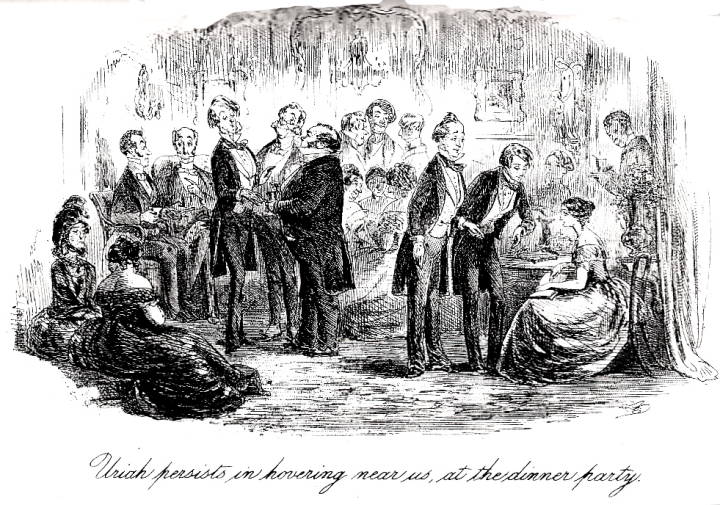
Source. Uriah persists in hovering near us, at the dinner party by Phiz (Hablot K. Browne). January 1850. Steel etching. Illustration for chapter 25 of Charles Dickens’s David Copperfield. Source: Centenary Edition (1911), volume one. Image scan, caption, and commentary below by Philip V. Allingham. [You may use this image without prior permission for any scholarly or educational purpose as long as you (1) credit the person who scanned the image and (2) link your document to this URL.]
It’s such an interesting thing … so stupid, and yet so rational at the same time given the evolutionary pressures that caused it to arise, I can’t help but be bewildered by its mercuriality.
Reader Comments (14)
Comments are presented chronologically, with replies indented beneath the comments to which they respond.
innerscorecard
September 29, 2014
It's interesting that all your examples are of people who truly possessed a lot of social capital (either before or after their death). I spend a lot of time thinking about the meaning or lack of meaning of much smaller amounts of social capital. For example, someone might go to law school or medical school because he or she feels that is a respected profession that will make his or her family and friends think he or she has "made it." Or someone might not go to an oil job in the Bakken because it's perceived as a manual labor job, even if that would be the job that would most improve this person's prospects. I think these are cases where the delta in social capital is really not that great, but seems infinitely great to the person making these choices.
A few other things (feel free to answer these or not as you wish):
Your thoughts on:
- Charlie Munger's recent statement in the WSJ that he is a better investor than Benjamin Graham was
- Sexual capital perceptions/discrimination (perception that people don't see a whole class of people such as asian males or black females as a whole as sexually attractive)
- Joel Greenblatt/Magic Formula
- Sardar Biglari/Biglari Holdings
- Hong Kong Umbrella Revolution
- "Coal rolling" (people in Idaho or the Deep South purposely polluting) - will there be any way to stop them? Will destructive fads like this simply collapse by themselves?
- People going into Apple Stores, destroying iPhone 6s by bending/cracking them for fun, and walking out
Mentles4716
September 29, 2014
Replying to innerscorecard
First time In your countryI will provide you the Job. If You do not have time to Come to Meet then You can Visit our Website Where You can Get Complete Training About this Online Money Making Program
......>>>>>>>> http://⌘.ws/nkmp
XCamed5153
September 30, 2014
Replying to innerscorecard
make up to 200 dollar daily how it is possible.now We are Providing the best way of Online Earning, Home Bases Jobs susee ....this site,,
>>>>>>>> http://⌘.ws/nkmp
Jeff
September 30, 2014
Replying to innerscorecard
I would also love to hear your thoughts on Joel Greenblatt.
John
September 30, 2014
Replying to Jeff
Agreed! A commentary on the Magic Formula would be interesting.
Scott McCarthy
September 30, 2014
Replying to innerscorecard
While I have for some time hoped Joshua would be willing to talk about Biglari, given the size of "his" company, I always presumed it would violate the site's rule of only discussing massive enterprises.
BH is the one company I would buy instantly upon hearing the news that it's CEO was hit by a bus. But the way Biglari Capital is structured, and the royalties due Biglari on change in control ... I can't own it so long as he's still at the helm.
Dave (nestle)
September 30, 2014
Well thank god that Joshua Kennon didn't hide all his talents in obscurity!
I wonder if he ever pondered this question himself(stealth versus sharing his talents with us)?
There is alot we dont know, but this blog alone could be a big attention grabber to some in the "fame business".
Thanks again Joshua!
FratMan
October 1, 2014
Was that game tonight enough to turn you into a fan???
Joshua Kennon
October 1, 2014
Replying to FratMan
I have to confess I didn't see it. The last time I can remember seeing the Royals play was in elementary school when my music class sang the national anthem before the start of the game. It was ultimately rained out so we didn't even get to finish all of the innings. I remember it was during that trip (I suppose this was a bit of foreshadowing of my personality) I saw a big, private door with the words "Coca-Cola" on it and being told that was the private company box. I wanted one because they didn't have to sit in the rain and it looked more comfortable, haha! I didn't even know what it was other than the fact it was impressive. Though, I might have gone to another game a few years later but it's been so long ... at least 20 years or so.
I'm surprised by the whole thing with the Royals. The business model of baseball is so fundamentally broken than it hasn't held any interest to me. It's largely a game of economies of scale with the Yankees and a few other clubs buying their way to victories. If they were to fix the pay rules so there was a more even distribution of talent among teams, that would be interesting. It's so bad right now that - what was it, I can't remember - the Cleveland Indians, maybe? - one of the teams literally has a business model built around losing games. Their actual baseball record is inconsequential to the profit machine they've built and they make money developing and trading away players like a house flipper who rehabs promising homes. It seems so disrespectful to the fans.
Maybe I should give it a chance, again. My problem is I just like individual sports better. I'd rather watch about any individual sport over baseball, basketball, hockey, or football and don't have a clue as to the reason other than team sports don't hold my interest. At all. On the other hand ... Wimbledon? Awesome. Masters? Cool. Olympic snowboarding? Incredible. Archery? Badass. Figure skating? Impressed by technique. Gymnastics? I can't even imagine having that kind of athleticism.
Except rowing. Rowing is a team sport that if we had growing up in my part of Missouri, I would have loved. It's the only sport that I find beautiful and wish I had the opportunity to try as a kid. Seeing the people out on the lake during sunset when I lived in New Jersey was so peaceful. I've thought about picking up for leisure. If I still lived in Princeton, I would have already been part of an intramural team.
You ... probably didn't need to know all of that, haha! Sorry. I'm up late reading a book on real estate because I'm thinking about a project Aaron and I might do and needed a break. I should go to bed but I think I'll keep working on it. It's been an obsession for the past few weeks.
Mr.owenr
October 2, 2014
It appears that wise and prudent use of social capital could be used to mitigate the downsides of social capital.
SFrentier
October 5, 2014
Social capital is something that people either intuitively seek out, or wish to avoid. And like you said, it can be in very niche areas or in the general public eye. It can be something for pure personal pleasure, or it can give one some kind of financial or business advantage, depending on one's situation and what they seek it for.
But what I find really interesting is that with the pervasive nature of social media, almost anyone, seemingly inexplicably, get tangled up in it. I've been finding that out since joining a national real estate investment forum called Bigger Pockets. The reason I joined was to meet peers, and generally have a good time discussing real estate. But I quickly discovered that I was being looked up to, sought out for numerous questions, and getting followed by dozens of people whom I frankly have no idea how they found me (given the 100,000+ membership of the site.) I also seem to get just about any post of mine, no matter how irreverent or sarcastic-ironic, favored by people. It's cute and all, and I do help some people out, but I'm really not crazy about the attention. Having made my 'fuck you money' (phrase popularized by Nassim Taleb, basically you have enough of it to do what you want, including telling people to fuck off:) I prefer to socialize with a few people I trust and stimulate me on an intimate scale, rather than get far away adoration.
If I was to venture a guess, in your case you seem to seek it, given your blog and the adulation you receive from fans. The interesting question is if it's purely for personal gratification, or if you derive a business advantage from it as well.
Joshua Kennon
October 5, 2014
I can see why it appears this way ...
... but, if I'm being bluntly honest about it, it has enormous disutility to me that makes me more than a little uncomfortable. So much so that there have been times in the past when I came within seconds of wiping the server and disappearing.
The About.com site was an odd thing that sort of happened at the tail end of the dot-com bubble when I was 18 years old and this blog started as a way to keep in touch with my retired Aunt Donna before, for whatever reasons, people found my writing interesting; writing I do for myself, have done most of my life, and will do long after I no longer publish since it's the way my mind organizes thought. (If I'm not near a computer, I have notebooks stashed everywhere so I can write out whatever it is I am contemplating.)
At this point, the reason I haven't dropped off the radar is a mix of 1.) obligation to pay it forward for the generosity shown to me by others when I was learning the ropes, 2.) pure selfishness in that I get to talk about really interesting concepts and problems with very smart people, often with different life experiences, skill sets, and knowledge than I have, which is intellectually satisfying, and 3.) I have the heart of a professor. I love teaching and seeing people adapt ideas that improve their lives, empowering them to be independent so they no longer need to rely on anyone else. The coolest thing about having done this for going on 14 years coming this February is getting a message from someone who first finds my writing and then, again, five or eight years later when they are debt-free with a six-figure (more, in some cases) portfolio or business. Knowing there is another family out there that has changed the trajectory of their life for the better, and now has financial independence, because of my work, gives me a huge sense of satisfaction even if I ultimately end up being forgotten. I'm a builder. I like seeing things improve. I get joy out of seeing other people do better even if I don't benefit it from it all. It gives me the same sense of happiness I get from planting a tiny rose bush and turning it into a huge plant or acquiring shares of stock and watching it compound to the point the annual dividend income is greater than my cost basis.
If the path had been a bit different, I would have been beyond stealth. If given my choice between money, power (the ability to get things done to improve society), and fame, give me the first two, you can keep the latter.
DVY
October 6, 2014
Replying to Joshua Kennon
+1- Big ups to Joshua. I'm still early in the wealth-building process (albeit w/a 6-figure job and just out of school).
He totally shifted my mentality on stocks and the market. My family comes from an ethnic background and have heavy distrust of the financial markets and with very good reason to have so.
The Soviets butchered their economies and treated public money like private slush fund money. The Asians aren't much better i.e. ( Joe Studwell's books about Money and Power in South East Asia- http://www.amazon.com/Asian-Godfathers-Money-Power-Southeast/dp/0802143911)
John Tate
October 9, 2014
Replying to Joshua Kennon
Here's a comment from one of those guys that found your blog a number of years ago and now has a six figure portfolio. Thank you Joshua