

I don’t talk about it very often, but one of the charitable organizations close to my heart are community food banks and soup kitchens. These non-profits collect groceries for those who can’t afford to feed themselves or their children, allowing them to avoid hunger. They resonate with something very deep in my core, maybe because I love cooking so much, but it strikes me as morally inexcusable for an American child to starve while living among the greatest aggregation of wealth ever amassed by a single empire.
In fact, the first time I used this platform to encourage you to open your wallets was when I discovered Project Open Hand, founded by the late Ruth Brinker, who was a retired food service worker. By harnessing the power of the Industrial Revolution (economies of scale, task specialization) her operation grew to the point that it can now feed a person good, quality food “made with love” for only $140 per month. They are so efficient that one of their most recent projects is building their own greenhouse so they can get fresh ingredients at cost while simultaneously reducing waste as they’ll be able to take only the quantity necessary for a single dish.
The result of this area of interest is that I’m often paying attention to food banks and soup kitchens in the news, trying to quietly monitor different operations and see if there is anything worth supporting. This regular item on the agenda led me to a National Geographic special called The New Face of Hunger. It looks at food scarcity and poverty in the United States.
The National Geographic Special On Poverty Makes Me Want to Stop Supporting Food Charities
I’m always trying to remain aware of my own feelings; to study them and make sure I’m behaving in an intelligent way. What I find interesting is the strength of my emotional response to the National Geographic special. After reading it, and watching the accompanying videos, I find myself grappling with ambivalence; specifically, a combination of contempt, pity, and compassion.
[mainbodyad]The story points out that a family of four qualifies for food assistance in the United States due to poverty if they earn $31,005 or less. The average benefit paid per person, per month, is $133.07, so this quartet would receive $6,387.36 over the course of a year. In other words, without ever having to spend a single penny of their own wages, the family collects $17.50 per day in transfer payments from other taxpayers that they can spend on groceries.
Do you have any idea how well you can eat on $17.50 per day if you have even a modicum of cooking skills? It wouldn’t even take that much time if you were well-organized. Think about breakfast. Take a family eating Kellogg’s Eggo waffles. Eggo waffles are normally $2.39 for a box of 10. That is 20.9¢ per waffle. Most kids are going to eat two. That is 41.8¢ per person. For a family of four, that’s $1.67 in waffles alone. If, instead, you made pancakes from scratch, you’d be looking at a cost of 6¢ per pancake assuming you paid full retail for the worst possible economies of scale (e.g., buying a 5 pound bag of flour instead of a 50 pound restaurant bag). That means with the same $1.67 you were spending on two measly waffles, you could stuff each member of your family with just shy of 7 good-sized pancakes. Or, you could still eat two, at a cost of 48¢, saving the other $1.19 for other items. That one change alone – and again, we’re assuming you got the worst possible price on your raw ingredients – is $434.35 extra per year. For a family earning $31,005, that is a 1.4% pay raise. Even better, that is after-tax money so it’s more than it appears.
Want a delicious topping? Don’t buy commercial pancake syrup (which isn’t even real maple syrup, it’s dyed corn syrup). A tiny bit of fruit, which can be purchased very cheaply if you rotate with what is in season and/or plant a few fruit trees or bushes, a bit of sugar, and you can make a jam sauce reduction to drizzle on top of your fluffy, piping hot pancakes. This is one of those things that is stupidly easy. I make these all the time, once even posting the recipe for a simple blueberry sauce. I did one in a couple of minutes the other night for a cheesecake recipe I was testing.
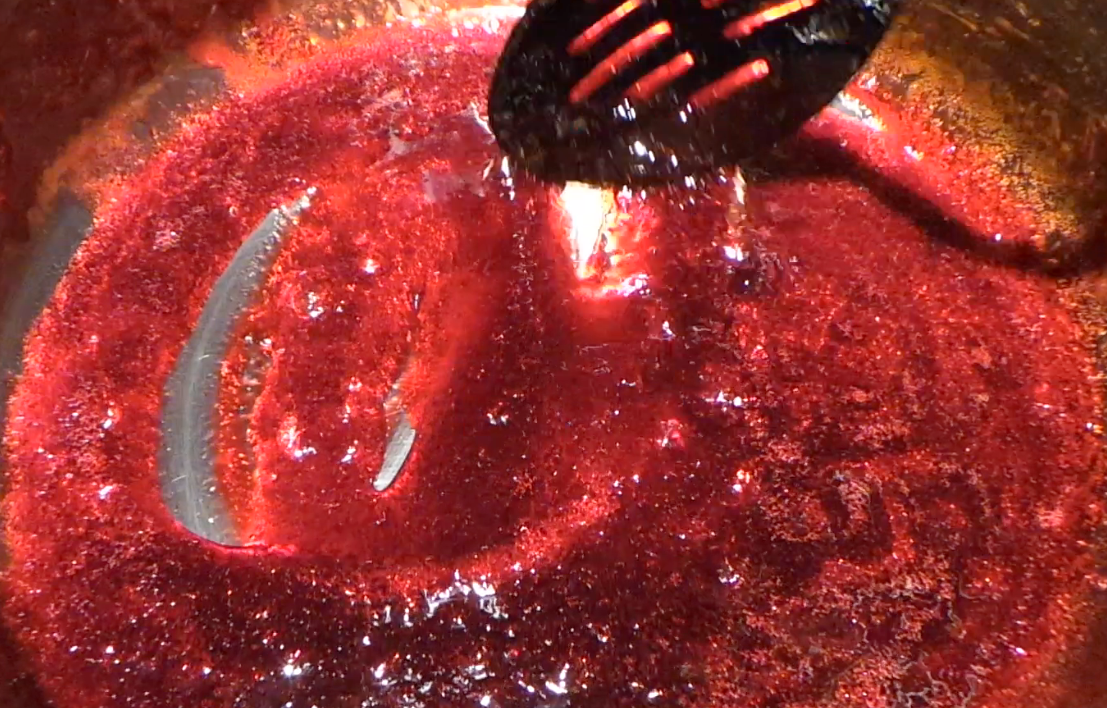
Mine was an orange, red currant, and plum syrup for the top of a cheesecake recipe I was testing from Bon Appetit.
One objection is that there isn’t enough time for people to cook for themselves, but the evidence shows otherwise. Nielsen tracks average media consumption by household and poorer, poverty-level households watch more than the average American amount of t.v. each week, which is already obscenely high (36 hours of regular television plus another 3-4 hours of pre-recorded or on-demand content through sources such as Netflix). That’s per person. In a household of 4 people, that’s a tremendous amount of surplus time each year; to be precise, 8,320 extra hours in the aggregate.
Beyond that, the National Geographic special shows pictures of some of the families and they are morbidly obese while talking about not having enough to eat. There is a well-documented correlation between poverty and bad decisions, particularly one chooses filling, terrible food, over healthy, less filing food as a sort of click-whirl response, even when it makes no sense. Nevertheless, I think it’s probably difficult for the average well-off American to listen to a family complain about not having enough food when the parents are at least 100 pounds overweight between them and could survive for several months in the wild on nothing but pine nuts and water. I think that might account for the lack of concern.
I Need to Think About the Morality and Ethics of Charity
I find myself in an odd place. One of the charitable causes I love most now has me thinking about culpability. Bad luck, which is just a word to describe negative random probability outcomes, definitely plays a role in everyone’s financial fortunes, though often to a much lower extent than folks realize. For example, the economic data is crystal clear that you can practically assure that you will never fall into poverty if you do three things, and only three things: 1.) graduate from college (preferably with little or no debt, even if it means going to a low-cost state school), 2.) get married, 3.) do not have children until after you are married. That combination has such overwhelming success, it’s like a magic formula. A small number of people in that group will be taken down by bad luck, and that’s why social safety nets are a good thing. People who did everything right, work hard, are honest, and just got the wrong end of the stick need assistance from time to time and I’m happy my tax dollars go to getting them back on their feet because, God forbid, I would want it there if I were in that situation.
[mainbodyad]Bad decisions, on the other hand? That’s different. If we are going to take money from one citizen in the form of taxes – money that could have gone to her own children – and force her to give them to someone else or face a prison sentence for refusing to comply, I think there better be a damn good justification. If someone in poverty can spend thousands of dollars a year on cigarettes (and there is a correlation in the data), I’m not so sure they should be entitled to food benefits because they have enough to support themselves, they just refuse to do it.
Perhaps this shouldn’t matter from a purely selfish perspective. Again, we’re not talking about a family where the mother is suddenly diagnosed with cancer and can’t work, we’re isolating this conversation to the significant percentage of people who remain in poverty as a result of bad decisions. Without transfer payments, they are likely to commit more crimes. Perhaps it’s a cheap insurance policy to keep assaults, rapes, murders, etc., down from where they would otherwise be? That is, by paying $1 in food benefits you may be staving off $500 in shattered windows or theft. There is a reason for the “bread riot” model in economics. Justified or not, when stomachs start growling, things get destroyed, people get murdered, and governments crumble.
Perhaps another, better argument is that the children of these people are innocent and don’t deserve to pay for their parent or parents’ mistakes?
What responsibility do we, as a society, have to those who are stupid? Who are not so much unlucky (everyone generally agrees, those people should have assistance) but, rather, make bad decisions? If we do provide support for the dumb, should it be done out of compassion or self-interest; an insurance policy against upheaval and crime? If someone drops out of high school and has multiple children out of wedlock, do we, as a society, have an obligation to clothe and feed them? Do we ignore their transgression for the sake of children? If we decide there is a minimum standard of living we, as a society, want to accept even if the person doesn’t deserve it, doesn’t that make us immoral ourselves since we are taking resources from far better causes?
I have a lot to think about … what I know now is that the National Geographic special makes me far less likely to write checks to food banks in the future and I don’t like it.
Reader Comments (22)
Comments are presented chronologically, with replies indented beneath the comments to which they respond.
innerscorecard
August 15, 2014
Have you read George Orwell's The Road to Wigan Pier?
Joshua Kennon
August 15, 2014
Replying to innerscorecard
I have not but it's on the list now. Thank you!
Kat
August 15, 2014
You might find this project interesting. One of the gaps cited is the lack of cooking skills among the people in this demographics. In the comments section, another gap that stood out for me was the lack of proper kitchen appliances and tools in these households. I think there were also a couple of non-profit efforts mentioned that focused on teaching these people to cook cheaply instead.
http://www.getrichslowly.org/blog/2014/08/12/how-to-eat-on-4day/
jerkstores
August 15, 2014
The statistic about the amount of money people get in benefits for food has bothered me for a little while. If you live in an area with a decent number of low income people you can just see the way they misuse the benefits. People usually pick one side or the other in this argument. It seems people either think that all or most of the people on public assistance are bums who shouldn't get any assistance, or they roll their eyes at those who complain about waste and tell them to get off their high horse. IMO there really is a need for the help, and there really are people who waste the public's resources with the benefits.
But I still think food banks do some good, especially those smaller ones run by churches. You can buy the food at the best price to get the best value possible for what you are buying, and these food banks really do benefit people who need the help.
Gilvus
August 15, 2014
I don't like to dwell on this subject because it always leads me to an unacceptable solution.
I recommend Edwin Black's War Against the Weak if that's not already on your bookshelf.
Mr.owenr
August 16, 2014
I'd like to point out that even though I make just $10,000 a year, I don't qualify for food stamps because I have over $2000 in assets.
http://in.gov/fssa/dfr/3099.htm
Only the super poor households that can not or will not save an emergency fund get the food benefits. Hope that makes you want to support food charities again.
Didactic Dude
August 16, 2014
Replying to Mr.owenr
Rules seem to vary by state. No asset test in oregon: http://oregonhunger.org/applying-for-snap
RogerMKE
August 16, 2014
Let me share a story about safety nets.
Years ago, we had an employee who managed some rental properties for us. She was a smart lady, and generally a pretty good and dedicated employee. She lived in one of our units, and oddly, despite the fact that she was fairly well paid, qualified for rent assistance that paid about 80% of her rent. She had some grandchildren living with her, so we figured that had something to do with it.
Years later, it was discovered that the social security card we were given for her employment was not hers -- it was her daughter's, who bore the same name. The whole time she was working for us, she was somehow collecting social security disability benefits, food stamps, rent assistance, and every other government program imaginable, all while earning around $40K a year. On top of that, she had a boyfriend of many years who was not on the lease (for purposes of rent assistance most likely), but was effectively living with her and providing a second income.
In theory, I like the idea of a safety net, but the potential for abuse is overwhelming and real.
Shouganai
August 17, 2014
Perhaps the solution is to provide money to those who can be trusted to use it sensibly, but provide cooked food to those who can't.
David Evans
August 17, 2014
I believe Charlie Munger's wise injunction "never underestimate the power of incentives" is the pivotal concept necessary for achieving the best solution(s) to the conundrum addressed in this post.
Connelly Barnes
August 17, 2014
Most of the symptoms people try to band-aid over are nearly always addressed way too late. The reason is crises are visible and dangerous so people try to fix those frantically but they don't address the causes -- the subtle mistakes / defects / engineering flaws that compound over the years to create said crises.
For example our "sick care" system which ignores health. Or affirmative action or treating poverty with money. Maybe they help, maybe they hurt. But clearly those problems originated in middle and high school education or probably even earlier by not having enough positive examples as career role models. So the political talking points are because there was a crisis, but they're completely beside the point. The logical treatment has got to be at the formative period of one's life.
This is the reason that if I make a charity it will likely be for the education of rural children whose families have next to nothing, like in rural China or India. They objectively have the least, and have the most to gain. And without all the strange distortions of the welfare state, they have a pretty rational outlook, and are highly self reliant, which has immense career value. Even though there are a few cultural oddities such as arranged marriage.
segfault
August 17, 2014
In my state, the benefit for a single person is much lower than $133 per month. I think it's around $50.
I saw a very sad sight in the grocery store the other day. I went through the self checkout, and when I went to take my receipt, I discovered that the person who used it before me had left their receipt. They bought 3 packages of bologna, 2 loaves of white bread, some bananas, and a gallon of milk, using their SNAP benefits to pay for them. The bologna and white bread are definitely unhealthy choices, and sound unsavory to me.
TheLonelyHumanist
August 17, 2014
I was once a meat cutter in a SNAP friendly grocery store in the brown side of town. I could tell stories you may not believe. I have had healthy adults ask me to read for them because they did not know how. Everybody who worked there ended up with a special bitterness.
Jared
August 18, 2014
Any opinion on negative income tax?
Andrew
August 18, 2014
Completely subjective observation - but every week I make a (bad?) habit of spying on people's grocery carts and comparing it to their weight. This has confirmed the common-sense conclusion that the obese people tend to have carts overflowing with soda pop, packaged chips and cookies, and a few frozen dinners. No fresh food at all.
I think a lot of people operate on auto-drive with no self-reflective mechanism (i.e. "zombies"). They literally don't or can't top and say "hey, my cart is full of junk and that's why I'm fat - I need to stop this."
James Crooks
August 18, 2014
Tricky questions, and having worked with youth education in an impoverished neighborhood (indeed, co-founded a non-profit that does such education), I've found myself increasingly frustrated with the scale of the problems that are from bad choices rather than actually bad luck.
But there's these feedback cycles, and the web of consequences becomes tangled. There's probably, if one could follow all the threads, a good game theoretic understanding of how these things occur, where these bad decisions are still "good" in some hyper-local sense (in part, because of the value system used to evaluate good and bad choices) that cause long-term negative outcomes. Fundamentally, I think these problems stem from how people evaluate good vs bad outcomes, and how rapidly they discount the future, and in my experience, a good deal of magical thinking gets mixed in.
A related amusing story: One night I was at a local pub with my thesis advisor, a successful mathematician married to a successful doctor and with, as far as I can tell, very good financial acumen. He was telling me that he was very conservative, even when he was younger, although mostly in a fiscal sense. And then he explained how, due to his conservatism, he used to work for the Democratic party, and believes in progressive taxes and social programs, because "if those problems get too big, it's guys like me that people come after!"
Like the jargon file says: haha, only, serious.
Melissa K
August 18, 2014
It is truly astounding to me the number of people from all walks of life who have no idea how to cook and eat a decent meal...or at least believe they do not know how. My grandmother, a Home Economics major and one-time social worker who taught cooking and cleaning, used to say if you can read then you can read a recipe and cook (I realize that she probably really meant if you can read since she knew many who couldn't growing up).
A great book on one chef's experience with this is The Kitchen Counter Cooking School. She taught several middle class women of all ages basic kitchen skills. It was a fun read. I also just found her blog: http://cookfearless.com/
Jack Scheible
August 18, 2014
If you subsidize something, you get more of it. If you tax something, you get less of it.
So we subsidize bad decisions and tax the results of good ones.
Brilliant.
Jack Scheible
August 18, 2014
If I were to extort money from someone, and give that money to a poor person, I would still be committing a crime. How is it any different if I pay gangsters to do it for me? How is it any different if I pay government bureaucrats to do it for me?
Government welfare programs are based in the sin to stealing, and thus are doomed to fail.
Charities based in love of one's fellow man will have God's favor.
Adam @ AdamChudy.com
August 20, 2014
I believe at least in the case of children we have an obligation as a society to do our best to give them a chance to break the cycle of poverty. Otherwise we just encourage the next generation to end up in the same situation.
I've recently been looking at this topic myself. I've learned a lot from the 2 articles below and the documentary on HBO. It was all pretty heartbreaking, even when it was caused by the poor decisions of the parents.
http://www.hbo.com/documentaries/paycheck-to-paycheck-the-life-and-times-of-katrina-gilbert#/
http://www.nytimes.com/projects/2013/invisible-child/
http://www.babble.com/best-recipes/what-i-learned-after-taking-a-homeless-mother-grocery-shopping/
test
August 27, 2014
Government is for all people in the nation state. All pay taxes, all should get benefits. If you provide only poor the benefits, it gives an easy excuse for the rich to co-op the middle class into cutting the benefit entirely. Can you imagine the police only providing protection for the poor?
Also instead of inflating cost of necessary goods through EBT which is just a subsidy to corporations that serve the poor, government should directly provide the goods and services albeit lower quality. Low quality food is free from government so you don't starve, but above average quality goods can be paid using private funds form one's own wallet. I think this is most fair and balanced.
Trey Henninger
May 8, 2016
Joshua,
Book recommendation for you: Beggars in Spain by Nancy Kress.
It addresses this situation quite well in the form of a fiction story. Very similar to Ayn Rands Atlas Shrugged as the story is intended to demonstrate the political philosophy. I highly recommend it and found the nuance to be quite good at addressing some of the concerns of eliminating charity for even those who make bad choices.