


This is one of those deep, working essays that many of you won’t want to read that deal with understanding the underlying structure, changes, and direction of society. It is a response to a question by commentator Frat Man left on this thread.
He asked:
Hey Joshua, I had a question for you. As every sports fan (and perhaps even non-sports fan) learned today, Jason Collins disclosed the fact that he is gay. It’s gotten a lot of news because he’s the first professional athlete in one of the “Big Four” sports to do it while being an active player.
Almost anyone who has been critical of Collins has been roundly criticized in social media outlets, be they newspapers, blogs, or Twitter. For example, Chris Broussard (a journalist) went on ESPN and started citing his interpretation of biblical principles and he called Collins a sinner and some other things. This hasn’t exactly made Broussard beloved, and almost every reaction to Broussard’s comments have been negative. Many are calling for his resignation or for ESPN to fire him.
Yes, I understand that free speech is only guaranteed from a government standpoint, and employers don’t share in the application of 1st Amendment Rights.
I remember you quoted Voltaire before for saying “Find out who you cannot criticize, and you will find out who rules over you.”
In the 1950s, you could not criticize the US government or else you’d be seen as a communist sympathizer. Nowadays, it seems that if you speak out against affirmative action, gay marriage, or (say) birth control, and you do it in an ineloquent way, you are quickly branded racist, homophobic, anti-woman, etc. In other words, there’s a very short leash with certain issues I think.
I’m curious: Do you consider it a good thing that we have this “quick to fire” mentality towards people that state the (usually conservative) position on these issues? If you get your facts wrong and sound stupid while making your argument in favor of gay marriage, there is a “no harm, no foul” attitude. If you get your facts wrong and sound stupid while arguing against gay marriage, it can easily be career ending.
On the other hand, if someone argues in favor of bringing back the “n word” on live television, we’d probably all agree that we have reached the point where we don’t tolerate certain arguments anymore. If the CEO of Procter & Gamble argued in favor of bringing back slavery, no one would express remorse if the Board fired him. I guess part of my question depends on whether being against gay marriage (or voicing the opinion that homosexuality is a sin, or whatever it may be) is something that passed the point where “reasonable minds can disagree” and has reached the “you are a bigot that should be kicked out of polite society” point.
Personally, I’m sad that we have this “fire ’em” attitude every time someone says something that we find abhorrent. I would much prefer to live in a society where anyone can let their ideas fly and it is up to the audience to draw their own conclusions from the facts presented. In Broussard’s case, everyone is making fun of him online. He’s being mocked and derided and being called an anti-gay bigot. By people exercising their own speech expressions, they are able to point out how ridiculous and wrong Broussard is. He’s experiencing very real damage to his reputation even if his career remains intact. Should that be enough? I’m curious what approach you’d recommend in response to these episodes where commentators say things that may be racist, homophobic,
This may seem an odd thing to assert, but my answer is going to be unexpected. I would argue that your question isn’t really about gender, race, political correctness, or sexual orientation.
Rather, this is a story about technology and how it has changed both how we interact, and how we accept claims made by others now that the availability of widespread information is free and accessible to everyone.
For many of you, this essay is going to be boring. We’re going to have to touch on multiple disciplines and areas. Yet, these are the things I enjoy staying up and thinking about in the evening because these are the things that change the direction of the world; that let you understand how the parts work together, how it all interrelates and influences the movement of the other pieces.
A Move To Personal, Rational Knowledge Driven By the Way We Interact
In 1942, my grandmother was born. That same year, so was another woman named Dorothy Counts. When she was 15 years old, she was one of the first black students to attend the Harry Harding High School in Charlotte, North Carolina. For four days, Dorothy endured unimaginable torment and harassment. In this photograph by Don Sturkey from September 4, 1957 (colorization retouching done by Sanna Dullaway), you see her sitting alone, as an entire auditorium of white students sneer at her.
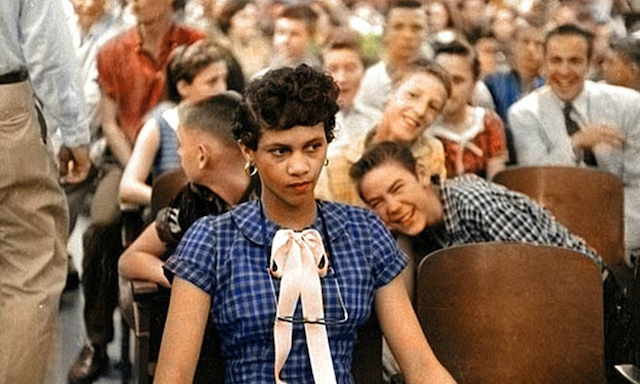
Dorothy Counts, 15 years old, being sneered at by an all-white audience of her classmates. After four days of harassment, she was forced to withdraw from school. Original photograph from September 4, 1957 by Don Sturkey, retouching done by Sanna Dullaway, who brings historical photographs into the modern age with her amazing work.

Dorothy Counts trying to attend school but being followed and mocked by the white students, parents, and teachers. It would be interesting to talk to her.

Every one of the boys and girls in that audience were behaving in a way they had been taught was not only expected, but desirable. They had been taught that Dorothy was not fully equal to them; that somehow, God had made her inferior. They were taught this by their parents, by their teachers, by their pastors, and by their friends.
Though firmly believed and strongly supported by the community, that conviction had no rational basis. Society recognizes that today.
I would argue that a significant portion of the rapid social change the world has enjoyed is the result of access to information facilitated by a rise in technology. From the television sets tuned in to watch Dr. Martin Luther King, Jr. give his famous “I have a dream speech” to Tumblr blogs that forge connections between young people halfway across the globe, we no longer live in isolated villages. You can be in bed at night reading about the effect of black holes on the perception of time or watch a video where someone talks directly to the camera about his experience suffering at the hands of bigotry. You can feel connected to people you’ve never met in person, and form communities of like-minded people on niche topics as diverse as vintage truck collecting to civil war reenactments.
Working together, those forces have changed behavior. You’ve seen a massive societal shift away from “revealed knowledge” – beliefs held because they were handed down from an authority figure, a religious sect, an institution, or a government – and toward “rational knowledge” – beliefs held because analysis of the data indicates what is most likely to be true based on demonstrable facts. Move forward a couple of decades and suddenly it doesn’t matter that your parents tell you Dorothy shouldn’t be allowed to sit next to you, or that your local activities leader says interracial marriage is a sin. Your own experience, and interaction with the world, tells you that these objections are false; there is no substance there. The “other” is less scary; less abstract. The other becomes real people, and you know them, even if only digitally.
As This Shift Has Happened, People as a Whole Have Grown Less Tolerant of Non-Rational Worldviews
As people began to rely on data, evidence, and facts for themselves, seeing and making connections with people they otherwise never would have met in real life, they have come to increasingly rely on a “harm test” when determining morality. Even I, myself, after being asked to define morality in clear, concise terms can see no other rational definition. As a result, when someone espouses an opinion, people seem far more likely these days do a gut check on the level of harm rather than defer to the institutions of power and authority, like their great grandparents’ generation did.
It took all of this to point out that what is really happening is not that society is disapproving of conservative points of view. Instead, society these days mostly objects to any view that cannot be rationally defended based solely on facts, whether it falls along the left or right side of the political spectrum. We’ll discuss some examples of both in a few moments.
What naturally happens is that when you identify with the people and groups who have been oppressed for no rational reason, you grow less and less tolerant of the inability of those who support on-going prejudice to come up with any reasonable explanation for their behavior. When this happens to a large enough percentage of the population, it becomes, as you say, not something that can be tolerated among polite society. Espousing the viewpoint is social, political, and career suicide. This is not mere “political correctness”. It is when an opinion is considered so irrational or harmful that it is deeply offensive to people on an emotional level.
An Illustration of This Shift Through the Lens of Abortion and Birth Control
Consider the stunning drop in abortion rates over the past few decades, which we have discussed several times in the past. No one talks about it, but it coincides perfectly with the rise of the sonogram, as well as the widespread availability of birth control. As sonograms become more advanced, abortion rates seem to drop further. Wary of the truism that correlation is not causation, looking through to the underlying trends it seems clear that it is not simply a coincidence. It’s an odd thought but I when I was born in the early 1980’s, my parents didn’t know what gender I was going to be until I was delivered in the hospital – and that was normal at the time. People forget how different things are now that you can plan your child’s baby shower with appropriate clothes and gifts.
Though there are certainly other variables at play, such as economic conditions, the GE and Siemens health care divisions have done more for the pro-life movement than every political lobbyist, every Church, every protest sign, and every op-ed piece. The technology that allows a parent to see a living, breathing, nascent human life inside of you fundamentally alters behavior for a large percentage of the population. It is a fact, so much so that there have been political fights in various states over whether or not the woman should be required to have an ultrasound before making an informed decision about termination. The opposition to this practice, which would not make abortions any less available, was vicious because it would “cause women to question their decision”. Implicitly, this connection has already been made.
This same technological advancement in prenatal imaging has also led to some unexpected consequences. Medical testing has become sophisticated enough that couples now know if they are going to have a child born with a birth defect or cognitive deficiency. The most visible example is Down Syndrome. Since the introduction of the in-womb testing less than a couple of decades ago, even highly religious couples abort children with Down Syndrome at a staggering rate exceeding 90 out of 100 pregnancies even if they are pro-life. It is so widespread, and cuts across so many demographics, that there is some discussion about the fact that the United States has effectively been engaged in a form of rapid genetic selection by terminating this derivation in the human genome to the point that it may someday be eradicated. Individual people, acting on a micro-scale, are quite literally changing the direction of human evolution.
This, along with the advancement of the point of viability, have caused even those with no religious affiliation, such as the late thinker and secular humanist Christopher Hitchens, to point out that the question of termination at the point of viability when the child no longer requires the womb of the mother, a point which he accurately describes as getting pushed further and further back toward conception as our medical intervention becomes more advanced, is a moral one that must be decided in a way that counts the (now) fully human occupant of the womb as having human rights.
On a related note, looking at second and third order effects, birth control and condoms reduce abortions, result in less poverty as fewer teenagers give birth before being able to afford to raise a child, reduce crime rates as the socioeconomic status of parents is the greatest indicator of the propensity of the next generation to engage in violent assault, rape, and murder, lower the transmission rate of sexually transmitted diseases which, in turn, lowers medical costs for taxpayers and decreasing the personal suffering of the infected, lowers cancer rates thanks to halting the spread of HPV which can cause cervical mutations, and helps prevent a single mistake from tying two people who are disastrous for each other together for the remainder of their lives, having a child brought up in that environment. There is no rational opposition – absolutely none – to widespread availability and use of contraceptives and birth control considering the alternatives and costs, both explicit and implicit, of a restrictive policy.
Thus you reach an interesting position where, though abortion is less popular than it has ever been since being legalized in the United States, opposition to condoms or birth control is deeply believed, by a large percentage of the population, to be a harmful, superstitious, irrational, fundamentally flawed and extremist position that is based on phony morality and designed to control reproduction by usurping authority from the individual and granting it to the legislature and religious institutions against the will of those who are affected. It leads directly to people dying and suffering. It is not a neutral position. The differentiation between the two is not an inconsistent opinion. They are not comparable, morally, ethically, or biologically.
I would argue that the greater support for pro-life positions is not a conservative win, nor is the greater opposition to birth control a conservative attack. Rather, both reflect a move by a large portion of the population to scientific, harm based morality; a standard that is vastly superior in its real world outcomes than anything followed solely because someone believes it is the will of God, or a supreme leader, or whomever they look to for guidance.
How This Applies to Your Question About Chris Broussard
On to your question about sports caster Chris Broussard. The civilized world over the past 25 years has seen the same thing happen with gay rights. A very stable portion of almost all given populations have historically expressed romantic and sexual compatibility exclusively with the same gender. A rational view of the condition would say that we should do what promotes stability, health, and wealth accumulation in society by actively encouraging those who are gay to enter long-term, monogamous marriages, use prophylactics to prevent sexually transmitted diseases if sexually active before marriage, and establishing households that contribute to the community by being ingrained in local cultural and civic activities so the broader civilization benefits from the additional human capital.
When someone like Chris Broussard says he believes homosexuality is “wrong”, which in religious speak (at least in my part of the Bible belt) often equates to homosexual acts not orientation, those who know gay people, who are friends with gay people, or who have a gay person in their family, immediately recognize that what has been left is a Morton’s Fork: Either the person who is gay is required to remain celibate and alone for life, never experiencing the joy of romantic attraction, physical companionship, sexual excitement, and contentment in growing old with someone with whom they are enamored, or they have to enter into a relationship with a person of the opposite gender and be satisfied with merely remaining friends, albeit one would hope friends who deeply love one another.
Not only is the latter option unfair to the straight spouse, it is also deeply depressing. While that may be a form of love, it is not the same, deep, abiding love that causes people to write plays, go to war, carve statues, compose sonnets, or die trying to save their soul mate. As anyone who has experienced that kind of true, lasting, permanent love can attest, those who haven’t had it in their lives have no idea what they are missing. Despite all of their protestations, it would be like a color blind person insisting he or she didn’t need to see color and really wasn’t lacking any enjoyment from a sunset or a painting. Unless you’ve been there, and lived through it, you cannot know. It changes your life. It can make you a better person. It can give you confidence to go for things that you otherwise might not have pursued. I would go so far as to argue that it is one of the few things that defines humanity and elevates it to something greater than the sum of its constituents.
(A small minority of people will argue that people can “change” their sexual orientation despite all evidence to the contrary. While bisexuals do exist, who could easily and happily switch between the genders, most people do not have that ability. I doubt you chose to be straight. I doubt you control when you are attracted to a woman, to the point that the attraction can even overwhelm your logical brain. I doubt that you can make your heart not pound, your palms not sweat, and your mind not race. I doubt that you could make yourself fall in love with a man. It’s an absurd belief based on nothing contradicting virtually all shared experience by both straight and gay people. You simply do not, and cannot, control the gender to whom you are romantically and physically attracted, nor is there any rational reason to restrict it to the opposite gender only as there are no negative consequences. (There are negative consequences to behaviors such as promiscuity, which is an entirely different issue.) Love isn’t logical. Sex isn’t rational. Emotions aren’t convenient. Why would any intelligent human being want to spend his or her life sacrificing what is inarguably the quintessential human connection?)
That is why people react so negatively to Chris Broussard, just as they do birth control. It doesn’t matter that he believes what he is saying. It doesn’t matter that he thinks that is what God wants. His belief contradicts all rational evidence, all common sense, as well as the harm test especially for those born between 1980 and present who grew up in this technologically connected world (to go back to my original thesis that it is the relationships people are forming that is changing the way society behaves). When people like Broussard advocate for things such as “traditional marriage”, it is not anti-conservatism or politically correct speech that gets a large portion of the civilization offended. Rather, it is a deep, instant, emotional reaction because he is not talking about an abstraction. He’s talking about their children; their friends; their brother; their sister; their coworkers; their teachers; their attorney; their neighbor.
On This Particular Topic, The Tipping Point Has Been Reached
You asked if I thought we had reached the point where this is no longer an acceptable topic of debate. After reflecting on it for a few days, I’ll share my experiences. Please note that society is made up of many sub-demographic groups. I exist in a bubble of wealthy, highly educated, self-driven people with divorce virtually unheard of, long-term marriages being expected, trust funds for your kids a given, and debate about sociopolitical trends a good time at the dinner table. This is not going to be true for everyone. I’m just sharing how it is from my vantage at this particular moment in time.
In my social and professional circles, we have unquestionably reached the point at which any opposition to equality for gays is no longer something that can be tolerated in polite company. It is now almost at the same level of support for women and racial minorities. Though looking at the data from institutions such as Pew and Gallup, a few exceptions continue to exist in a handful of enclaves in the Southern States, especially among the lower classes, the elderly, and the under-educated, this support for gay rights is almost universally true if you were born in 1980 or after and / or if you have a college degree.
Examining the data from those demographic trends, especially among my particular sub-demographic (who tend to be the people who end up running everything – well educated, wealthy), it is now treated as an almost universal fact that if you think there is any moral difference between straight and gay couples in any area of life – marriage, hospital visitation, adoption, inheritance, tax filings – you are a bigot. There is no wiggle room or nuance. You’re going to be treated as such.
It may seem unfair, it may seem unreasonable, but it’s a fact. And the people who feel that way are not doing it because of politics; it is personal. It is emotional.
To illustrate how deeply this is felt: I watched one acquaintance in New Jersey cut off ties with a former long-time friend over the Chick-fil-a debacle because her friend continued to eat at the restaurant. The friend was upset saying, “We can agree to disagree.” The woman I know – a married, straight, Christian, college educated mother living in New Jersey – finally told her, “You don’t get it. This isn’t an abstract topic. Your beliefs have a very real, negative effect on people I know and care for and you gain nothing from it. You are ruining their lives simply because you are a bigot. You may not think you are, but you are. I can’t have you in my life. I can’t have you around my children. I don’t want them hearing that any more than I would allow you around if you said it was wrong for them to marry someone of a different race.”
If you think that she was in any way motivated by wanting to harm conservatives, harm her church, or act in a politically correct way so as not to offend anyone, you’re going to have a bad time understanding social trends. It’s much more basic than that.
This sentiment is now a given in most sectors of the economy. Recently, there was a conference by major employers on Wall Street where the heads of the investment banks said they had no choice but to support fully equality in all areas for gays and lesbians because if they didn’t, the young people coming out of college would refuse to work for their firm. It’s like the 1950’s and 1960’s when friends and colleagues of Jewish people refused to join a club that their Jewish friends couldn’t. Goldman Sachs CEO Lloyd Blankfein said on the topic, “To be successful, we must attract, retain and promote from the broadest pool of talent available. We have no factories or plant equipment, all we have is human capital. My job is to create an environment where everybody can thrive. If you ignore this as a chief executive, you are insane.”
A few days ago, a realtor was fired because he published a flyer that contained a praise of the “traditional family”, which was so offensive to so many people that he threatened the profitability of the brokerage for whom he worked. He said he “didn’t want to offend anybody … I didn’t have bad intentions.” He truly didn’t understand that the things he wrote are, to a large percentage of the population, a deal breaker. It’s not different than my own experience … I once cut ties with a trust agent at a major national bank because when the door was closed and we were discussing some of the portfolios under his purview, he referred to someone from the middle east as – I kid you not – a “sand n****r”, as it were the most natural thing in the world.
The upper end of the culture and economic spectrum has shifted so heavily, in fact, in the recent Supreme Court cases about marriage, more than 300 of America’s largest corporations filed with the court asking them to strike down the marriage bans because it was costing them money, making it difficult for them to move the most talented employees to the divisions that needed them based on the state-by-state laws, and messing with the taxation effects of their health, bonus, and other benefits.
It’s just the reality. If you were to walk into a trustee meeting of a successful museum or university outside of anywhere but the deep south, and say, “You know, I believe marriage is between a man and a woman, we’ll just agree to disagree”, it would be like saying, “You know, I like blacks and all but I just think they should keep their kids out of our schools and stick to their own kind.” It is professional, social, and cultural suicide, even more so if the person thought it was merely a minor disagreement, which would make it even worse. Vendors aren’t going to want to deal with them. Customers are going to avoid them. It’s a distraction that has no good outcomes.
(Edit: Seconds after I published this, the news broke that Delaware just became the 11th state to pass marriage equality, following Rhode Island a few days ago. Minnesota is expected to pass it in 48 hours on Thursday. Yes. I’d say the tipping point is over and done. Nate Silver was right. He predicted several years ago, and has updated his model since, that between 2012 and 2016, the dominoes would begin to collapse in everywhere but the south as the older generations died and younger voters came of age.)
How This Affects Business and Firings (the Answer to Your Question)
It took more than 3,500 words thus far for me to arrive to heart of the question so you would understand why I am going to answer the way I am going to answer.
When you realize just how strongly defenders of race, gender, and sexual orientation feel about the topic, it becomes very clear that opposition is, in the long-run unless you exist in an isolated enclave of the rare sub-demographics (e.g., 72 years old, living in Alabama, high school only education, below the poverty line, evangelical), a losing proposition that can cost you a lot of money.
As such, it is almost always the best business move to:
- Fire the person,
- Get the controversy behind you, and
- Move on with the firm’s primary operations.
It may not seem fair, but it’s just good business. That doesn’t mean you should do it, but it is good business. We at least need to be honest about that.
Do I think the quick-to-fire culture is good? Not particularly. It can lead to some unjust situations sometimes, especially when a mistake is an honest one. It can turn teachable moments, and opportunities for reconciliation, into open hostilities that fester and last for years.
Do I think it is understandable? Yes. If you are a running a hotel and your general manager says he doesn’t want his son to marry an African American girl or your restaurant chef says he doesn’t want to serve Christians, you’re going to alienate a significant part of your customer base in a way that goes straight to their heart. Their response is going to be visceral. From a dollars and cents perspective, you’re better off firing the manager. If you don’t, you’ve opened yourself up to claims of discrimination later, which adds an element of contingent liability.
This sort of things affects the bottom line, even in places you wouldn’t expect. The other day, there was a young boy scout going through my neighborhood raising money. When his mother kept hearing that raising cash was going to be hard because no one wanted to support an organization that banned gay members, she was shocked. It was as if she actually didn’t realize walking through an upscale neighborhood full of professionals was going to result in her being told this every time she knocked on a door. I live in the Kansas City area – this is not New York or San Francisco – yet she seemed genuinely, honestly baffled as if this were some sort of surprise that she kept running into this same objection and hesitancy to help her son.
So … yes. It is no longer an area where reasonable people can disagree. The tipping point has been passed. You may not realize it if you live in an echo chamber, but for the nation as a whole, the culture of every major institution is already there. With only two or three notable exceptions, if you think you could get hired as an executive by a Fortune 500 company and this would be an area where “reasonable people can hold different opinions”, you’re going to be shocked at the ramifications for your career and social life. It’s not because there is some secret plot to infringe on your rights – your beliefs truly are that offensive to people. They truly do hurt people, and make them angry, because you are advocating for something that harms others.
And if you’re running a business, the temptation to dump and rehire can be a strong one. This has only been made worse by another change ushered in by technology: Your words can now live on in infamy for years. When they are uttered, people react immediately, so you get the brunt of the emotional anger (a few generations ago, by the time you got around to seeing someone again, the anger would have subsided.)
To reiterate, though, it may not seem like it, but this is really a story about technology. None of this would be happening if we still were engaged solely with the technology that was present in the 1970’s.
TL;DR: No it’s not always good that it always happens. Sometimes it is. Yes, it is understandable that it does almost every time. Yes, it is the most rational course of action if you are running a business. Yes, the tipping point on the particular topic has been reached. In conclusion, it’s all been accelerated by technology. My guess is the underlying facilitator (technology) will result in greater support for human rights of those in the womb once viability has been reached, and greater support for total equality for minorities of all types.
Reader Comments (37)
Comments are presented chronologically, with replies indented beneath the comments to which they respond.
Joe Pierson
May 7, 2013
I always wondered what type of person I would of been if I was born in a poor family in the deep south (would I be sneering too?), or how much better a person I would be if I was born anywhere 200 years from now. But I am sure not everyone was sneering at Dorothy Counts in that auditorium, some people are ahead of one's time.
"Travel is fatal to prejudice, bigotry, and narrow-mindedness" is a wonderful Mark Twain quote. Virtual travel works too.
Joshua Kennon
May 7, 2013
Replying to Joe Pierson
That's one of the best quotes I've ever heard. Thank you for sharing that.
Your comment on Dorothy Counts also made my day. It made me feel hopeful about the world because you're right.
Gilvus
May 7, 2013
Replying to Joe Pierson
Would I be sneering?
To answer that question, look at your temperament. Do you ride the latest technology, fashion, and fads without thinking? Or do you make decisions based on fact-based evidence? If the former, you live for the rush of feeling "in" with the popular crowd due to human herding instincts - you would've sneered, and made sure your friends saw you sneering so they accept you as one of their own. If the latter, you are resisting the urge to conform - you would've observed the historic scene at a distance and wondered who, what, when, where, and why.
Judging from your posts, you and I would've watched the scene unfold from the sidelines followed by a lively discussion about it later.
scott
May 7, 2013
joshua,
I thoroughly appreciate your blog and your insights on a wide range of topics, I may be vilified, however i felt compelled to add my two cents to this discussion. If you are not a Christian, and don't subscribe to the inherent truth in the Bible I can't persuade an individual that homosexuality is wrong, aside from the fact that mother nature didn't make the plumbing work in a homosexual relation for procreation.
While slavery is never condemned in the Bible (God sold His people the Israelites into slavery on numerous occasions!) there are also no passages encouraging the taking of slaves. There are numerous passages that condemn the sin of homosexuality: Rom. 1:26-28, 1 Cor. 6 : 9, Jude 1:7. The correlation from slavery to homosexuality in light of what Scripture says is a stretch that cannot be made. There has been improper exegesis in the past on what the Bible does or doesn't say about slavery. The sin of homosexuality is usually a sign of a continuous spiral further into a debased society that views personal pleasures above what Gods command is for His people i.e. Sodom and Gomorrah. I do agree with you Joshua that homosexual marriage will one day become the norm, the Bible talks about how in the end times people will be lovers of pleasure rather than lovers of God. I think one of the steps the homosexual movement is making to try and align their lifestyle with the Bible is too redefine the scriptural definition of marriage. While i am normally more Libertarian in my thinking, and there is a twinge inside of me that doesn't care from which sphincter and individual derives their pleasure I need to defend what the Bible says.
While some may in scorn have visions of grandeur and perfection, i am the first to admit that i am sinful myself and continually struggle to lead a life in accordance with scripture. I have to fight desires of greed, contempt, anger and sex, being straight doesn't exclude me from a desire to have sex with multiple people. This blog is in essence all about self restraint! Putting off that desire to buy the fancy house and exotic car for today and instead buying streams of income for the future. Left to my own devices I would be eating hamburgers everyday and a bowl of ice cream before bed. The argument that fighting the sin of homosexuality is somehow unique is simply inaccurate.
While all issues have a pendulum in our culture the homosexual movement will go from being ridiculed and derided unfairly, (instead of an open discussion) to outright vitriol and hatred to anyone that dares disagree. So while many in our culture are already deeming me a lunatic for these beliefs i make no apologies for the Bible and the commands that the Lord has for his people.
Joshua Kennon
May 8, 2013
Replying to scott
I'm glad the site has been useful to you and you continue to enjoy it. =)
Although the topic isn't actually about abortion, or slavery, or gay marriage - we're really discussing whether it is desirable and / or understandable to live in a culture where holding an unpopular opinion can result in significant career ramifications and how technology helped accelerate the process relative to past experience - you took the time to write specifically about gay marriage so here are my thoughts. Take them for what they're worth; you may not be interested in them at all.
I think a considerable source of vitriol that you are likely to experience in the future - and it will not be small, on that you are correct - is because of, at the very least, the appearance of hypocrisy. There is sort of a natural human defense system that doesn't tolerate it very well and I think, in mental model terms, that is the source of the conflict with a certain strain of evangelical Christianity.
I purposely try to avoid discussing my personal religious views on the blog despite the fact that it is well known I am a big financial supporter of Christian ministry. Without saying too much, I was that devoutly religious kid who grew up in Bible school and spent his lunch hour off under a tree a Bible in my lap, a concordance on the ground, highlighter in hand so here is the problem from someone who at least understands the background of what you are saying.
You have men commanded to take infants and small children and dash their heads and bodies against rocks until they bleed to death, their skulls bashed in, as well as hold down pregnant women and use their swords to rip open the wombs, slicing and cutting the unborn children as her guts spill out into the ground (Hosea 13:16, 2 Kings 15:16, Numbers 31:17, 1 Samuel 15:3, Psalms 135:8, Psalms 136:10, Psalms 137:9). You have husbands given the right to force their wives to have an abortion if she is even suspected of an affair, even without proof (Numbers 5:11-21). You have parents who are told it is moral and required that they murder their sons and daughters if they are disobedient (Leviticus 20:9). You have a father burning his daughter alive as a human sacrifice to the lord in exchange for a military victory (Judges 11:30-40). You have a prophet of God get his feelings hurt over being called bald so God sends female bears to maul a group of 42 children, ripping open their flesh and tearing their limbs off (2 Kings 2:23-24). You have husbands told that they are to murder their wives if her hymen is broke on the wedding night (Deuteronomy 22:20-21). You have commandments to slaughter anyone who believes another religion (Deuteronomy 13:7-12).
And, contrary to what you said, the Bible does condone slavery in several places. If you need slaves, you are permitted to take them from the neighboring countries, as well as their children, and "treat them like property" (Leviticus 25:44-46). These slaves were then commanded to "submit yourselves to your masters with all respects, not only to those who are good and considerate, but also to those who are harsh." (1 Peter 2:18). Another form of slavery was permitted for fathers who wished to sell daughters in servitude, only the women were not considered people in that they, unlike men, were never allowed to be set free (Exodus 21:7).
If you were sold by your father into a life of servitude, no chance of getting free, not owning your own children, and having no control over your life, time, or money, and God told your master he was permitted to do it and that you should obey happily even if he is cruel, that is about as close as condoning as you can get without throwing a parade.
The list is endless. The things commanded in God's name that the ancient Israelites believed came from God - from banning certain crop rotation patterns, clothing materials, or sprinkling pigeons blood over leprosy victims, to murdering those who worked on the Sabbath or cutting off the arms of someone who accidentally harmed a neighbor - were at best utterly stupid and at worst immoral, demonic, and evil; things that we would imprison people for today, locking them up and throwing away the key. They make no rational sense in a world with the scientific knowledge we have today and we now recognize them for the primitive beliefs they were. I doubt you really worry about the fact that eating any leftovers more than 3 days old is an "abomination" in the Bible (Leviticus 11:41). Why? We have this magic thing called electricity and companies like LG and General Electric make refrigerators. We don't need to worry about it. That scripture is no longer relevant. Yet, according to the Bible, in black and white, if you are eating turkey sandwiches 72 hours after Thanksgiving, you are committing an abomination.
No Christian today stands up and advocates God's word when it comes to excluding from Church hunchbacks, dwarves, the blind, those with scabs, broken foods, broken hands, amputations, severe acne, facial scars, deformed limbs, or crushed testicles, all of whom are forbidden from entering the assembly of God (Leviticus 21:16-23).
No Christian today stands up and advocates banning children born out of wedlock from the assembly of the Lord, even though they were forbidden to enter by God to the tenth generation. (Deuteronomy 23:2).
No Christian today stands up and advocates murdering those who invest in corporate bonds, buys shares of bank stocks, or takes interest on their savings accounts and money market funds, even though Ezekiel 22:12 said that these things are abominations and that those who accept them shall surely die, their blood being upon themselves. These securities all generate cash from lending to the poor, often at double digit, sometimes at triple digit rates, with fees. It's point blank called an abomination (not acceptable) in the Bible.
No Christian today stands up and advocates for God's word by demanding that rape victims be forced, against their will, to marry their rapist. (Deuteronomy 22:28-29).
All of that is ignored, forgotten, excused, and forgiven, while you actually believe, without any sense of irony, that two loving, committed, monogamous people who want to dedicate their lives to each other instead of being forced into a marriage with someone they don't love or remaining alone for the rest of their life is a sign of the fall of society.
I know this is going to sound like an attack, and it is not so I apologize for how it is going to come off: Do you understand what that sounds insane, especially to the younger generation?
Do you understand why it is incredibly hard to take, at face value, your insistence that you are just following the Bible when, in fact, you are ignoring 90% of it?
That is morally bankrupt. It sounds crazy, like listening to the mothers in the isolated tribes of Africa who take sharp objects and castrate their daughters because it's a tradition and they believe they are doing the right thing since God doesn't want them to feel sexual pleasure justifying their actions - and worse - getting offended as Westerners try to stop them. It's barbaric.
For the past few thousand years, mankind has raped, murdered, pillaged, bludgeoned, maimed, decapitated, shot, burned, wiped out, and enslaved his fellow man. Many times, it was a direct command in scripture. Other times, it was raw ambition. Yet now, here we are in 2013. At this very moment, we are standing at a point in time when abortions are at historical lows, murder rates are at historical lows, standards of living are at historical highs, famine is at historical lows, lifespans are at historical highs, violent rapes and muggings are at historical lows ... the list is endless. And you're saying that a 14 year old boy who realizes he can never love a woman, who doesn't want to kill himself, who doesn't want to force himself to end up with someone he can't stand, who doesn't want to be alone, can't find love, settle down, be monogamous and have a family. And worse, that if he does that, somehow his very existence is a sign that the world is coming to an end and that we have degraded ourselves from this righteous past - which was filled with all of these violent monstrosities.
I know I've already said it, but it sounds insane. It is one of the biggest reasons, when you look at the data from religious data firms such as the Barna Group, that more and more young people are turning away from the Church, losing faith in God, and writing off Christianity. The Bible is only used today to stand against whatever form of popular bigotry happens to be en vogue. Right now, the target is gay people. During the Civil Rights movement, it was used to justify racism. Before that, it was used to try to stop women from having the right to vote.
And that's the bad part. The same people talking about Sodom and Gomorrah ignore that her sins are explicitly stated in Ezekiel 16:49 when God is spelling out why he is going to destroy his children: "Now this was the sin of your sister Sodom: She and her daughters were arrogant, overfed and unconcerned; they did not help the poor and needy. They were haughty and did detestable things before me." The Jewish writings of the time detail what these "detestable" things were and they are the most disgusting, cruel crimes you can imagine. Though it didn't make it into the finalized Bible, the Jewish scholars still talk about the four judges of Sodom in the Talmud - Shakrai, Shakurai, Zayyafi, and Mazle Dina - who did things out of a horror movie. Even worse is the "cry that rose up to God", which is referenced in the Christian Bible but the original story was omitted. You can read it in the Talmud. (Short version: The men of Sodom were so rich, they detested the poor so they forbid the people of the city from helping any travelers or showing them any hospitality. They refused to sell food to any traveler so they would starve to death in the middle of the city with all this abundance around them. A maiden saw a poor man who was dying and felt pity. She hid bread in a pitcher and fed him. Enraged that she had broken the rules, her body was dabbed in honey and she was hoisted to be eaten alive by the bees and animals, as she cried out to God for help.) This is one of those things that falls into Basic Theology 101 yet most people never bother to learn. They think what we call the Bible just magically appeared, ignorant of the centuries it took for men like you and me to sit around and have very heated debates about what we believed was inspired by God.
I mean, most Christians don't even realize that the Protestants and Catholics have different books in their respective Bibles! They don't realize the horrible fights at the Council of Carthage in 397 A.D. when the early Church fathers got together and argued over whether the Book of Revelation was inspired by God or the ravings of a lunatic madman (the latter being an opinion that our own founding father Thomas Jefferson believed wholeheartedly, as he thinks the final vote of the Council was wrong as it could not have possibly been inspired by God.) How do you deal with a population who doesn't even understand that the only reason that book is considered scripture is because a bunch of old men decided it was nearly four hundred years after Jesus Christ was on Earth, and that many consider it non-inspired?
I mean, the typical American evangelical doesn't even realize that the entire concept of "the rapture" was literally invented for the first time in the 1800's by William Miller, a rich farmer who became convinced that the Book of Revelation had been interpreted wrongly for thousands of years and that the "right" interpretation was that there was going to be a rapture (all believers disappear), and an anti-Christ would rise as a sort of opposite-Jesus figure anointed by the devil to deceive mankind, and a period of Great Tribulation would begin as the world fell apart. His new doctrine was responsible for the founding of the Seventh Day Adventist, who converted much of the United States into believing what was absolutely unthinkable to thousands of years of Christians. I have family members who have believed since the 1970's that the world is going to end any day now.
That is why the Church has lost my generation. Looking back a few centuries from now, I think this time period when the average person gained access to widespread information - maybe 1990 through 2030 - is going to have as profound an effect on the institutions of Christianity as Galileo's scientific discoveries did in reshaping doctrine. The Christian church in America is the single greatest creator of atheists and agnostics in business right now because it has taken positions that contradict real world experience, just as if it tried to tell people their 3-day old food was still an abomination.
Personally, if you forced me to make a sociological prediction, I would put my money on Albert Einstein's belief that Jesus Christ will stand and Christianity will evolve to reflect Him: His love, his message, and his two commandments. Meanwhile, the deity of the Old Testament that slaughtered children, turned away deformed kids, and demanded the wholesale murder of neighboring nations to steal their wealth and take their land, will fade into the same obscurity as Zeus.
Tyler Phillips
May 8, 2013
Replying to Joshua Kennon
Some of your best content is in the comments you post. Hidden gems.
FratMan
May 8, 2013
Replying to Joshua Kennon
That response was glorious. We need more Joshua Kennons on the loose in this country.
Ron
May 9, 2013
Replying to Joshua Kennon
Great Post and even better response in the comments.
Darius R Hinton
May 12, 2013
Replying to Joshua Kennon
Subscribed to your site, this comment was powerful.
TheLonelyHumanist
May 15, 2013
Replying to Joshua Kennon
Hear Hear!
Ian Francis
May 8, 2013
It never fails to amaze me people's ability to hate. Perhaps society no longer accepts hating people because of there race, gender, sexual orientation, or religion, but instead it accepts hating people for a lack of rational thought. I would not accuse most people reading this blog of hating others for this reason, but from perusing the comments sections on certain articles and reading people's comments in social media like Facebook and Twitter, it seems that people have now ganged up to hate and vilify those who don't have the same social, moral, and ethical beliefs they do.
It is one thing to stop supporting a company or person who has what you feel to be immoral beliefs, and to separate yourself from people who you feel will be a negative impact on yourself, your family, and your children, but actively wishing and supporting negative acts to be carried out on someone who does not hold your same beliefs is hardly a step away from the behavior of the children shown above. I am glad to see that the internet and the spread of information has made people otherwise ignorant of other cultures and behaviors into informed individuals, but it has done nothing for the seemingly innate desire to hate others and join into the herd mentality.
The herd is currently supporting a set of ideals that I hold to be very important, but I worry that they still don't really understand the concept of debate, discussion, and compromise.
We have come a long way in the last generation to fight against intolerance and ignorance, but we have a long way to go to be in a mindset as a society to have a rational, peaceful debate on most ethical and moral topics.
scott
May 8, 2013
Joshua,
No offense taken, I appreciate this dialogue. I am a firm believer in Voltaires saying “that
I don’t agree with a word you say but I will
defend to death your right to say it.”
In a lot of circles people are not mature enough to have an open
discussion on religion, sexuality and racism.
I would like to first start by saying in our mental models
an individual needs to go back to the beginning and answer these
questions. How did the world come into
existence? In the scope of the universe if the earth was one fraction closer to
the sun it would burn up, and one fraction further away and it would be a
frozen tundra, who designed this? Why
does a seed turn into a flower or a vegetable? How does a sperm and egg unite
to form life? What is happening inside the egg?
What is the purpose of our three score and ten on this round ball we
call earth? Where do we go when we die? In
my mind answering theses questions brings an individual to the conclusion that there
is a God, a creator and a sustainer to this universe. We are just a pin prick in time and in this
universe. Multitudes will disagree and
billions of dollars will be spent to avoid the possibility of a God and
Creator. Once I acknowledged that there is a God I have to find out his purpose
in making this universe and what his desires for me are. This is where scripture a collection of books
inspired by God himself reveals himself and his commands for his people. His
desire is that all things serve him and honor him, somewhat fitting from someone
that just made everthing (can the clay say to the potter why did you form me
this way? Is. 45:9). Further reading into the scripture shows us who God is and
what his demands are and they are
impossible! Yet He gave us a way to
spend eternity with him by sending His son Jesus Christ. The Christian life is not a perfect one, it
is a constant struggle with sin, sex before marriage is a sin and so is
homosexuality. God asks us to struggle
with our sin and fight temptation,
constantly living in an adulterous life or a homosexual life egregious
in light of his commands. For the record
I’m not a proponent of the belief in the rapture, my thinking is more along the
lines of Martin Luther and John Calvin.
If you want a great discussion look up TULIP and predestination.
The verses that you cited in your response were
Levitical Laws given in the Old
Testament. Jesus Christ came to fulfill
the old testament laws and so they are no longer a requirement of us today. “ Christ is the culmination of the Law so
that there may be righteousness for everyone who believes. Rom. 10:4” “(Jesus) said to them, Do you not see
that whatever goes into a person from the outside cannot defile him…”Mark 7:
18-19. Meaning all the food laws that set Israel apart from the nations have
been fulfilled and ended in Christ. You
are right that the violence exhibited in the Old Testament was appalling and
yet it shows that God deals harshly with sin and does not take sin lightly, He
is a just God. Again how can we as the
created tell the creator how to treat us mere mortals. When the Lord was leading Israel He was judge
and jury and He will be again someday when the earth does end. I’m not a concrete bunker,gold storing, six years
of food storing end of worlder, but I am a believer that God will come back one
day when we least expect it to bring judgement on those who have not made themselves
perfect through Jesus Christ.
My first encounter with the homosexual lifestyle came on a family trip
to san fransisco where we had the unfortunate timing of sharing the same hotel
with a gay convention. The entire night
we had to hear gay men chasing each other down the hall in some sort of partner
swap. My objection to homosexuality is
based on scriptures condemnation of it as a sin just the same as I would
condemn adultery. I did some research
per your suggestion and there are some interesting statistics from the Family
Research Council. There is a desire on
the homosexual side to paint a picture of men growing old together and yet realities
paint a different picture.
The following Is taken
from the family research council, accompanying study references can be found there:
The Dutch study of partnered homosexuals, which was published in the journal AIDS, found that men with a
steady partner had an average of eight sexual partners per year.[12]
Bell and Weinberg, in
their classic study of male and female homosexuality, found that 43 percent of
white male homosexuals had sex with 500 or more partners, with 28 percent
having one thousand or more sex partners.[13]
In their study of the
sexual profiles of 2,583 older homosexuals published in the Journal of Sex Research, Paul
Van de Ven et al. found that "the modal range for number of sexual
partners ever [of homosexuals] was 101-500." In addition, 10.2 percent to
15.7 percent had between 501 and 1,000 partners. A further 10.2 percent to 15.7
percent reported having had more than one thousand lifetime sexual partners.[14]
So to say that few homosexuals engage in anal sex is
somewhat contrary to some of these profligate statistics. While the desire for monogamy is the
exception not a generality, the other statistics are somewhat alarming. The incidences of abuse among homosexual
partners is greater than heterosexual partners as well as the possibility of
increased communicable diseases. I didn’t
want to offend you by bringing up these statistics but they are somewhat
relevant to the conversation. This being said I am cognizant of young boys
struggling with sexuality and my advice to them would be the same as to some
young boy that wants to engage in intercourse with women and that it is a
temptation that needs to be harnessed.
Again I hope that you don’t view my comments as hate speech, and you
trust me when I say I don’t hate homosexuals.
Its easy to end an argument by saying an individual just hates me, and
avoid the conversation.
I may as well cover the race issue since there may be some
people I have yet to offendJ I believe that the pendulum has swung to the
opposite end of the spectrum in the race issue as well. Obviously parts of the country are different
and yet I attended a liberal college and the second day of class I was subject
to a tirade by an English professor on how white men have destroyed our country
and how WASPs are destroying any chance of a minority to succeed. On a side note, try applying for college aid
as a straight white male:)
. One conversation I had an African American male that stood out to me was an
individual who was still bitter at the U.S. government for not giving his
great-great-grandfather a mule and five acres for moving out west because of
his race. This was a terrible time in
American history, and I feel badly for that generation. Is this guy going to succeed in life with the
mind set that three generations back his family member was wronged? This victim mentality is only going to keep
him in abject poverty as he looks to the government to make things right again
for him. My great-grandfather came to
this country with $20, didn’t speak the language and was ridiculed for his
heritage and yet he pulled himself up by his bootstraps and made something for
himself. We live in the best country in
the world, and everyone has the opportunity to succeed if they put their nose
to the grind stone. Life Sucks! You will
be mistreated! But your success in life is determined how you react to negativity. You talked about the mindset that some have
regarding eating habits of African Americans.
Statistics don’t lie, what are the health statistics on African
Americans? Heart disease? % of
population in prison? % of abortions? The issue that does seem to be discussed is
the lack of African American coaches in the NFL and yet 97% of NBA players are
black?
I don’t apologize for my beliefs and will stand by
them. I take comfort in the fact that
one day we will all have to die and face the maker of the universe and give an
account. If the only thing in this word
is this world I’m content with the life I’ve led. I have probably provided enough fodder for
the critics 🙂 Cheers
Joshua Kennon
May 8, 2013
Replying to scott
I'm glad my intention came across. This is one of those reasons I much prefer long conversations over coffee rather than the written word on the Internet where you can't pick up inflection, tone, body language, etc.
Though I don't discuss my religious beliefs on the site, all I will say is that I do not think your faith in a creator is necessarily irrational. You won't get any major disagreement from me there. I'll leave it at that.
While we are on the topic of mental models, though, I do want to point out one thing that is really interesting. Will you permit me to talk about the mental models involved for a moment? (Again, this discussion actually has nothing to do with gay marriage or homosexuality - I'm interested in the thought process; it just happens to be the particular point of discussion - we could have been discussing tribalism in Iraq for all that it would matter.
I'm going to put the mental models in italics.
You mention your first encounter with "the homosexual lifestyle". But it wasn't. It was the first time you noticed you were around gay people. Roughly 1 out of every 33 men identifies as gay or bisexual. Walk through the grocery store, go to Wal-Mart, pick up supplies at Home Depot, and start counting. You simply don't recognize it because you are looking for confirmation bias of what you believe homosexuality to be. It is also the spotlight fallacy - you associated the behavior of a sub-group of people with the behavior of an entire group of people.
The only type of men that would attend the sort of gay convention you mention are the counterparts to straight people that attend things like the Naughty in N'awlins Swingers Convention. You noticed them because that is what you were looking for; that is what you had been taught homosexuality was.
Your studies were provided by the Family Research Council. It is, along with the KKK and Black Separatists movement, listed as a designated hate group in the United States by the Southern Poverty Law Center. THE SPLC is not some far left institution - you have to work extremely hard, for a very long time, engage in radical behavior and utilize dishonest propaganda to make that list. You have to be in it to win it. The leader of the group, Tony Perkins, is a man I consider to be one of the most deceitful, intellectually manipulative men working in politics today.
But let's ignore that and look at the actual studies. First, it is interesting that FRC is forced to go back to studies that were literally done before I and my generation were born, meaning they were studying "homosexuals" who were already of age, so we'd be looking at a time period of people born from 1962 or earlier. Throughout this period, when these studies were done, being gay was literally a felony. As in, you would be imprisoned, disgraced, lose everything, fired from your employment, and blacklisted as you sat in a penitentiary.
If you, as a straight man, were 18 years old and knew that if you were ever caught with a woman, you would suffer all of those things, basic human psychology tells you that you're never going to risk being exposed. You're going to likely let the pressure build up and then, when it gets to be too much, find someone at a bar, go in the bathroom, and thirty seconds later, it's over. You're never going to risk being seen in public together. You're never going to see the same person twice and risk family and friends talking or asking questions. You're never going to allow yourself to develop feelings and an emotional attachment that could compromise your safety. Yet, you are still a man, so like most married men who have sex an average of approximately 120 times per year, you're going to crave that connection.
The result is going to be by the end of your life a string of one-night, or rather, two-minute, encounters.
Not only is this basic rationality given what we know about human nature, we see it in the data. The earlier response linked to the new study showing that for the 18-24 year old men who identify as gay in the United States, the fact they have grown up in a culture that permits marriage has caused them to radically decrease promiscuity and begin looking for long-term relationships. People respond to superpower of incentives. Promiscuity was a symptom; second and third order effect consequences caused by the conditions of the time.
But even more so, consider the fact that all of those studies were done on men who openly identified as homosexual despite the legal consequences. In most cases, to be in that position, you'd have already lost your friends, family, and traditional employment, meaning you were an outlier on society. Conservative, normal, well-behaved folks were never part of the sample because they never would have openly admitted to being gay in 1960, 1970, 1980. It was unthinkable.
Consider Okcupid.com, one of the largest online dating sites in the United States. They have a database that shows massive amounts of real world data, from real people, looking for relationships living their lives today. Their findings match all of the scientific studies done in the past decade: Gay people are not promiscuous. Their behavior is exactly identical to straight people. You are no more or less likely to have a different number of sex partners based on your preferred gender. You can read the data set for yourself here.
The actual quote from their enormous data set: "Another common myth about gay people is that they sleep around, but the statistical reality is that gay people as a group aren't any more slutty than straights. Median reported sex partners: Straight Men (6), Gay Men (6), Straight Women (6), Gay Women (6).
You believe that gay people are more promiscuous, despite all of the evidence, because you want to believe it. It is, again, a form of confirmation bias and subconscious prejudice. The largest dating sites in the world, the Centers for Disease Control, the Journal of Sexual Medicine ... year after year, decade after decade, we see the same thing. Yet, your brain is attempting to rationalize and ignore because it isn't consistent with what the assumptions you absorbed early in life.
The stereotype is completely untrue, just like the belief that gay men are significantly more likely to engage in anal sex is untrue (see our past exchange for academic sources). You believe it because you want to believe it. The facts are in direct contradiction. It's the same reason anti-gun people want to believe gun violence is rising when it's falling. It's the same reason pro-life people want to believe abortions are out of control, when they have fallen to the lowest rate since Roe v. Wade, both absolutely and relatively. The entire point of studying mental models is retrain your brain, restrain it, as you wisely put it, from it's natural tendencies - to look at facts, and data, and make a decision based on what the evidence shows rather than illogical presumptions.
But let's ignore all of that. Let's throw it out the window, go back to studies from the 1940's-1980's for a subgroup of people who are now mostly dead, who were subject to conditions that no longer apply, and lived in a world with different incentives and disincentives.
Even if everything these now defunct data sources showed were true, all of the things you mentioned are objections to promiscuity.
There are rational objections to promiscuity. There can be significant cases made against the spread of disease, the emotional costs for a large percentage of people, the societal costs, etc. Intelligent people, looking at facts and data, can make a very convincing argument that it is a significant social negative, even if it does serve a biological imperative among the straight population.
Thus, while the concerns you raise are good ones, they are all directed at the consequences of promiscuity and have nothing to do with being gay. Your assertion otherwise contradicts the facts. That is how you can tell it is a form of bias based entirely on internalized assumptions, prejudices, and bigotry. You're carrying around a data file in your brain that, by all accounts, is simply not true.
Joe Pierson
May 9, 2013
Replying to Joshua Kennon
Joshua, you have the patience of an oyster, attempting to correct someone’s lifelong revealed knowledge when they believe it’s pure rationalized knowledge….. that is a hard nut to crack.
Ian Francis
May 9, 2013
Replying to Joshua Kennon
Ah free will. I love that conversation. And not because I choose to, but because of a string of events, creating a chain of cause and effect, occurred that resulted in a certain set of inputs to be fed into my senses that were processed in a way defined by my brain structure, and resulted in the output you are reading now. This is, of course, complicated by the fact that while people see time as a strict linear progression of cause and effect, actually, its more like a big ball of wibbly-wobbly, timey-wimey, stuff.
Put simply, the answer lies in your point of view. The mistake I think people make is assuming there is only one right answer. Special relativity showed us that point of view is very important. The velocity of an object is relative to where you are standing. Imagine two spaceships, alone in the blackness of space. Both travel past one another at 30 MPH. Is one travelling 30, the other 0? Both 15 and 15? Somewhere in between? Without a frame of reference, you cannot answer the question. From the point of view of spaceship one, spaceship two is travelling 30 MPH. From spaceship two, spaceship one is travelling 30 MPH. Both are correct.
The first rule of solving a scientific problem, is define your system. That is, draw or imagine a boundary around the system you are referring to. Without that, you cannot begin to solve the problem. Where you draw that boundary will determine your answer. Put that boundary around the entire known universe and there is no free will. There are events, actions, and reactions. That would be trying to take the point of view of God. Take the point of view of you, that is draw the boundary to include everything EXCEPT yourself, and suddenly you can say you have free will. The latter is how we normally perceive the world, which is why we feel like we have free will. The former is how we tend to perceive the world when looking at it from a scientific standpoint, which is why it seems that the evidence points to the fact that there is no free will. Both are right in their own respect, it is just a matter of knowing where you are putting the boundaries of your system.
Joshua Kennon
May 15, 2013
Replying to Ian Francis
This analogy involved space ships, math problems, and the phrase "wibbly-wobbly". Winning.
TheLonelyHumanist
May 15, 2013
Replying to Ian Francis
Yeah!
Kapitalust
December 3, 2016
Replying to Ian Francis
Hey Ian, I know this is from 4 years ago and long shot you might see this question, but I am intrigued and a little confused still about what you mean by free will as dependent on the boundary of you system. Is this merely a guess on your part or steeped in some form of logical rigour? This is an area I have lots of personal interest, but will freely admit not knowing too much other than having a mere opinion.
Ian Francis
May 9, 2013
Replying to scott
"I would like to first start by saying in our mental modelsan individual needs to go back to the beginning and answer these
questions.
How did the world come into existence?
In the scope of the universe if the earth was one fraction closer to the sun it would burn up, and one fraction further away and it would be a frozen tundra, who designed this?
Why does a seed turn into a flower or a vegetable?
How does a sperm and egg unite to form life?
What is happening inside the egg?
What is the purpose of our three score and ten on this round ball we call Earth?
Where do we go when we die?
In my mind answering theses questions brings an individual to the conclusion that there is a God, a creator and a sustainer to this universe. "
I am curious what you answers are to these questions that brings you to the conclusion that there is a God. Know that I am not challenging your belief, but would like to know what answers you came up with. I have provided my answers to those same questions below as a comparison.
As a side note, I base my answers on the scientific method, which basically boils down to evidence-based answers, and a knowledge that we cannot know any absolute truth, only a probability whether an answer is correct or not. Gravity is a well-established concept, but I cannot PROVE to you that the laws of physics do not dictate that gravity will pull me up tomorrow. That being said, I am going to continue living my life assuming gravity will work as it has for the past 13+ billion years, because in all probability, the equations we have derived to describe gravity are correct. The rules and equations man has developed over the centuries only exist to support evidence of events that have already happened. One grain of evidence against a well-established equation or rule can completely undermine an entire branch of science. The future is probabilities. Gravity will probably behave as it always has, with something like a 99.999999999999999999% certainty (I probably could add a few more significant digits to the end).
Keeping that in mind, my answers to the questions would be:
1. As far as science has been able to determine, Earth, like any other planetary body was formed from the accretion of matter in a protoplanetry disk that was formed as the matter that made up our solar system became more and more gravitationally bound. The details are hard to pin down since this is over a time scale many times greater than the entirety of human history, but all evidence points to this being the most likely method. see http://en.wikipedia.org/wiki/Formation_and_evolution_of_the_Solar_System
2. The statement behind this question is simply not true. There is a relatively wide band around the sun where liquid water can exist, known as the Goldilocks Zone, or more scientifically, the Circumstellar Habitable Zone (CHZ). It is possible you are referring to this zone, and the estimate for its size that was developed using a computer simulation in 1979 (5% closer to 1% farther from the current orbit of the Earth), though there have been numerous studies that range from 50% closer to 300% farther, with the mean being 20% closer to 60% farther, a range of 74.4 million miles. This, to me, is hardly evidence that someone designed it. see http://en.wikipedia.org/wiki/Circumstellar_habitable_zone#Solar_System_estimates
3. I will leave the details to someone more versed in biology and/or genetics, but I believe the simple answer is genes. see http://en.wikipedia.org/wiki/Plant_genetics
4. Same answer as 3. see https://en.wikipedia.org/wiki/Fertilisation
5. See 4.
6. I don't know. The idea of a purpose to anyone's life supposes a higher power. To answer this question is to already assume the answer to the overall question, "Is there a God?", is Yes. I hold no evidence, and do not know of anyone that holds any evidence, that points to there being a purpose to life. That is not to say there isn't, but without any evidence for or against, I cannot answer that question.
7. Again, this question is leading. The assumption here is that you are not referring to the physical body, but the metaphysical soul or consciousness. Assuming the latter, you have already answered the overall question, and you need not proceed further. My answer would be the same as 6, I don't know.
There is a good chance you can already figure out what my conclusion is, that I do not have enough evidence one way or another to determine whether there is or is not a God. There is literally no evidence that God exists, as well as literally no evidence that God does not exist. The very definition of God, an omniscient, omnipotent being that created the planet (and presumably the Universe itself) and created life is outside the bounds of science. Science can only strive to answer questions about the observable universe, and that definition has placed God outside of those bounds.
EDIT: I know my references are from Wikipedia, however, not only have studies shown the reliability of Wikipedia is on par with printed encyclopedias (http://news.cnet.com/2100-1038_3-5997332.html), each of these links provide their own references to their source material.
James Ashenhurst
May 9, 2013
It is ironic that many "anti-racism" activists, tending to be of a leftish persuasion, do not realize what an ally they have in capitalism. It serves as a counterweight to nationalist and tribal instincts.
TheLonelyHumanist
May 15, 2013
Replying to James Ashenhurst
I'll second that. I remember a white supremacist, here in the South, who I worked for briefly just before the housing collapse. He started the company meeting with "I like how we are all... White..." He was actively trying to build an Aryan construction company. But the moment it cost his bottom line, his precious Aryan brothers were replaced by whoever was working for the least money. He was a true believer in his racism. He was willing to go to great lengths to build a racist business. But the market just doesn't have room for bigotry.
Matt
May 9, 2013
I'm curious as to how this topic relates to the issue of global warming. It seems that it is taboo to have any criticism or questions about global warming, at least in any liberal area. And when I say global warming, I mostly refer to predictions of catastrophic global warming. It is certainly irrational to believe that CO2 does not cause a greenhouse effect and that the concentration of CO2 has risen over the past two centuries. And while no educated people would disagree on this fact, it seems that a substantial group of people take this a step further and assume that because of the greenhouse effect, we are all doomed if we do nothing to stop fossil fuel burning. (It is most likely that some people will be disadvantaged by climate change (displacement of millions of people living in coastal low lying regions if sea levels rise as much as predicted), yet it is also likely to benefit other groups of people (warmer climates in regions away from the equator)). Also included in many of these conversations is the phrase "the scientific evidence is overwhelming", even when, according to my own research, there are reasonable objections to be made about such predictions. It seems to me that this issue has been highly politicized to the extent that even highly educated people can become extremely biased and irrational on the issue.
I don't think that this issue is entirely about revealed vs. rational knowledge. On social issues such as civil rights where the morality of the issue is black and white, framing the situation in a revealed vs rational knowledge framework seems reasonable. But for other issues that are not so clear, I think this is more of a case about the ownership of ideas. If an idea cannot be disproven outright, there is always the temptation to stick to your original idea and be biased against competing ideas simply because of sunk cost fallacy. (In the words of Charlie Munger, "Better to add a sigma than to change a theory.") In essence, if you become invested into an idea, you take your position as the default position where competing ideas have the burden of proof to show that they are correct. Naturally, if both sides do this and there is no concrete evidence either way, rationality tends to deteriorate and both parties resort to rhetoric and other devices to try to win the battle. And it is in this type of situation that I think that the tendency to respond immediately and forcefully is unwarranted, and thus bad for society.
(Another example of this could be in the economic sphere. Central bank policies over the past few years have been very controversial, and I don't think even economists know what the correct answer is. Given that there could be political or philosophical motives behind the different camps, the same thing applies here too I think.)
Joshua Kennon
May 12, 2013
Replying to Matt
In my opinion, the best solution that I've found for protecting yourself against the temptation to fall into an irrational click-whirl response or secular religion trap of believing, without reservation, data that cannot be proven beyond a shadow of a doubt is to constantly remind yourself that there is always the possibility you are wrong, but you should weight your probabilities by the critical thinking categories, "False", "Almost Certainly False", "Possibly False", "Unable to Determine", "Possibly True", "Almost Certainly True", and "True".
Too many people go to the extremes of the spectrum when very few things should ever make it past the "almost certainly" category.
For example, it is true that if you have 2 oranges and you add 2 more oranges, you now have 4 oranges.
If, on the other hand, you said "President Obama has been taken over by an alien robot who looks and behaves like him", I would say "Almost Certainly False". The probability is very low. However, I would not put it in the category of an absolute "false" because I haven't seen blood work, x-rays, MRI scans, etc, and heard an opinion on the matter by the best minds in science, nor has the existence of extraterrestrials capable of producing such life been disproven. To state "false" would require making several assumptions, and taking a leap of faith without any supporting evidence.
That shows you how extreme the standard should be if you want to think clearly and avoid giving into assumptions. That way, by keeping few things in the absolute "true" or "false" pile, you are far less tempted to click-whirl a regurgitated response.
A Related Note about Global Warming and This Issue: On global warming, you framed the issue nicely. You are correct, that there is virtually no doubt that greenhouse gases are a real cause, that they are almost certainly causing a significant rise in temperature, and that they are most definitely likely to be caused by manmade activity, such as the burning of fossil fuels, even while acknowledging that some climate change is due to naturally recurring cycles of weather patterns that have now been pushed far outside of their 600,000+ year norm.
My personal opinion is that the leap you are describing by those who want global warming to be addressed - that all efforts must be taken to stop the consequences of global warming - have to do with a moral economic argument. Most greenhouse gases are being caused by nations such as the United States and China. Imagine you are the leader of a nation such as Spain or Japan. You don't have a lot of real estate relative to those two other nations. Much of your infrastructure would be wiped out if the sea level were to rise.
From your perspective, China and the United States are engaged in radical non-consenting socialism. They are insourcing the profits from their economic activity, and outsourcing to you, your nation, and your people, the costs of those operations. You will have to pick up the tab. You will have to deal with the destruction. You will have to rebuild roads, airports, and bridges. You will have to accept higher population density as you are forced to build up, instead of out.
Meanwhile, you are going to all of the trouble and expense to mitigate your impact on greenhouse gas emissions, while people in the coal industry, for example, in the United States, stop any meaningful change on the parts of the nations most responsible for the potential damage. It's like having a drunk friend who stole your credit card, is living high on your money, and you are going to be stuck with the tab. Maybe nothing will happen. Maybe it will work itself out and you'll get your money back with no damage to your credit or bank balance; but why take the risk? Better to try and do something now, while you can, to reduce the harm.
From the perspective of these nations, the economic analysis is much like homeowners insurance. The odds are good something is going to happen. Given proximity, the odds are good they are going to be hurt most.
For us in the United States, the economic analysis is fairly compelling, as well: Spending a few trillion dollars to switch the United States over to nuclear power, and our automobiles over to hydrogen, is such a small price relative to what we'd spend if even 5% of our coast lines were harmed. Just like homeowners insurance, it's better to pay a little (relative to world assets and GDP) now, even if it means putting some companies out of business, rather than deal with the consequences later. Plus, this should free up our hydrocarbons for much more valuable uses (plastics, chemicals, etc.), and lower our energy and transportation costs.
It would also almost instantly end our trade deficit across the board, increasing standards of living for poor and middle class Americans over time.
Thus, I suspect when most people get passionate about global warming being a problem that requires addressing, it is because they are immediately factoring in all of those arguments, without making the logical verbal leap to connect the dots to whomever they are speaking. This is exasperated by the fact that the scientific community, the people closest to the data, are, despite some of the political pressure to conform, almost unanimously overwhelming in their insistence this is something we need to at least try to fix with policy.
My personal suspicion is that if you talk to most global warming deniers, they believe it isn't happening at all despite the numbers. They are not making the perfectly rational, and at least worthy of consideration, argument you are that, though it is happening, we shouldn't necessarily be concerned about it, which could be a reasonable position based on present factors, though one that would require some moral considerations about the ethics of non-consenting socialism).
Matt
May 14, 2013
Replying to Joshua Kennon
I can certainly see the argument of externalities with regard to the global warming issue. It is certainly difficult to deal with unless international treaties are made. Policies made by individual countries just don't cut it, as seen by what has happened in Europe. (In essence, Europe has seemingly done a good job decreasing per capita CO2 emissions, but not because they demand less CO2 intensive goods and services. They just outsourced the dirty manufacturing to India and China, so the net effect is more unclear). Even if the US were to spend a few trillion revamping our energy production and moving automobiles to hydrogen (I haven't done much research on hydrogen cars but as I recall they are currently not very viable, especially with the amount of energy required to process the hydrogen for use in cars anyway), the problem requires the whole world to follow suit for it to have a substantial effect. The problem as I see it is that the cost benefit analysis is extremely complicated. I'm not sure if you've read any of Jeremy Grantham's quarterly letters at gmo.com, but if you haven't, I would definitely recommend it. They provide some interesting insights into resource problems, environmental issues, and deficiencies in our accounting system, among other issues.
One article in particular presented a case on how using high discount rates for investments lead to short term thinking given that, say, at a 14% discount rate, a dollar today is worth $.25 in 10 years, and $.001 in 50. Given that a 10-25 year investment horizon seems to qualify as "long-term", it is understandable that almost nobody thinks about investing for the 150 year time period (a period for which even 10% growth seems unreasonable). Naturally this leads to a bias towards investments that pay off big in the short term and leads to the unpleasant conclusion that your grandchildren are worthless (it is still less than a penny on the dollar at a 10% discount rate). Assumptions about the discount rate radically change the cost-benefit equation with respect to global warming and resource issues, and is sadly something that probably will not be talked about seriously in the political sphere.
Although you could make global warming an issue about justice, I think it is possible to sway more people using economic arguments about the finite nature of resources and argue for the adoption of lower discount rates in order to make us think more about the future (hundred years time frame).
P.S. About your comment that "This is exasperated by the fact that the scientific community, the people closest to the data, are, despite some of the political pressure to conform, almost unanimously overwhelming in their insistence this is something we need to at least try to fix with policy." I would actually contend that it is the opposite. At this point in time, the political pressure to conform is actually in favor of those supporting catastrophic global warming. Scientists who suggest even a hint of questioning against the consensus have a difficult time keeping their jobs and their respectability in the scientific community (none of which is related to intellectual dishonesty). The pressure to conform is enormous, given that as a professor, you are highly incentivized to work on projects that will attract funding. (And not very many people outside of oil companies and other special interest groups will fund research that challenges the current models, which is something that is very disturbing. Science is not supposed to be about "consensus", it is supposed to be about challenging our current knowledge for its robustness and trying to discover something new. Although I suppose issues with science, politics, and funding could be an entirely different topic...)
I know of a professor of mechanical engineering who, although he initially agreed with the consensus, got curious and decided to research more into the topic. Sadly, his intellectual curiosity earned him animosity from his colleagues when he suggested that the portion of the IPCC report which was intended for consumption by politicians and the media did not accurately reflect the uncertainties in the data.
While I would agree that wipeout risk is unacceptable and that viewing this in terms of an insurance policy is a sensible idea, I feel that politics has in a way corrupted the science to a degree that I am not exactly sure what to think. I threw this on my "too hard" pile a couple years ago, but I think I'm going to have to go and take another look at the data to see what I can find.
Scott McCarthy
May 10, 2013
Joshua,
This post led me to start thinking about the gay marriage issue from a game theory perspective. Given how important the religious right is to the viability of the GOP, Republicans can't really support the issue.But given the composition of the Democratic voter bloc, and the current balance of power, I can't rationalize why the pro-gay marriage side seems to be settling for small, incremental advancement, when it seems to me they could play a trump card and win the substance of the issue fairly easily. I mean, it would take less than an hour. Literally.
If I were playing this game for the pro-gay marriage side (assume I'm the President), I would be incredibly tempted to force my opponent into a Pyrrhic Victory. I could win the game by conceding a point. Why not direct the Surgeon General and the Secretary of Health and Human Services to classify "Same Sex Attraction Disorder" as a mental illness? Using an Executive Order, I would proclaim that all such "afflicted" persons are immediately protected by the Americans with Disabilities Act. A second Executive Order would be used in the more traditional sense, to clarify which law has precedence when federal laws conflict with one another, and I would declare that the ADA takes precedence over DOMA.
Under the Supremacy Clause, federal law takes precedence over state constitutional amendments, so the"traditional marriage" laws in every state that as enacted them become nullified. It also has the added benefit of classifying any person or group who conducts the brainwashing camps meant to "cure" people of their homosexual tendencies as practicing medicine without a license, and practicing treatment not accepted by the FDA, and subjects them to significant jail time accordingly.
I'm not saying there wouldn't be any collateral damage - homosexuals would become "prohibited persons" under the Gun Control Act of 1968, for instance. But in the case of Obama, it might actually be advantageous to force the NRA to strong-arm Congress into changing some definitions, and could compel Republicans to vote in favor of protecting rights for gays (certainly making the NRA come out in support of a gun bill from Obama would be interesting political theater, and could actually weaken the NRA in the process, opening up possibilities for non-gay rights measures).
It's entirely possible that I'm not seeing the whole board here, but why is this not a dominant strategy? Obviously classifying homosexuals as mentally-ill might make some people upset, but in the context of the possibility to win a much greater, and expedited victory on so many other fronts, wouldn't it be an acceptable trade-off?
Joshua Kennon
May 12, 2013
Replying to Scott McCarthy
That's an interesting thought experiment.
You are definitely correct that the Republicans are now facing a series of strategy decisions that are all bad. (It's especially bad the higher up you go in the organization structure; I remember reading a piece about how Republican committee members were frustrated that they were behind the technological curve by years because they couldn't find young, advanced programmers and web designers to work for them because the generational dynamics are so overwhelmingly in the favor of Democrats on social issues that these potential employees refused to consider taking a paycheck from what they considered the "American Taliban". They were afraid having it on their resume would be a huge black mark. How can you go to Silicon Valley to work with gays and foreign nationals when you're biggest career claim is having built the "traditional marriage" and "anti-immigration" websites of politicians that are attacking their respective families?)
My guess is that the approach you suggest would work, but it could come at a much higher cost in the future that isn't worth the trade-off. You are correct that the pro-equality sides are foolishly settling for small, incremental wins when they really have the numbers, demographics, finances, and institutions to force a "game over". However, if we were sitting around in the Oval Office, you were President, and you suggested this course of action, were I an advisor, my first thoughts would be:
1. It would be easy to reverse later by a more conservative administration, leading to a lack of permanence that would make the legal planning issues for gay families even more complex. Lawyers, accountants, government agencies ... it would be a nightmare for everyone involved, including the people who had to track things such as the HR administrators at Fortune 500 companies. Given the trajectory of wins on the pro-equality side, trying to speed it up by a few months, or maybe even a couple years, by forcing a technicality could end up dragging it on for another decade. We're so close to winning, let's not fumble the ball three yards from the touchdown line.
2. The NRA argument is actually rather brilliant. You'd have the gay rights lobbies potentially fighting for equality of handgun ownership so that Republicans couldn't say no and had to remove them as a prohibited class. The more I think about it, the more I can't help but enjoy the irony and laugh at how perfectly strategic such a chess move would be. I'd love to see it just for the poetic absurdity of it.
3. Calling it a disorder would then permit government funds to be used to try and "treat" it. The big American medical associations have been so overwhelming in their recent findings that these therapy methods are dangerous, leading to increased depression, suicide attempts, et cetera, that several states have, or are in the process of, making it illegal to offer the services to anyone under the age of 18. The idea of suddenly have religious medical organizations taking taxpayer funds to run straight conversion camps, funding our opponents, seems short-sighted.
4. The moral offense taken by a large number of highly educated, straight and gay people, to the idea, even if a legal technicality, that there was anything "wrong" with being gay any more than hair color or eye color would probably cause a massive drop in political donations, loss of political capital, and intense personal dislike among the base. Even if the war was won, it would come at an enormous cost to the party and the politicians involved. It wouldn't be seen as a strategy move. It would be seen as an attack. Your legacy would be severely damaged, even if your outcomes were good.
5. Not to sound opportunistic, but the longer this conflict drags on, the worse and worse Republicans look in the eyes of the general electorate, which is having older voters die off every day and new, 18 year old voters joining the ranks of those who can decide local, state, and national elections. The conservatives are doing tremendous political damage to their brand equity, and creating a stigma so strong that some lifelong Republicans are now embarrassed to admit their political affiliation. We should milk it for as long as we can because this cow is a productive one. Last week, the GOP threatened to derail immigration reform for millions of families simply because of an amendment that said gay married couples would be entitled to equal treatment as straight married couples in terms of getting an automatic citizenship path for their spouse or sponsoring a green card. We should run television ads saying, "Republicans hate gay people so much, they are willing to sacrifice the health and safety of millions of Hispanic and other foreign families who want to live the American dream and come here legally." It would further cement the disgust with the 18-24 year old age group and pay dividends for at least 1-2 election cycles.
Scott McCarthy
May 12, 2013
Replying to Joshua Kennon
Addressing your last point first - that doesn't come off as opportunistic at all. Opportunistic is Rahm Emanuel not letting a tragedy go to waste; trying to sustain a political advantage for as long as possible is merely pragmatism, and I would expect nothing less out of you. But particularly if you can force the gun vote, I think you'd do more aggregate damage in the GOP primary process (either the incumbent has to have the NRA run ads against him, or he opens up a significant opportunity for his opponent to run to his right, and playing to the base in the primary does tend to have success). Better yet, by forcing the hand of some up-and-comers in the party, you weaken the GOP for decades. It's what you're seeing happen to Marco Rubio in the wake of his immigration efforts - he's succeeded in upsetting a large faction of the establishment and money that had been behind him, and for no real benefit. Crafting a set of circumstances where your opponent is damned if he does, and damned if he doesn't is one of the rare perfect moments in politics, and they should not be ignored lightly.
In the meantime, you control the NIH and all of their grants currently. There's no reason to think that Republicans would want to make those grants any more than you do, should they take back power. Increasing funding for anything to do with those "therapies" is purely an albatross around the neck. Earmarks are unlikely to survive any floor votes, for similar reasons - Party leadership would never allow them. This is why I'm less worried about the potential for the Executive Orders to be reversed by a future Republican president. By then, it will be radioactive, and not worth the repercussions - and a major financial and campaigning boon to your side should they ever happen.
If anything, the major weakness of taking an approach like this is that by now, it's probably too late - the time to do it was before public opinion was on your side. By now, the tactics may well be louder than the results. Though Obama did successfully distance himself from his Solicitor General, who had argued that Obamacare was a legal tax.
I'm not convinced that taking this course of action wouldn't compel Congress to pass measures that would make it moot anyway. Calling it a "disability" would also open the door to everything from handicap parking to SSI benefits, unless Congress passed a suitable bill to do all the important bits themselves - a bill which could be vetoed if even a single amendment that you didn't like somehow got attached (I would be sure to be exceedingly public in making this point known in advance).
[Imagine that ad in a primary, by the way, for anyone who votes against it: "Congressman John Doe voted to give gays government stipends and preference for federal jobs!" Alternatively, everyone who votes for it is a "flip-flopper," and untrustworthy, on top of alienating his base. Imagine how many incumbents would lose their jobs.]
scott
May 10, 2013
Let me know if your ever in the pacific northwest I'd love to go for coffee, cheers
Jacek Janiszewski
May 11, 2013
"Reason is always a kind of brute force; those who appeal to the head rather than the heart, however pallid and polite, are necessarily men of violence. We speak of 'touching' a man's heart, but we can do nothing to his head but hit it."
Each time I read your blog I understand the gist of that quote better. Your logic is sound and I agree with the methods you use. Morality based on distributed harm assessment instead of imposed central guru/religion or firing employees detrimental to business - all of those are perfectly rational and optimal approaches, though my gut disagrees with many of your final conclusions. Cognitive dissonance indeed.
The interesting phenomenon here is that there's far less negativity towards gay women than gay men. Which leads me to think that the de facto reason behind the anti-gay movement isn't opposition to homosexuality itself, but some sort of innate and universal negative reaction towards male homosexuality. Hell, I find two lesbians cute, two gay men I find very off putting.
For a humorous example of this here's a short clip from collegehumor
http://www.youtube.com/watch?v=DAQ8J7vDy4E
I'm not particularly offended by anyone being gay, but I am offended, for some reason, by gay parades and even more so by open gay promiscuity. Though as far as casting my vote the specific issue of gay marriage hinges on whether homosexual partners can fulfil the societal role of a regular marriage.
Joshua Kennon
May 15, 2013
Replying to Jacek Janiszewski
"though my gut disagrees with many of your final conclusions. Cognitive dissonance indeed."
It is an enormous asset that you recognize that is what it is - cognitive dissonance. That kind of self-awareness lets you choose how you will respond and not simply react based on the scripts that were handed down to you through family, culture, and society. You can choose to be better, because you can work out what is better, even when it isn't popular. That is, to me, the definition of righteousness. That is where goodness manifests. That is how change starts in the world; how institutions like slavery are broken. That is what makes a human evolve into something more than a mere animal and, instead, become part of humanity.
You might be interested in a book. The phenomenon you are describing is detailed wonderfully in The Righteous Mind. In essence, it studies the neuroscience behind morality and the recent discoveries that humans have what amount to two moral networks. The first is the higher cognition, intelligence-driven rational logic that gave us the great poets, philosophers, mathematicians, and creators. When you think through problems, this is the one that taxes your brain and is responsible for the enlightenment, human righteous, democratic representative governments, bans on inhuman treatment of prisoners, a desire for peace, etc. The second is the low-cognition "gut feeling" that is based upon a form of pattern matching based on past exposure. One is not superior to the other; both are required. A woman's intuition, for example, can often spot dangers to a child even when there is no outward sign of malice. A pilot is trained, on the other hand, to ignore this intuitive neural network and believe solely his intellect by focusing on the instruments, not his vision or senses. (When you look at my psychology profile, for example, I'm actually an ENTJ, meaning that my outward appearance is one of rationality and logic, and I allow it to make the final decision, but my internal decision making is highly intuitive. When I talk about insights, like spotting vulnerabilities in the trust fund rules the other day, it's not my higher order brain that does it - I read the page and it's like a light bulb goes off and I see it all together, like a cop who says, "I have a feeling about this ... hold on." I just ... feel things.)
The book talks about how, depending on the culture in which you grew up, the gut neural network, intuition, can create some bizarre outcomes that are in direct conflict with rational morality. For example, "A young married woman went alone to see a movie without informing her husband. When she returned home, her husband said, 'If you do it again, I will beat you black and blue.' She did it again; he beat her black and blue." In a very large percentage of the world, the husband is judged to be the moral one and the wife the immoral one. Likewise, "A widow in your community eats fish two or three times a week." That is considered a major moral breach that creates intense discomfort in India. It doesn't even cross an American's mind that there could be something deeply immoral in that sentence.
What you are experiencing on this issue is the same. You absorbed a series of prejudices growing up that conflict with your intelligent rational brain. That fight, that physical feeling, is unpleasant. People will do great things, sometimes go so far as to murder, to avoid it.
When I first began using rationality and studying logic around 22 years old, I went through a six month period where I realized some of the things I had believed in my entire life were entirely immoral and irrational; nothing but passed down cultural traditions that had no intrinsic value, but rather, were merely repeated pattern behaviors. I still remember feeling almost nauseous about it. It finally went away when I resolved that the rational evidence would always win, and if I found superior data, I would always remove the illogical idea from my mind. If not enough data was present, I would throw it on the "too hard" pile, and work at it, like someone who builds a ship in a bottle, slowly putting together the pieces until it forms.
(P.S. I'm really interested in your opening comment. One of the things I've been doing for awhile is tracking the feedback based on certain articles. A significant portion of people write me, and talk solely about emotions - how my content gave them home, "spoke to [their] heart", gave them direction and meaning, and made them finally feel like they were powerful, and worth something. At the same time, somethings the exact same piece would result in other people writing me saying, "You are cold, and logical, and have no feeling." A few months ago, another commentator on this site, Gilvus, happened to say something along those lines, while the reaction privately through the contact form was the polar opposite from other readers. The goal in studying the feedback was to try and see if I could figure out the why. When I write, to some people, I seem to speak directly to their heart and emotions (a good example is a young woman who, on this very topic, wrote me and said I was the only online writer she had ever read who wrote about it in a way that it pierced the heart and explained the struggles and choices she had to face). To others, when I write, I seem to speak solely in a way that goes directly to their brain. There is no consistency. The same piece can elicit wildly different reactions. I've finally concluded that my personal writing style is somewhat of a chameleon. People read into it what they want; like a prism, it appears blue to some folks, green to others. It fascinates me and still sits on the top of my "too hard" pile because I cannot solve the mystery.)
Joshua Kennon
July 25, 2013
I was watching an interview with Nestle Chairman Peter Brabeck-Letmathe this evening and one of the questions reminded me of your great point about discount rates (it starts at the 27:56 mark). Basically, the audience member says the fundamental problem with any sort of corporate or other investment in things that benefit overall society through these positive feedback loops require a payoff period that exceed what the current equity market will reward, causing institutional impediments that are practically impossible to overcome due to the incentive structure it creates.
It really is an interesting position and I'm glad you shared this two months ago because it's been in the back of my mind ever since. It may be as simple as lowering the discount rate in analysis; to value the benefit to grandchildren yet unborn as nearly equal to a unit of utility today.
Joshua Kennon
July 31, 2013
I just might take you up on the offer someday, haha!
jerkstores
August 12, 2013
There's a way to go about this that can please almost everyone and it's to get the government out of "marriage" altogether. Whether you're gay or straight, the government can call it a "civil union". If you want to be married at your church you would be expected to file the official papers with the government before the church ceremony. This would work for EVERYONE.
This shift to call opponents of gay marriage bigots without any regard for their religious beliefs is, quite frankly, a cheap shot. It works best with the young, secular generation. Calling it "equality" was also a smart move, even though it's a dishonest one since people always had "equal rights" in marriage. This is true even in the days when inter-racial marriages were banned. Inter-racial marriages, and I'm in one of those, was a NEW RIGHT in many areas of the US. Also, unlike gay marriage, inter-racial marriage has a long history of existing outside of the US.
Most of us get that gay people are for the most part born that way. People are born predisposed for many things, from things as benign and treatable as having bad eyesight to being psychopaths. People are even born predisposed to be pedophiles. The "born that way" argument simply doesn't work with regards to gay marriage, at least when used in the simplistic way it's often used. One thing that does work is the whole "two consenting adults" thing, but changing the meaning of what a "marriage" is like a big middle finger to God in the eyes of many.
Not taking a reasonable, middle ground path that will appease a large enough number of the (mostly Christian) opposition to gay marriage while still guaranteeing that gay people have equal (not separate but equal, but equal) rights and benefits guarantees this will be an issue that will divide the country for a long time. Much like how the abortion issue has divided the country.
Joshua Kennon
August 12, 2013
Replying to jerkstores
Five quick questions, if you'll indulge me:
1.) If the concern is the conservation of the word "marriage", then such a plan certainly wouldn't achieve that. Instantly, overnight, you'd have certain religious groups sanctifying polygamous marriages, the Unitarians and part of the Episcopalians celebrating marriages for same gendered spouses, people suffering from Objectum sexuality declaring themselves married to buildings, etc. Given that this directly contradicts the goal of preserving the term marriage making it a free-for-all with no restrictions:
A.) What good would come of this?
B.) Don't we already have this system? It's called Holy Matrimony. If you are divorced, just try getting married in the Catholic Church. If you are not a Mormon, just try getting sealed in Temple.
C.) How can this argument be framed as a religious one when Pew and Gallup show 55% of mainline protestants and 54% of Catholics in the United States support equal marriage rights? That certainly mirrors my own generation, and I'm smack dab in the center of the Bible belt with friends and family attending End Time revival meetings (I mean that literally). To argue that this is an attack on a particular religion, when a majority of those who identify as that religion believe it, seems an indefensible position. (If you are tempted to respond, "they aren't true Christians / Jews / Muslims", how would you overcome the No True Scotsman fallacy?).
2. Leaving aside that saying there should be a de facto middle ground on a given issue without adequate justification is another logical fallacy, this one known as Argument to Moderation, let's talk pure strategy for a moment. From an entirely tactical point of view, what incentive does the marriage equality side have in doing this when, even among evangelicals under 30 years of age, they are overwhelmingly winning? Virtually every data point from every major statistical resource over the past decade or two shows that the trends are incredible. In other words, the demographic shift is so strong, that through the natural death rate over the coming 10 to 20 years, the victory curve by all conceivable metrics will look identical to opposition to interracial marriage, so why would they concede to anything, snatching defeat out of the jaws of victory?
Arguing that there is a history of interracial marriage is, yet again, a logical fallacy known as argumentum ad antiquitatem. The Bible says in Genesis 43:32 that the Egyptians believed it was an abomination to eat with a Hebrew, and that was certainly bigoted even though it was a sincerely held belief. The tenacity of an idea, or the conviction with which it is held, does not entitle the holder to reverence. I bought some short to intermediate term high quality bonds for my mother-in-laws retirement accounts this afternoon, and there are hundreds of millions of people alive today who believe that this is an abomination because she is now collecting interest on the lent funds. It's not a cheap shot to tell them how utterly foolish this belief is, even if they don't like it. How would this particular topic be any different?
jerkstores
August 12, 2013
Replying to Joshua Kennon
Personally, I wouldn't mind that. I do see polygamous
marriage as a next logical step here in this whole gay marriage
thing. If some wackiness happens as a consequence of separating the
state from “marriage”, it doesn't bother me.
A) What I see happening is the society being free to disagree
with other people over whatever “marriage” arrangement they
happen to get into. My area, the northeast, is extremely secular.
I've gone to numerous secular weddings. People are more likely to
openly mock religion if it comes up. Over time I think people would
increasingly just settle for civil unions and just think of
“married” people as churchy types.
B) To me the problem with not separating “marriage” from
“civil union” is that, while the government will not get
involved with forcing their views on the religious right away
chances are that it eventually will. Right now the Catholic
hospitals are forced to provide contraception to patients.
Eventually, they might be pressured to marry people who are living
in sin. My wife's family lives in a country that has the exact
opposite problem, too much church involvement in state affairs. Over
there the church dictates social policy to the point where priests
tell parishoners who are living in abject poverty to not use birth
control and government-funded contraceptive programs for the poor
are blocked. I think that both approaches, forcing church
institutions to conform with secular norms and using the non-secular
majority to block necessary legislation, are the wrong way to go.
C: In my experience most people who identify as adherants of any
particular religion are NOT religious. In my area of the country,
the Northeast, a lot of people who identify as Catholics go to
church once or twice per year. My parent's church is mostly empty
and only has two Sunday masses most of the year. Come Christmas they
add a midnight mass and an additional morning mass, and each mass is
packed. I married a protestant and, since I'm unhappy with a lot of
things about the Catholic Church, I was happy to switch. There is a
higher number of involved parishioners in our protestant church, but
it still was a bit more crowded on Christmas.
The more “progressive” churches, such as the Episcopalians,
should be free to define marriage however they like. So, really, it
shouldn't matter to gay marriage advocates.
Of course everyone should have the same rights under the law.
The law doesn't know if you're gay or straight. Calling it “marriage
equality” is great politics but it's not totally logical. By law
people are not required to “love” the person they marry. I don't
know of any current law in the US that forbids a gay man from
marrying a women, or vice versa. Given that, people have equal
marriage rights. The same could have been said of inter-racial
marriage. Wrong as it was to forbid it, people had equal rights at
the time. “Marriage equality” as it's known today really is
redefining marriage as it's been known throughout modern history.
It's a great tactic, but a flawed one. Some people are already
coming along and saying that we won't have full marriage equality
until incestuous and polygamous marriages are recognized.
I did not see anything in your link that said that young
“Evangelicals” or “Christians” were overwhelmingly supporting
gay marriage. When I was younger I was more “open-minded”, enough
to support not just gay marriage but the legalization of all illicit
drugs. I also believed in a small government that did not get
involved in health care, that did not “police the world”. Over
time, I changed my opinions. I find that younger people tend to be
more on the liberal or Libertarian side, in general.
I brought up inter-racial marriage because many who are in favor
of gay marriage compare it to inter-racial marriage. Much of the Old
Testament doesn't apply to Christians. Christians, at least those in
my circles, believe that when Jesus fulfilled the Old Covenant. Many
of the old laws do not apply. Homosexuality was condemned in Paul's
letters. Homosexual acts are considered sins in the New Covenant.
Ultimately the argument boils down to “sky daddy” stuff. The
gay marriage side has a long way to go, but I agree that over time
their side will “win”. In the near-term gay marriage advocates
will continue to win in blue states, but there will be strong
resistance in red states. The overturning of DOMA does complicate
things for non-gay marriage states. I imagine some of your friends
and family who attend end time meetings might see gay marriage as a
sign of the times, more rejection of the word of God and in the case
of those who speak against gay marriage “persecution”.
My view is that taking government out of marriage altogether, even if it
creates a secular institution that serves the same purpose, would
work if only it were tried. It makes it easier for people with
traditional religious views to deal with the change, separating the
government from an institution that many view to be sacred and
defined by God, while serving the same purpose with regards to
property rights. I bet, if there was only any sort of organized movement for it, it would even mean full "equality" sooner than this push to just legalize gay marriage would. I haven't seen recent statistics but support for civil unions for gays has long been stronger than redefining marriage. With any luck, you could get some of the same Bible Belt states that banned gay marriage to go along with an approach like this. This of course will never happen, given the point we're at now. Barring an unforeseen Supreme Court decision, we're going to instead watch this play out state to state over the next few decades. So be it.
Thank you for taking the time to respond to my comment. I tried to
send this to you via “fan mail” instead of the comment since I
wasn't sure if you'd see it, but I don't think your fan mail form is
working. I saw some of your stuff on About.com a while ago, and only
just discovered this blog. I admire your passion and depth of
knowledge of financial matters, and look forward to reading more of
your posts.
Remy Scholtens
November 3, 2015
One of the best essays I have ever read. Not only does it give words to views I have held for some time now (that homosexuality should be every bit as normal as heterosexuality, as in that people don't even bother to ask if your gay or straight because it is of minor or no special interest) (which is somewhat a mainstream view here in The Netherlands, but is also one still snickered about in private) but it also gave me the realisation how relatively new these worldviews are as viewed against the history of mankind. Its like the renaissance enlightment all over again.
I have been going through the archives for a few weeks now sinds finding the website and I must say I am deeply impressed with the depth of your reasoning and the sheer amount of knowledge and wisdom the website contains. I find myself coming back and back. Considering the quality and all the effort that must have gone into creating this blog, the whole thing is a steal and your selling yourself short here 🙂 I want to sincerely thank you for sharing with us. I'll be reading.
Joshua Kennon
November 3, 2015
Replying to Remy Scholtens
Thank you for the kind words. Welcome to the blog! I hope to see you around more.