

Rosemary, Garlic, and Lavender No-Knead Bread Recipe
After working through several types of bread recipes, I am going to share with you one of the more popular, easier dinner breads we’ve made. It comes from an adaptation of a famous no-knead recipe published in The New York Times. In our tests, it performed very well and requires almost no effort, a handful of ingredients, and can serve as a very easy introduction if you’ve never baked a loaf of bread in your life. It should not be intimidating for you, even if you haven’t turned on an oven in years.
The base recipe can be flavored with anything you like – you can add brown sugar, cinnamon, and raisins, you could go for a traditional bread flavor, or you could put in black peppercorns, jalapeños and cheese. The next version I am going to post is probably going to be an apple, cinnamon, and brown sugar derivation.
That is the beauty of the recipe. It is completely adaptable to your needs. If you have even a small amount of baking skills, it can become a foundation that is easily changeable for whatever occasion you require. If you make a version you don’t like, change the seasoning as the base bread mixture should still work perfectly.
In this recipe walkthrough, I am opting for a rosemary, garlic, and lavender flavor. It is perfect for dipping in extra virgin olive oil, which you can also season if you like. For those who prefer more traditional garnishes, it works just as well when spread with a high quality butter. If you are used to higher end, true breads, you’ll love it. If not, you might think it is overpowering. That is why I encourage you to design the flavor yourself.
It is almost impossible to fail when using this bread recipe. Give it a try. Once you’ve had fresh bread, you will never be able to go back to the supermarket version. Not only is the scent amazing as it fills your home, but the feel of the warm loaves, the crack of the toasted surface when you break into it for the first time … it’s good stuff.
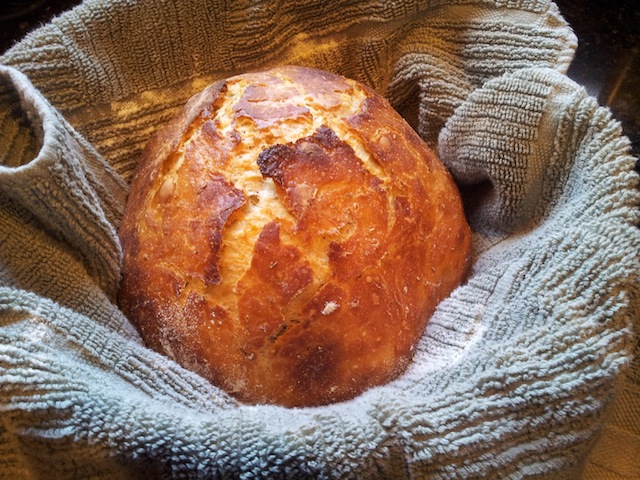
This is the finished product of the Rosemary Garlic and Lavender Bread recipe …
Rosemary, Garlic, and Lavender Bread Ingredients
The first thing you need to do is gather the ingredients for your bread. This recipe will make two loaves.
- 1/2 teaspoon active dry yeast
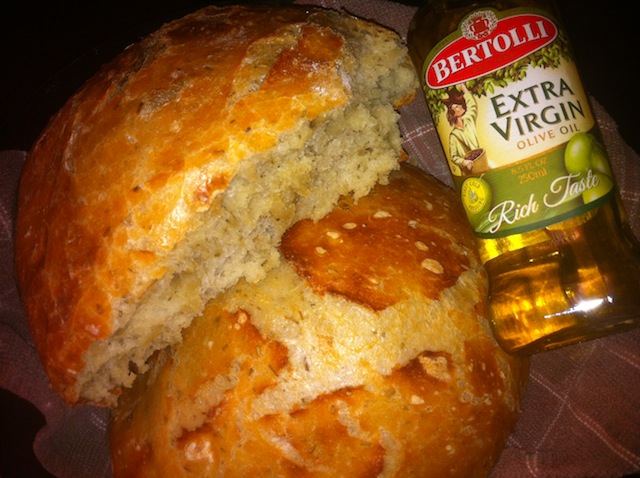
I like serving the bread with olive oil as a dipping sauce. You can flavor the oil to your preference. A high quality butter also works well.
- 6 cups of unbleached bread flour (do not use all purpose flour!)
- 3/4 teaspoon sea salt
- 3 cups of warm water
- 1/4 cup seasoning mixture (see below)
In our case, we are making a rosemary, garlic, and lavender bread. You can buy pre-made seasonings at the store, or you can make your own. For this particular loaf, I tested a seasoning recipe posted on the Food network website, only I reduced the total quantity to make a smaller batch to coincide with the bread recipe.
This Is The Seasoning I Used to Flavor the Bread
If you need to make the seasoning yourself, put the following ingredients in a blender. Again, if you don’t like Rosemary, choose a different seasoning because this bread will not be enjoyable to you. You might stuff yours with apples, brown sugar, and cinnamon, for example. I might try and post that version, as well, to show you how different it would look based on the versatility of the bread dough.
- 1/3 cup dried rosemary leaves
- 1/3 cup dried slice garlic (or 1.3 tablespoon garlic powder if you prefer)
- 2/3 tablespoon dried lavender blossoms
- 2/3 tablespoons brown sugar
- 1/4 teaspoon Ancho chili pepper
- 1/3 cup kosher salt
- 2/3 tablespoon peppercorns
If you go with this seasoning, you will only use 1/4 cup in the bread recipe. Store the rest for future use.
Again, you can use your own seasonings to get the bread exactly how you want, adjust the proportions, decrease or increase the salt, etc. It’s about finding what you love.
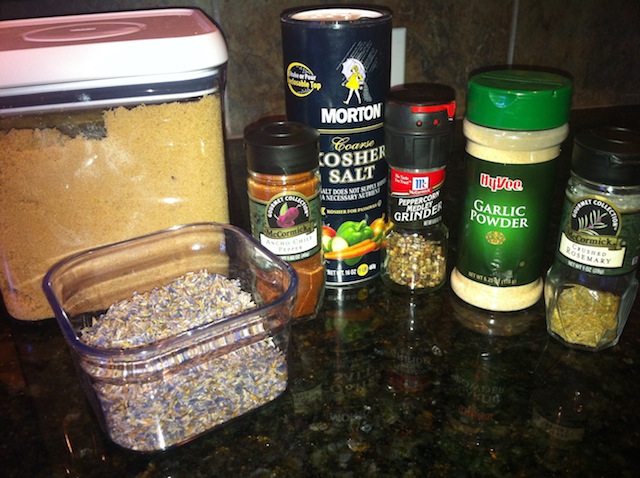
Mix the ingredients in a blender and then blend for a few seconds until thoroughly together. You will not use all of the seasoning. Set it aside for now.
Making the Bread Mix
Now it is time to make the bread mix.
Step 1: In a large bowl, pour the water and the yeast. Let it sit for 2-3 minutes to activate.
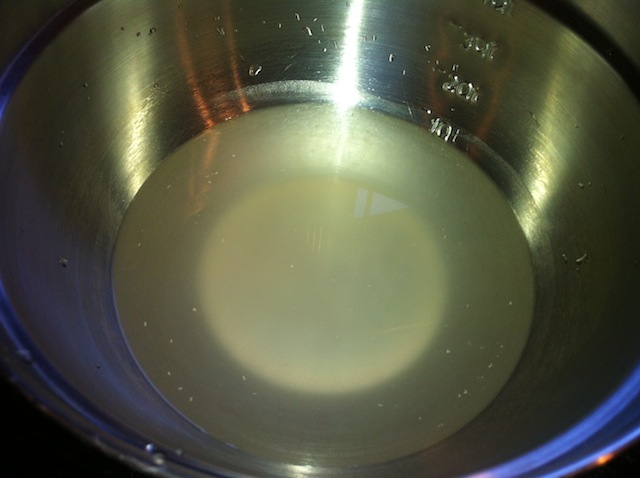
Step 1 Rosemary Garlic Lavender Bread Recipe
Step 2: Dump in all the other ingredients (6 cups of flour, 3/4 teaspoon of sea salt, and 1/4 cup of rosemary, garlic, and lavender seasoning).
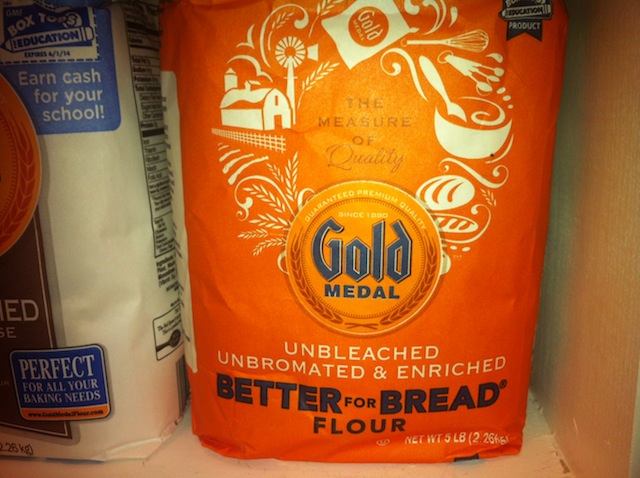
Quick reminder: You must use bread flour and not regular all purpose flour. Bread flour has a higher protein content and is going to result in a better end product. Bread flour is one of the major differences between mediocre bread and excellent bread. In honor of the 26-year case study of General Mills I published earlier today, I used Gold Medal flour, which is made by the company.
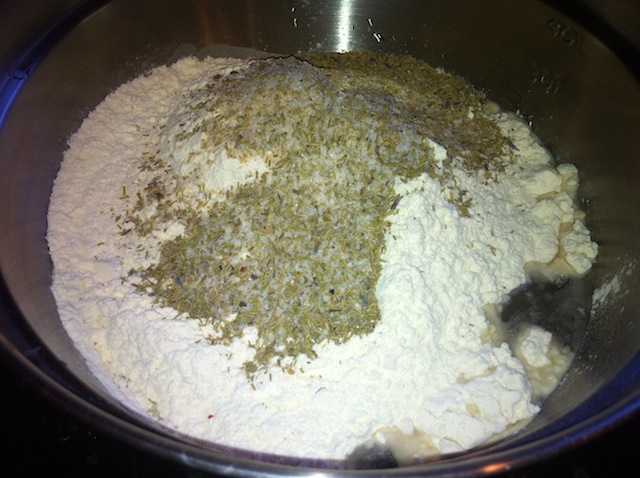
Step 2 – Dump in all the other ingredients, mixing it into the water …
Step 3: Stir the ingredients in the bowl for a minute or two until the bread looks like a giant, wet mess. You might be worried at this point because it looks messy and pathetic. That is okay. That is normal.
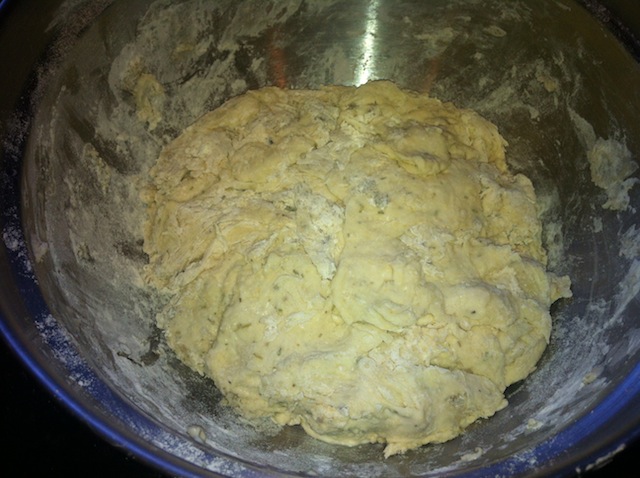
Step 3 – Mix the contents of the bowl together for a couple of minutes until it begins to look like a disorganized mess. Don’t worry. This is normal.
Now, cover the bowl with plastic wrap and let sit on the counter for 18-20 hours.
Preparing the Rosemary, Garlic, and Lavender Bread
When you come back 18-20 hours in the future, take the plastic wrap off and look at your mixture. It should appear wet and you should see bubbles in the surface.
Get two bowls and sprinkle a little bit of flour in the bottom. Then, sprinkle some flour on a clean surface such as a kitchen counter. Dump the dough mix out onto the surface. Wet your hands to avoid sticking. Now, split the dough into two balls.
Put each ball in its own flour-sprinkled bowl, throw a dishtowel over it, and let each dough ball rise for two more hours.
Baking the Rosemary, Garlic, and Lavender Bread
Turn your oven on to 450 degrees and place a round dutch oven into it. The dutch oven needs to heat for at least 30 minutes so that it is too hot to touch. Once your bread has set aside for the two hours we discussed in the previous step, take one of the lumps out of its basket, stretch the surface into a ball so that the skin of the dough appears tight, and drop it into the hot dutch oven (don’t burn yourself!). You might hear a sizzle as the cool dough makes contact.
Put the lid on the dutch oven and put it back in the oven. Set the timer for 30 minutes. Bake.
When the timer goes off, remove the lid from the dutch oven bake for another 5-10 minutes. This part will brown the exterior of the bread to look like you see in those beautiful French bakeries. Keep checking it to get it to your preferred level of toastiness. It is entirely personal preference as to how well done you want the bread.
When this has completed, and the bread is as brown as you would like it, remove the dutch oven from your oven, and get the bread out of it into its basket as soon as you can so it doesn’t burn the bottom. Let it cool for 10 minutes.
Repeat the process with the second bread dough ball you have sitting in the other basket.
That’s it. You should now have two loaves of rosemary, garlic, and lavender bread ready-to-eat. Serve them. If you did it correctly, they should be restaurant quality. This particular seasoning goes well with Italian food, especially spaghetti, lasagna, or other tomato-based dishes. It has a very strong flavor profile and is not for the faint of heart. For me, it’s a bit too salty, but that is how everyone else prefers it.
I like serving the bread with olive oil as a dipping sauce. You can flavor the oil to your preference. A high quality butter also works well. You can tell half of one of the loaves was already eaten before I could take a picture.
Experiment with this bread recipe. If you like whole oats, add some of those. If you want onions and cheeses, add those. This is a template upon which you can create anything you want. It really is that easy. Once you know the flavors your family loves, this can become your go-to dinner bread.
The next bread recipe I will share will probably be the honey wheat sandwich bread. It is by far the most popular we’ve made, but it is more difficult. It is the basis for the cinnamon, sugar, raising, and honey wheat bread smothered in strawberry jam I posted about last week.
If any of you come up with great derivations or adaptations on this bread recipe, send me pictures and a description so I can post them as an update!
Reader Comments (10)
Comments are presented chronologically, with replies indented beneath the comments to which they respond.
Ian Francis
January 10, 2013
Why do I see olive oil orbiting Jupiter when I glance at that picture?
Joshua Kennon
January 10, 2013
Replying to Ian Francis
Because you were a STEM major.
As a liberal arts major, I see the existential crisis of man as he confronts his own mortality, seeking reason in the grains of the very Earth to which his body will someday return. Garnished with lavender, of course.
Gilvus
January 10, 2013
Replying to Joshua Kennon
As a glutton, I see two things that should be in my belly right now.
Steven
September 29, 2013
Hey Joshua, I'm giving this a go (along with the tomato sauce with onion and butter recipe). Two question - my seasoning mix came out dry, how come your seasoning mix appears wet on top of the flour? Also, how big a dutch oven do you recommend for this use. Apparently we don't have one, and it seems the come in all sorts of different sizes!
Joshua Kennon
October 1, 2013
Replying to Steven
In that picture, I had put the water into the bowl, then the flour, then the seasoning mix and the water was starting to absorb. The mix itself is dry.
I think for this particular loaf, I used an approximately 6 quart dutch oven, round.
The best inexpensive version is from Lodge. It retails for $115 on their website, but Wal-Mart has it on sale for $49.97.
The best expensive brands are Staub, which makes a 6 quart version for $199.95 (they have multiple colors so look around the site) and Le Creuset. For the Le Creuset, you could probably get away with the 5.5 quart round model for $275. The next size up is the 7.25 quart model, which is $325.
I have all products from three companies in a wide variety of ranges, sizes, and color and am crazy about them. I think I’ve probably posted them all on the site at some point in the cooking pictures so you could go through them to get a better idea.
My thoughts: If money is a concern, you’re going to get about 95% of the performance from the Lodge model, especially considering the unbeatable price Wal-Mart has at the moment. It’s really a great value. If you’re obsessed with color, want something you can keep for 25+ years, and is built like a tank, go with Staub or Le Creuset.
I’d definitely go with the traditional round shape models first as they are so versatile. When you branch out, especially for holidays, I’m crazy about the Staub Coq au Vin shape. It works great for certain dishes and meats that require that longer shape.
Good luck! Let me know how it turns out!
Joshua Kennon
October 1, 2013
Replying to Steven
In that picture, I had put the water into the bowl, then the flour, then the seasoning mix and the water was starting to absorb. The mix itself is dry.
I think for this particular loaf, I used an approximately 6 quart dutch oven, round.
The best inexpensive version is from Lodge. It retails for $115 on their website, but >Wal-Mart has it on sale for $49.97 here:
http://www.walmart.com/ip/Lodge-Color-Enamel-and-Cast-Iron-6-qt.-Dutch-Oven-Green/8803041
There are two “best" expensive brands.
The first is Staub, which makes a 6 quart version for $199.95 (they have multiple colors so look around the site). You can find it here:
http://www.surlatable.com/product/PRO-1101781/Staub+Grenadine+Wide+Round+Cocottes
The second is and Le Creuset. For the Le Creuset, you could probably get away with the 5.5 quart round model for $275. You can see it here:
http://cookware.lecreuset.com/cookware/product_5-1%2F2-qt.-Round-French-Oven_10151_-1_20002_10138_21056
The next size up in Le Creuset is the 7.25 quart model, which is $325. You can see it here:
http://cookware.lecreuset.com/cookware/product_7-1%2F4-qt.-Round-French-Oven_10151_-1_20002_10139_2105
I have all products from three companies in a wide variety of ranges, sizes, and color and am crazy about them. I think I’ve probably posted them all on the site at some point in the cooking pictures so you could go through them to get a better idea.
My thoughts: If money is a concern, you’re going to get about 95% of the performance from the Lodge model, especially considering the unbeatable price Wal-Mart has at the moment. It’s really a great value. If you’re obsessed with color, want something you can keep for 25+ years, and is built like a tank, go with Staub or Le Creuset.
I’d definitely go with the traditional round shape models first as they are so versatile. When you branch out, especially for holidays, I’m crazy about the Staub Coq au Vin shape. It works great for certain dishes and meats that require that longer shape.
Good luck! Let me know how it turns out!
Bean
January 19, 2015
Replying to Joshua Kennon
The dutch ovens do not need to be enameled for bread recipes - plain old cast iron works beautifully, and are heaps less expensive. The only limitation is that you can't cook acidic stuff (tomato sauce, etc.) in the un-enameled ones. Thanks!
Mrs. Ackroyd
March 14, 2015
Hi Joshua. I have been baking no-knead for a year or so now. Here are some variations I like: Peach/Walnut/Ginger, Pumpkin/Cranberry, Rosemary/Garlic/Parmesan. Cherry/Almond, Sunflower seed/Rosemary/Garlic, Apricot/Walnut, Prune/tea leaf. Dried fruit works great!
Mrs. Ackroyd
March 14, 2015
Look for cast in in thrift stores. I got a 6 quart dutch oven for $1, reasoned it and use it almost every day!
Mrs. Ackroyd
March 14, 2015
Look for cast iron in thrift stores. I got a 6-quart dutch oven for $1, RESEASONED and use it almost every day