

The Energy Saving Investigation Continues!
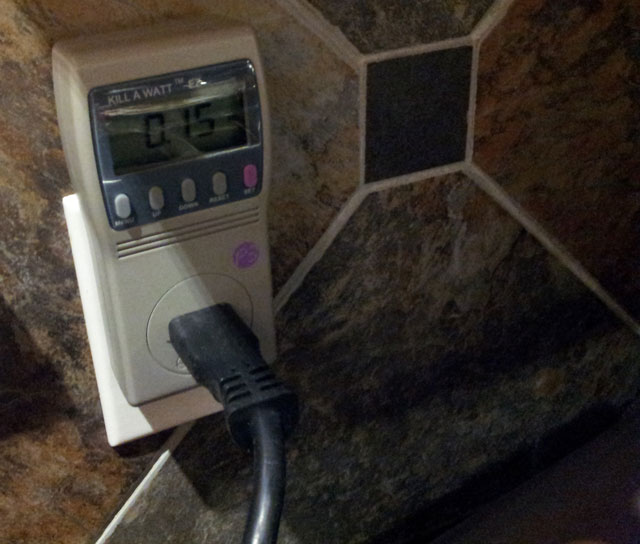
Thank you all for the amazing comments and suggestions you left on my post about my investigative project with the weird kWh figures I was getting from my utility company. I’ve been so obsessed with the project I haven’t had time to write individual responses, but I did read every one of them and, in many cases, add it to a task list to check and / or immediately go out and spend some cash on a device that could help narrow down the problem. For example, I now have Kill-a-Watt measurements being gathered so I can isolate certain appliances and electronics, measuring the actual, real-world use.
I also decided, while doing this, that I would go ahead and finish switching the entire house to energy efficient lighting. I ran a full intrinsic value analysis, just as I would if I were valuing an expansion project or a fixed income security. The returns are much higher than they were a few years ago; so high, I can no longer ignore them.
Here’s just one illustration. My preferred LED light bulb costs $32.97. I’ll pay $2.54 in sales tax. Thus, my net cost per LED light bulb is $34.75. Each replaces a 65 Watt regular incandescent light bulb but burns only 13 Watts, while providing the same Lumen equivalent as a 75 Watt bulbs. That means each LED light bulb burns 52 Watts less, while providing a brighter light. Assuming each bulb is lit for 3.5 hours per day, on average, the savings amount to 66,430 Watts per year, or 66.43 kWh. The electricity in my area costs $0.1038 per kWh, so this creates a very clear, net cash savings on my electric bill of $6.90 per annum, per bulb.
Based on my net cost of $34.75 per bulb, this results in a 19.86% return on capital employed. The real return is going to be higher for two reasons: 1.) These bulbs have a warranty of 6 years but are projected to last an average of 22.8 years, meaning that I will save the cost, time, and hassle of having to replace each light socket somewhere between 6 and 50 times over the coming decades, and 2.) Electricity prices will inevitably rise with inflation, so any increases in the rate charged by the utility company will more quickly recoup the savings compared to the position I would have been in had I not made the capital expenditure.
There are very few places in life where one can get a cash return of 19.86%+ on capital, consistently, with practically zero risk, while simultaneously reducing their environmental footprint and experiencing a substantial increase in the quality of the lighting, which now looks museum-quality as we opted for the LED light bulbs with a bit narrower beam focus.
In some situations, I was able to replace 65 Watt bulbs with 14 Watt compact florescent bulbs (CFL). Using the same average lit rate assumptions, they should save $6.76 per annum in electric costs, while costing $9.66 after sales tax per bulb. That is a cash return of 69.98% on capital employed.
Again, I know of almost nowhere else in life where such a high return is so easily achieved. Think of it like buying a blue chip stock where you lay out cash today to collect dividends in the future. Only in this case, you are laying out cash today to have less cash taken from you in the future. The net economic effect is identical.
As I gather more information from the devices now monitoring the electronics to determine whether more draconian actions are necessary (I’m hoping some of your suggestions turn out to be correct and I can end the investigation – a wayward vampire device that is defective and draining large amounts of energy or a broken refrigerator seal), I’m running cost-return analysis with various energy input assumptions to decide whether it’s worth it to switch out some of the almost-new appliances I already have for gas versions. I’ll have to pull my energy research files and look at the total supply and distribution situation to determine whether I think low natural gas prices are sustainable for 36 to 48 months. I may also research solar rebates for my area and see if it is feasible to create some sort of internally generated power to offset my kWh pull from the grid.
I realize I’m being irrational here in the sense that the best I can hope for is, say, a 50% reduction in usage, or $1,000 per year. Given the time investment involved, this is an utterly stupid way for me to behave since it’s a rounding error on my annual household income statement, having practically no utility to my family. But my inner investor can’t let it go because it looks like the return on capital is going to be 20% or higher for all outlays involved and once it’s done, it will also free up some time as many of these items have longer useful lives. Fellow value investors out there know what I’m talking about – finding a guaranteed 20%+ return on outlays is like discovering the ultimate weapon in a video game. The emotional reward is so enormous you want to scream and throw your first in the air, singing, “We Are the Champions”. How can I let it go, when it’s just there, waiting to be picked up for a few days of work? It’s like finding money in the street.
Perhaps, for poetic justice, I’ll use the savings to fund more energy investments. Over a 30 or 40 year time period, these savings could easily result in an extra couple hundred thousand dollars worth of utility shares by the time I’m in my 60’s or 70’s. That’s more money for charity; more money for gift transfer to my children and grandchildren. It’d be like that scene in The Graduate, only instead of “Plastics”, I’d point to limited partnership certificates for a pipeline in which I had an investment and whisper, “Lightbulbs” or “Water Heaters”.
Reader Comments (35)
Comments are presented chronologically, with replies indented beneath the comments to which they respond.
m r
September 22, 2013
You fatcats didn't finish your plankton! Now its mine! lol
But seriously this reminds me of that article about how houses are going to have more solar panels on the roofing in the future. They're currently its equivalent to having granite countertops on a new home, but will become more affordable/common according to the article.
Joshua Kennon
September 22, 2013
Replying to m r
That's a great article; thanks for sharing it. I believe it! I'd definitely consider a solar system on a house a plus, and they're on my list of things to research now for this project. For some reason, the idea of getting to the point my household utilized a net 0 kWh thrills my inner engineer, but makes my inner utility investor recoil in horror.
I'm not sure how the regulatory agencies would react were the power grid to experience a situation where self-generating power was cheaper than the grid itself. Speaking from the perspective of a securities analyst, the entire return generated by a power utility is determined, to a large degree, by the economies of scale provided through the granting of a local monopoly. If you had a situation where enough people were to fall off the grid, even partially, it is entirely possible that utility companies could be driven into bankruptcy as their past stability resulted in them having some of the highest debt loads of any corporation type. Hence, you'd have what have been blue chip stocks for generations suddenly becoming speculative gambles. A paradox of sorts is that were the utilities to attempt to recoup these costs from those remaining on the grid, the surcharges and increases could drive more people from the system even faster, creating a sort of self-reinforcing tidal wave. It's happened before in many other industries so it is not beyond the realm of possibility. It's one of the things that makes investing so interesting.
Steve
September 22, 2013
Hey Joshua, have you done the math over simply upgrading to a CFL? Is the additional expense worthwhile?
Joshua Kennon
September 22, 2013
Replying to Steve
The CFL are nice (and definitely the best return on money in exchange for sacrificing a bit of light quality), so we have a few of them in places like rarely used lamps in a side room or something, but the newer LED with 3000K light brightness and a focused beam just looks so much better that the additional cost, given that it was still a fantastic return on capital outlay, was not a difficult question for me. (I like the look you get at really nice restaurants or art galleries where the light doesn't just flood the room but highlights right underneath it so the area you are using is well-lit but there is some visual interest to the room; entirely personal preference.) I tested a bunch of the different options and this bulb blew the others out of the water. I liked it so much that I spent all day running around every store in Kansas City that had them. So far, I've managed to get my hands on 26 bulbs (a few in slightly smaller or larger sizes for specialized uses), and I'm going to place an order to get the rest I need shipped in now that I have these installed and there's no question this is the bulb for us.
Some people don't like the focused, art-gallery look, in which case there is no advantage for LED over CFL and the latter have much better returns from a purely financial perspective as the Watt savings are practically identical but the cost-of-acquisition is a fraction (albeit, you have to replace them more often). One could practically mint money switching over an entire residence to the CFL as the payback period for heavy light users would be very short. After a year or two, it would all be cash savings that fell to the bottom line. For my area, it works out to roughly $0.0053 per hour each light bulb is lit (that's a bit more than half-a-penny) if you're comparing a traditional 65 Watt bulb to a CFL equivalent replacement. But you had up all of the light bulbs, all of the hours, all of the days, and it ends up being thousands of dollars over a few years. It's about twice that if you live in an area where energy is more expensive, like the New England states.
Gilvus
September 22, 2013
Replying to Joshua Kennon
Don't forget safety issues. CFLs contain mercury (in its vapor form, no less - far more hazardous than liquid mercury). But otherwise, CFLs are on par with our latest LED technology in terms of luminosity per unit energy and are far cheaper. This will change as LED technology and manufacturing processes improve.
I'm an LED enthusiast and don't settle for less than high-quality diodes in my emergency light sources. But the pragmatism of CFLs outweigh my nerdlust for next-gen technology when it comes to home lighting 🙁 I was unaware that LEDs have been gaining a foothold in accent lighting, though; thanks for the info.
Austin
September 22, 2013
After reading your site of nearly 6 years, I am excited to see you cover this topic. I have been in the solar industry for 4 1/2 of those 6 years. Even to hear you mention it in passing on an energy efficiency post (almost as exciting) just makes me smile wide. Especially being in the Midwest, likely the last region to adopt significant renewable energy, it means a lot that such ice cold investors are considering solar power. There seems to be nothing you can't thoroughly research on your own but if you were interested in more information from a solar insider, I would love to help.
Joshua Kennon
September 22, 2013
Replying to Austin
Haha! Be careful what you wish for, I might just wear you out with questions! Thanks for the offer; if I end up thinking that path is a real possibility, you'll definitely know.
Joshua Kennon
September 22, 2013
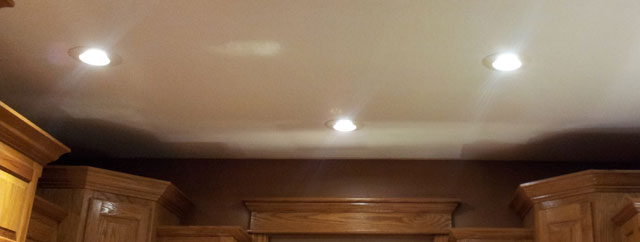
Great point! I had no idea about the accent lighting features of LEDs, but it turns out it has to do with a math intersection between something called the beam angle and distance from surface. I really like the much more narrow beam angles. Right now, I'm responding to you on a MacBook at the counter of my kitchen and the new lights above it are creating a sort of restaurant-like focus only on where I am working (see picture). They are actually, I think, 36 degree angle beams (I could be wrong on that, I'd have to double check), which you'd normally use for a larger light area, but since they are only a few feet above the countertop surface, they have a much more narrow effect. Figuring out the math of exactly how wide you want the light shaft to be is kind of fun. (Also a bit frustrating, since if you need 10 or 15 degree beam angles for regular hallways to create paths of light, you have to find specialty retailers online that carry them.)
Gilvus
September 22, 2013
Replying to Joshua Kennon
That sort of lighting would make me feel exposed and uneasy. Being highlighted would make it very easy to see me...and very difficult for me to see outside the "bubble" of light. Maybe your camera is exaggerating the difference between light and dark? Or maybe I'm just paranoid :-/
I'm not surprised that you have a sweet spot for color temperature considering both you and Aaron got perfect scores on that color IQ test. Here's the thing about sub-3000K lights though - too yellow and you get that cheap-apartment feel. But go down far enough (sub-2000K) and you get into the fiery colors, which IMO are better produced by actual candles. Nothing "sets the mood" like a couple of well-placed tea lights, though I've never bothered to try with an LED lamp.
One thing that both excites and vexes me about LEDs is the current rate of improvement (and obsolescence). I use a flashlight that I bought in 2011 for everyday carry. Today, the same model is much brighter, much more efficient, and significantly cheaper than the one I bought in 2011!
Joshua Kennon
September 23, 2013
Replying to Gilvus
No, you aren't being paranoid 🙂 All the other lights in the house are off, just those two are on (and they were partially dimmed) and the photo was taken with a camera phone so I get what you are saying. When an entire room is lit, you can definitely see everything but it has that exact same feel of walking through a Tiffany & Company where there are shafts of light accenting different things, so suddenly the vase on the table looks like it is glowing. It's a brighter version of this sort of effect ... the paintings are lit more than the surrounding wall and the floor has different light and shadow patterns. A lot people prefer a flat light that illuminates everything equally like this. I find the latter harder to focus, whether I'm reading or thinking.
I hear you on the LED advances. I didn't realize before this project that there is such a big difference in what you pay for versus what you get; that LED bulbs are very much like consumer electronics where more expensive really does translate into better quality and components in almost all situations. I hope that the bulbs I bought today cost a fraction in only a few years. I figure, that way, it makes it even more likely to be adopted by society, and at the same time, I'm still earning my same return on capital so there's no reason for me to be upset.
Joshua Kennon
September 23, 2013
Replying to Gilvus
No, you aren't being paranoid 🙂 All the other lights in the house are off, just those two are on (and they were partially dimmed) and the photo was taken with a camera phone so I get what you are saying. When an entire room is lit, you can definitely see everything but it has that exact same feel of walking through a Tiffany & Company where there are shafts of light accenting different things, so suddenly the vase on the table looks like it is glowing. It's a brighter version of this sort of effect ... the paintings are lit more than the surrounding wall and the floor has different light and shadow patterns. A lot people prefer a flat light that illuminates everything equally like this. I find the latter harder to focus, whether I'm reading or thinking.
I hear you on the LED advances. I didn't realize before this project that there is such a big difference in what you pay for versus what you get; that LED bulbs are very much like consumer electronics where more expensive really does translate into better quality and components in almost all situations. I hope that the bulbs I bought today cost a fraction in only a few years. I figure, that way, it makes it even more likely to be adopted by society, and at the same time, I'm still earning my same return on capital so there's no reason for me to be upset. That's the great thing about science!
(Don't you love that we live in a world where a gif of Bill Nye the Science Guy on a reality dancing show exists for occasions such as this?)
Gilvus
September 23, 2013
Replying to Joshua Kennon
Not a gif and no bowtie, but you get the idea.
joe pierson
September 23, 2013
The LED lights I have purchased haven't lasted more then a year, the problem I had with them is the internal electronics that is used to convert 120V AC to 5V DC (or whatever is the internal DC voltage the LED requires is) goes bad due to the cycling off and on.
jb1907
September 23, 2013
I have had some CFLs that have burned out way before they were supposed to. We all are just getting sucked into pay $30 for a bulb when 1% of people will actually save the paperwork to replace the bulbs.
Joshua Kennon
September 23, 2013
Replying to jb1907
Really? I kept all of the paperwork, original documentation, and proofs of purchase with warranty in a sealed container, that is now indexed and put aside. I also digitized a backup copy on our cloud server so I can grab it if the original paper versions need to be recreated. It took something like 1-2 minutes to do. If someone spends thousands of dollars on bulbs to save money, and doesn't take less than two minutes to insure they are entitled to a full refund if the bulbs don't last the promised lifespan, I don't think they have a right to complain ...
I'm not trying to be contrary, but, my God, how hard is it to keep track of a few pieces of paper?
Joshua Kennon
September 23, 2013
Replying to jb1907
I don't meant to be contrary, but, my God, how hard is it for someone to keep track of a few scraps of paper to guarantee a refund in the event the product doesn't perform as promised? (This isn't directed at you; more of a general question.) As it stands now, a few seconds of work means there is no risk in the project from a financial perspective - they either perform as promised, or you get a refund or replacement that does.
It took less than two minutes for us to not only save the original documents, but have them scanned with the receipt, proofs of purchase, and warranty information, for archive on our cloud server in case we ever need the backup.
People can't be that lazy ... I realize very few people are going to have this kind of record, but ... really? I hope you're wrong on such a low-ball estimate. Or better yet, I hope the tech keeps getting less expensive so eventually the bulbs are a few bucks so people don't even bother with the paperwork at all.
jb1907
September 23, 2013
Replying to Joshua Kennon
Yes, they can. How hard is it to sign up for a 401K and many people don't. Not many people are organized enough to save warranty information. I have a file, but I suspect many people lose track of the information or move and lose it to the next person that moves into the house. Me? I would take the light bulbs if I invested that much money in them.
Joshua Kennon
September 23, 2013
Replying to jb1907
Ha! Excellent point on the 401(k). I remember reading a psychology study that resulted in many firms changing the system to auto-opt-in because few people would take the time to sign up or opt out even though the stakes were hundreds of thousands, or even millions, of dollars in lifetime wealth. I would hope, in a case like this, where you had an explicit cost - and actual outlay they had to go spend - there would be a greater chance of them protecting it. Perhaps not; you're probably right.
jb1907
September 23, 2013
Replying to Joshua Kennon
Great story on 90 year old with all her records. Of course, she is one of .0000001% of people that keep a car longer than 20 years. If I had to bet, I would do the same thing for my car and try and drive it 300,000 miles. I would be curious how much the lifetime battery charge was. I bet they never thought they would replace it that many times.
Joshua Kennon
September 23, 2013
Replying to jb1907
Agreed; I would love to have some record like that! There's a better story on her here with more details. She's gone through "18 batteries, eight mufflers and countless oil changes". Her secret was obsessive record keeping and always opting for the product with a lifetime warranty when it was made available to her. She bought it for $3,289 in February of 1964 and drove it through 2012.
jb1907
September 23, 2013
Replying to Joshua Kennon
I kept my last car 12 years and only had 72K miles on it. It might take me 45 years to get to 500K miles.
tvn
September 23, 2013
While you're on the topic if energy savings I'd thought I'd share something I've noticed. I live in the southern US (so it maybe more practical down there) but I see increasingly more homes on just my street having solar panels.
The more I think about it the more sense it makes to me. Solar has come a long way in that it's more affordable such that even residential homes can have them. The sun rains down virtually unlimited free energy. While variables such as location, cost and weather comes into play the net energy savings are worth it.
This is just something I know will work for me, personally, but I hope that can be another avenue towards your minimalism project through the reduction (or even elimination) of your electrical energy dependence from the grid.
Joshua Kennon
September 23, 2013
Replying to tvn
I would love to go solar. I don't know nearly enough about it, at this stage, to know whether the economies would be a good return on capital for my particular situation and geographic location. I need to research further.
Ian Francis
September 23, 2013
FYI, I compiled my electrical usage data and put together a small write-up on it. Hope this helps give you a comparison.
-Ian Francis
S
September 23, 2013
What about a power company rebate? My local utility offers rebates on upgrading lighting fixtures to CFL or LED. http://homeenergysavings.net/Utah/lighting.html If this is something that is available through your own utility, it could greatly improve your ROI. If you haven't already, you should check it out.
Andrew
September 23, 2013
Joshua, I found your next home!
http://www.techhive.com/article/2045715/this-smart-home-in-utah-hits-a-bold-new-benchmark-net-zero-energy-consumption.html
lokgp
September 23, 2013
There are certain things in life that looks great in theory, but they are not practical in real life. And certainly, some things apply well for commercial uses, and some just don't do as well for residential (normal household daily use).
1.) If you don't use large amount of energy, the solar panel installation is just another investment that would pay for itself only, and no money saved in the end. It is a Capex that needs another Capex to replace. Contrary to popular believe, the best money/energy saving method is to reduce and don't buy it in the first place. Look at the smart phones that needs constant renewal, eventhough it promise to give a lot.
2.) For people who seek perfection, any imperfection in the performance of a solar panel will drive you crazy and, makes you spend more money to get it perfect again. Its a form of frustration, which you just can't sit around staring at. Energy from a power provider is always perfect and requires zero maintenance. Solar panel will require constant rework, and a capex that continues to promise a lot, but will only return the investment. There are batteries and controller to worry about as well.
3.) With more parts, comes more trouble. A fan will always work. But not an air/conditioner. There are too many parts that can go awry. But when they work well together, they are wonderful. And it does take a lot of effort to make they work well. The A/C can be not cold enough etc etc, but the fan will always spin and deliver what it promises. So, anything that promises more than 10 years of life, is just voodoo. Even a house cracks and need repairs every 3 years. The expectation in theory is simply not realistic. LED lamps works forever, that is true, but let's not forget that LED lamps run on DC and needs electronic power converters. No electronic parts that takes up lots of heat to convert power will last very long. The weak link of LED lamps are the electronics parts. And it is unfortunate, that you can't change the electronics only. That's why you can see the heat dissipater fins on LED lamp. Its to help cool down the electronics. Even if the electronics work, consider the brightness of the lamp. Incandescent blows out before the brightness deteriorates. CFL and LED losses its brightness as time goes by. And you would replace them as you think they are no longer bright enough. It is similar to a car, you replace because you think it is no longer good enough. And anyway, LED light spectrum is different from incandescent. It will take some time to get used to. On a realistic basis, CFL is the best option in terms of brightness, life and energy savings. But, you still change CFL after they get dim, so, you see, these mercury lights outlive their usage.
4.) These LED lights and solar panel will work great in commercial applications such as warehouses, 24 hours manufacturing centers, retail malls. The savings is outstanding. And the time to recover the investment greatly shortened. But in a residential house, the benefits are not clear.
5.) Health and safety consideration. LED lights and its effects on the eyes are unknown yet. LED light are artificial and very different than sunlight. It has very limited spectrum. Its looks bright but rapidly losses its energy after short distances. It gives a glare but don't reflect well. So, I wonder will it encourage early cataract. It is like the Ikea wood cabinets. You can't be exactly sure. But, they seem like money savers. I know someone who is an engineer, and there are only Cathode Ray Tube TV and monitors in his house. And he says, none of my children wear glasses or have poor eyesights. So, even with all these dangerous eye destroying rays stories, it does feel warmer looking at CRT screens, compared to the cold blue LED screen. And there are more people wearing glasses now than when we had CRTs! So, there is some concerns here. It is a bit like deciding whether we should put corn-fructose or sugar into Coke.
6.) But, if you find great joy in testing new technology and discovery, then proceed. Spending money to get some joy is worth it. 🙂 Have fun!
joe pierson
September 24, 2013
Replying to lokgp
The problem with the LED lamps is the 120V power, you basically have to stuff a power supply into each lamp, which is nuts. It is very hard to keep it cool so you have electronics that are subjected to extreme stress. You have to use very expensive parts. Much better to have a DC power line (like 48Volts) running throughout your house and have one power supply supplying everything.
http://www.edn.com/design/analog/4411475/Ensure-long-lifetimes-from-electrolytic-capacitors--A-case-study-in-LED-light-bulbs
lokgp
September 24, 2013
Replying to joe pierson
What a great article! Thanks!
Joshua Kennon
September 23, 2013
This is amazing!!!
Joshua Kennon
September 23, 2013
I checked and there are none in my area. This is a great point that everyone else should see for themselves because if you lived in an area with an incentive to switch, you're absolutely right - it could drive the ROI through the roof as the net cost is lowered, letting the savings recapture the outlay quicker.
Bob Roberts
September 25, 2013
Josh, are you sure that your electric company is actually reading the meter? Our utilties mostly estimate electricity usage in the DC area rather than reading meters (in fact they can't even get in to my backyard to read mine). It makes me wonder if consumers might be in for a big surprise once more smart meters are installed.
Joshua Kennon
September 25, 2013
Replying to Bob Roberts
I saw the meter reader a month ago, so I'm fairly certain they at least periodically check on it. One thing I am going to do is take manual readings myself now that we are switching everyone over to the lower energy items and see if the power company's measurements keep pace. By recording all of it, and waiting to reconcile the utility usage report to the actual figures I catch on film, I'll have a better idea of where to go from there.
E
October 6, 2013
Hi Joshua,
Do you have a well? I recently had a similar problem with a rental property we own. Our electric bills were out of control. It wasn't until the well pump failed that our electric consumption mystery was solved. After replacing the well pump our electric consumption for the property dropped over 50%.
Take care, e
Colleen Turner
September 3, 2014
I cannot believe this, but I have been going through the same thing for a year! The electric company finally told me to file a 'Theft of Elecricity' report! Adding that the problem is 'not on their end'. But I can go you one better...I have months where there are DAYS that supposedly, I used 0 electricity! For example, Oct. 2013, there are 4 days in a row, 0,0,0,0 usage! Impossible! Everything was running as usual! Any ideas???