


Why Don’t People Realize You Can Do This In Real Life?
During college, one of Aaron and my closest friends made a comment that still haunts me to this day. I was explaining that if you own a share of The Coca-Cola Company, you actually receive a proportionate cut of the company’s profits on every single can of Coke sold. This makes sense, after all … if a business is divided into 100 shares outstanding, and you own 1 share, you own 1% of the company. If you own all 100 shares, you would own the entire business and get all of the profit, right? For me, this falls into the, “We hold these truths to be self-evident” category.
She looks at me and says, “No. That isn’t true.” Not knowing how to respond, I kind of raise an eyebrow … “What do you mean?” I inquire. “Well,” she responds, “the stock doesn’t really have anything to do with what the company does. Just because I own shares of Coca-Cola doesn’t mean I’m seeing any of the profit from Coke sales down at the supermarket.”
For one of the few times in my life, I was absolutely dumbstruck. I had explained, very carefully, how a company is divided into pieces and those pieces were traded by buyers and sellers. The prices these buyers and sellers is reported each day, but they may or may not be rational so it is up to you to focus on paying a fair price and buying the most dividend income and look-through profit as you can for your money. She still didn’t make the connection and it made me sad because I wanted her to understand that, if you get enough of these “pieces” of businesses that we call shares, and you choose them wisely, you will just sit back and collect cash throughout your lifetime so you can do anything you want.
As I play the Tycoons game on Facebook throughout the day (I just leave it open on a MacBook and periodically go over and play for a few seconds before resuming whatever else it is I was doing), I start thinking about all of the people playing who aren’t financially experienced. Tonight, for example, I bought a chemical plant. That got me thinking … do most people realize they can buy a real chemical plant by purchasing a “share” of Du Pont?
If someone owned 10,000 shares of DuPont, over the past twelve months, they have received a real-life dividend of roughly $16,400 from their share of the profits. Just like the businesses in the game generate earnings to be redeployed, the real world works exactly the same way. Every chemical that leaves the factory is, in effect, working for the shareholder and generating cash flow and (you hope) earnings.
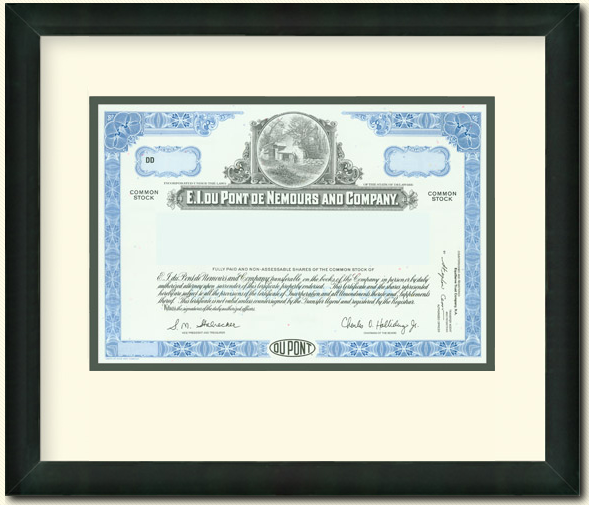
Why do people who enjoy these games get so into them, but never carry those principles over into real life? Do they just not know it is possible? Maybe if a stock broker setup a store where you could walk in, see framed certificates of different companies, and you shopped for them like picking out a lamp, people would get it. They would see the physical checks arrive in the mail each quarter.
Reader Comments (3)
Comments are presented chronologically, with replies indented beneath the comments to which they respond.
Paul
January 3, 2015
Did she go into why she thought that wasn't true?
speedgraphic
February 2, 2015
She's honestly pretty right about non-majority, common shares for a non-financial person, especially for a company that doesn't give dividends.
Joshua Kennon
February 2, 2015
Replying to speedgraphic
While I understand why it appears that way, I don't agree at all, especially over long periods of time where the statistical evidence is beyond dispute.
Year-to-year movements are random (at least once every 36 months you're likely to see a movement of 30% or more in share price). That is certainly true. However, the academic work has proven what common sense should dictate: In the long-run, asset prices are driven by cash flows and they will eventually revert to a given valuation multiple mean because people are mostly rational despite going off the reservation every once-in-a-while. That is, the longer one remains invested in an asset with a public quotation, the more likely it is the ultimate compounding rate of that asset relative to cost will reflect the actual business performance. This is the reason risk declines precipitously with portfolio time horizon. A representative basket of high-grade stocks that might be terribly risky over a 2-year period might hold practically no risk over a 25 year period.
That basic truth is the entire justification for the existence capital markets and the very foundation of finance. If it were otherwise, why would any intelligent person be willing to buy an outside, passive minority stake in an enterprise? It'd be illogical.