

An Update on the (Almost) Year-Long Energy Saving Program
Almost a year ago, I began to notice some weird things with our electric bill. What followed was me getting obsessed with figuring out where the energy was going, even measuring the daily cost of operating my coffee pot. Then, a resolution to take $2.4 million in future wealth from the stockholders of KCP&L. It will take one more statement cycle to get true year-over-year comparisons since the cost savings didn’t start to kick in until October, and only August has now been concluded, but I pulled our kWh figures and temperature data to see how the changes we made are doing. It seems to be paying off nicely.
May of 2014 is a bit of an outlier because we spent half the month in Southern California, which you can tell from the archives. Otherwise, it seems like the biggest dividend paying move was spending quite a bit of money on high quality LED lightbulbs. I got sidetracked so I haven’t crossed off the one thing on my list that could potentially double these savings figures, which would be to replace the water heater. That needs to get bumped back to the top of the agenda.
The numbers are good but I can do better. It’s a bit of a game, sort of like the new one Aaron and I just created with a bank account modeled after Xillia 2, but I’ll write about that sometime later because I’m about to go enjoy lunch and play the post-game super bosses.
Thank you again to those of you who shared your secrets, tips, and suggestions. I still have a lot to learn about energy efficiency but I’ve enjoyed the process, thanks in no small part to all of you.
October 2013 vs. October 2012
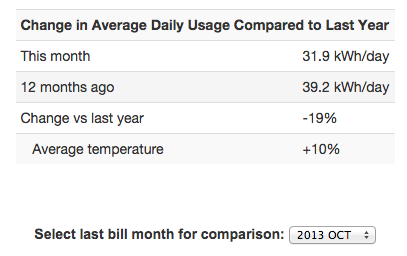
November 2013 vs November 2012
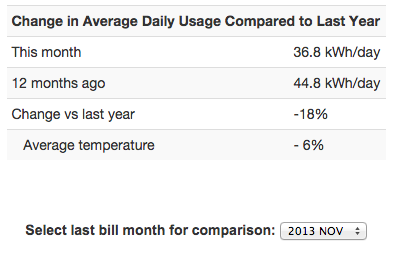
December 2013 vs December 2012
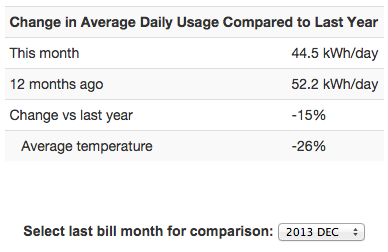
January 2014 vs January 2013
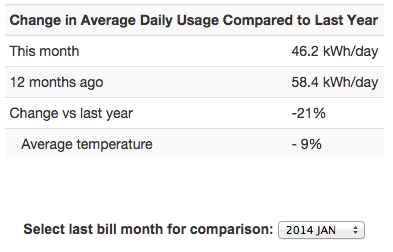
February 2014 vs February 2013
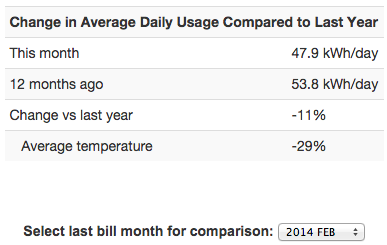
March 2014 vs March 2013
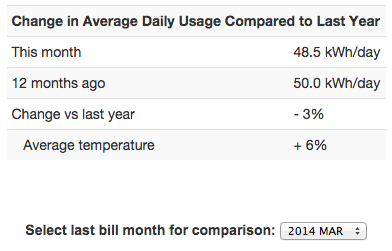
April 2014 vs April 2013
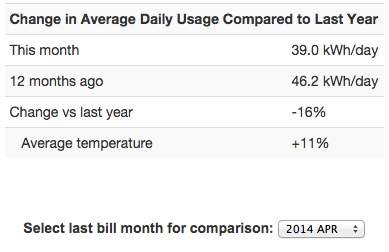
May 2014 vs May 2013
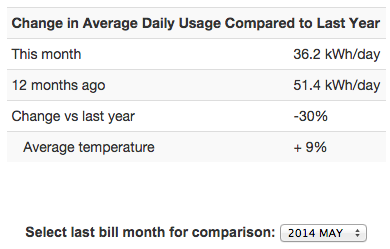
June 2014 vs June 2013
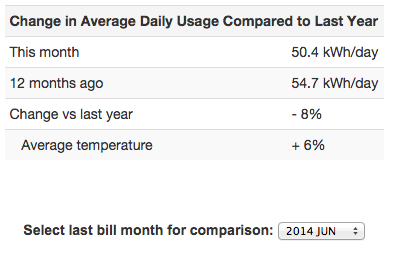
July 2014 vs July 2013
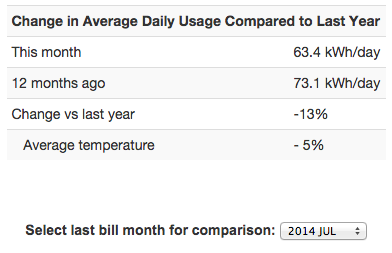
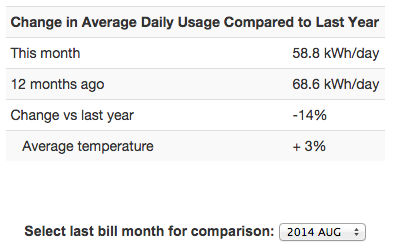
August 2014 vs August 2013
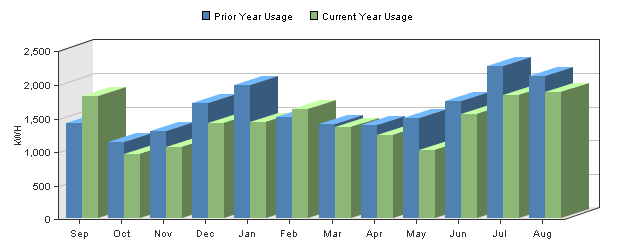
The energy savings program started in late September after seeing how high the kWh usage was (you can see it in the chart), going into effect in October of 2013, at which point our electricity usage began to fall considerably. We’re about to approach the 1-year anniversary so I can do a true year-over-year analysis once I get the bill for September sometime in October.
Reader Comments (17)
Comments are presented chronologically, with replies indented beneath the comments to which they respond.
joespr
September 8, 2014
>>it seems like the biggest dividend paying move was spending quite a bit of money on high quality LED lightbulbs.
I find this hard to believe. Don't you have a refrigerator, dryer, air conditioner, washer, electronics, etc., that all could have been assessed to lower your bill?
Joshua Kennon
September 8, 2014
Replying to joespr
Nope. They were all manufactured within the past few years and very good quality so there wasn't a big efficiency gain to replacing them. The only exception is the water heater because the previous owner from whom we bought the house, who only lived here very shortly after having it constructed (he was a Vice President for a pet pharmaceutical company, if I recall, and had literally built the place then was relocated to another state, forcing him to sell it in the midst of the real estate crash), wanted the biggest, most excessive hot water heater he could get. It is now responsible for 25% of our entire home energy use, whichi s one .
I broke out the light bulb math on this post. It was crazy how much less energy they use. We replaced every single bulb in the house that could be replaced and almost all of the net reduction and savings come from that one investment. The technology has really changed in the past few years.
What is that old Aesop's fable? Small foxes spoil the vine or something like that? This was a real life example of how a tiny most people overlook had an outsized influence.
joespr
September 8, 2014
Replying to Joshua Kennon
Well, live and learn. I would never have thought that changing lightbulbs would be the biggest savings. Everything I have read says to look at the fridge first, etc. Oh well....
Time to check my own house now...
joe pierson
September 8, 2014
Replying to joespr
Depends on the number of light bulbs, Joshua had many 10's of light bulbs, 40 maybe?
Eric
September 10, 2014
Replying to Joshua Kennon
Why not get a tankless water heater?
Joshua Kennon
September 10, 2014
Replying to Eric
That is a great question. It's been on my list of things to look into and I still haven't done it beyond the initial research sometime last November or December.
The figures I have are still one month away from a true year-over-year analysis but if I hold the same reduction (13.03%) on last year's September figures, it looks like we will have taken our 12-month energy usage to approximately-back-of-the-envelope-best-guess 17,094 kWh vs 19,489 kWh in the prior twelve month period. That means a net savings of 2,247 kWh, leaving aside the other major variable, which is seasonal temperature fluctuations, as well as changes in the home (e.g., an extra television now in the gym, etc).
Right now, the water heater we have is classified under the "least efficient" category by the U.S. Government. It's fantastic. I don't think we have ever run out of hot water even with houseguests, laundry running, the dishwasher going. It uses 5,106 kWh per year of energy, which means it is probably responsible for just shy of 29.87% of our entire electricity usage. Part of this is sheer tank volume. The typical American home has a 50 gallon tank installed and this one is 62% larger (81 gallons).
That means everything else in the house that isn't on natural gas (stove, fireplaces) - including the air conditioning, furnace - comes to 11,988 kWh. In my mind, I've sort of divided everything into those two camps - water heater (5,106 kWh) and everything else (11,988 kWh).
I'd really like to get down to 12,000 kWh per year as a major goal, which would be a huge reduction from the starting figures. We're on the right track, but I still need to come up with another 5,094 kWH saved per annum to hit it.
On the water heater front, there's a bit of gambling on my part. Since we can go with either natural gas or electric, if I opt for the tankless model, the choice will definitely influence the rate of return since natural gas is so incredibly cheap at the moment. But will it be in 5 years? 10 years? There's a bit of an energy play embedded in it, which I enjoy.
TheLonelyHumanist
September 19, 2014
Replying to Joshua Kennon
I don't know much about your climate but around here the best ROI is going to be a cheap solar system (with 30% tax credit) to preheat the water and use a cheap electric tank system with an insulating blanket to store at (or if needed, raise the temperature to) the recommended 120F. From there you can modify your behavior to maximize use of solar and minimize reliance on the element.
TheLonelyHumanist
September 19, 2014
Replying to Joshua Kennon
Also, climate control is normally the lion share of energy cost. The cheapest way to decrease energy cost is therefore almost always an insulation upgrade.
TheLonelyHumanist
September 19, 2014
Replying to Joshua Kennon
Had a brainstorm in the shower... There's no cheaper cost than not buying. So I would not switch out your water heater at all. I would simply insulate it better and try to collect enough energy to preheat your water. The size (if properly insulated) will actually be to your benefit. If you don't have enough solar power to heat your water, you can use the waste heat from a geothermal heatpump (which would lower your overall energy use anyway, and also has a 30% tax refund) to preheat the water.
If you can't find an insulating jacket for your water heater, I would get creative with aluminum foil and expanding foam. A radiant barrier under a few inches of closed cell foam will block well above 90% of the heat escaping for a fraction of the cost of installing another unit (let alone purchasing it). This should bring you a lot closer to your goal.
koen
September 8, 2014
I am wondering why American energy consumption is so high. Is it because you live in a harsh climate, have limited isolation, and heat/cool your house with electricity?
The average household of my Western European country consumes 3500 kWh per year, while a one-person households consumes about 600 kWh per year (mainly due to smaller housing).
Joshua Kennon
September 9, 2014
Replying to koen
Those all play a role. Climate makes a huge difference. When we were looking at real estate in California, the kWh usage for households was a fraction of what it is here in Missouri because you don't need the furnace or air conditioner throughout the year.
Household size makes a difference. As of 2012, the U.S. had an average of 2.63 people per household versus 2.1 for Finland, 2.01 for Sweden, 2.19 for Switzerland, 2.20 for France, 2.00 for Germany, etc. More people under one roof means more energy per household since you have more people taking showers, making coffee, washing laundry, etc.
Physical house size is also a big component. The typical house in Sweden is 83 square meters, in Germany its 109 square meters, in Italy, it's 81 square meters. To provide a comparison, I still live in the first house I ever bought and it is just shy of 280 square meters, which isn't all that unusual. When you have that kind of space in a country where the heat index can easily hit more than 38 degrees Celsius due to humidity, and the winter can have a wind chill factor of -29 degrees Celsius, it takes a lot of energy.
Affluence is another factor. The U.S. has much more disposable income than Europe. Our "poor" family with two parents and two kids - the people you see when the media is talking about those Americans living in poverty - literally have an income that is much higher than the median income in rich nations such as Ireland. That's how spoiled we are. All this disposable cash means more iPods, iPads, computers, video game systems, televisions, printers, and other toys charging.
Cost is also another factor. Energy is very cheap in the United States. Depending on the country, by the time you add taxes, levies, and VAT, the cost per kWh is sometimes double or triple in many European nations what it is here. The country is so huge, even state-by-state figures differ. Even non-electric forms of energy, such as petrol are stupidly cheap here. A gallon of gasoline in Kansas City is going to cost you around $3.20 at the moment, while in Italy, the same amount would cost you $9.35.
Melissa K
September 14, 2014
Replying to Joshua Kennon
You often talk about the knowledge that the affluent pass onto their children and this post is a great example. You pretty effortlessly switch dialects to fit your European audience. I recently was debating school English curricula and argued that we need an earlier emphasis on audience for kids.
Arceris
September 8, 2014
Did you transpose February in the graph? It doesn't look like it matches the table data well.
Joshua Kennon
September 9, 2014
Replying to Arceris
The graph is auto generated by the power company, I just took screen shots.
Joe O (arebelspy)
September 9, 2014
Replying to Joshua Kennon
Yeah, that's weird, the table shows a YOY decrease in Feb, the chart shows an increase...
Felipe
September 13, 2014
Very interesting numbers. I wonder why the savings in march were so much lower than the average. Do you have fixed kWh prices?
Where I live (a Scandinavian country), most people choose to pay the spot price for electricity. So my bills sometimes are higher a given month, even though I used less energy. That happens especially in our harsh winter.
I am currently living in an apartment that should be quite energy efficient, it was built in 2009 and it is 84 square meters (considerably smaller than your house), my estimated yearly usage for 2014 is 11291 kWh. I am going to considering upgrading my light bulbs, but the biggest problem here is heating during the winter...
Andrew
September 16, 2014
Do you know about the effects of blue light Joshua? It possibly effects sleep and also might effect eye health.
Energy efficient lightbulbs sometimes emit more blue light than the old fashion type. The effects are mostly in regards to night time and our internal clocks. There are also some theories in regards to cancer too.
Maybe something to research a bit if you haven't. I haven't dug very deep myself, yet.