

Surprise, America! Your Meat Is Held Together By Meat Glue and Some Hershey’s Isn’t Even Chocolate, Anymore
It’s possible your beef, pork, lamb, fish, or chicken is really a bunch of scraps held together by something known as meat glue, or transglutaminase enzyme. The next time you go to the store, you may want to check for it so you know what you are actually buying.
In theory, there is nothing inherently wrong with it as it can allow you to create dishes that otherwise wouldn’t be possible. The problem is that, when used to make bigger cuts from scrap, it can introduce bacterial risk in the meat itself and, in some cases, is made from the plasma in blood, which is religiously or culturally unacceptable to some people.
How do you know if you are eating meat glue? The Department of Agriculture, Federal Register: October 31, 2001 (Volume 66, Number 211), Rules and Regulations, Page 54912-54916 specified that meat held together by meat glue in a market must be called “reformed” or “formed” somewhere on the packaging so look for it. If you’re in a restaurant, you’re out of luck. They probably aren’t going to admit that is what they do to save money and there are no laws in the United States requiring them to tell you. There is practically no major difference in the final product in terms of taste or texture so you’d never know.
A blogger at Cooking Issues points out that, if fraud were the intent, there are plenty of ways a dishonest butcher could steal from customers, including “alginates, carrageenan, salt with tumbling, gelatin, compression”, which is certainly true. A butcher could go to jail if he or she tried to sell a formed/reformed product as a prime cut and someone caught him or her. He’s absolutely right.
The same thing is happening in Australia. Here’s a video showing how it works …
Even deli meat isn’t exempt. There are “three types of cold cut meat and poultry products: Whole cuts of meat or poultry that are cooked and then sliced (examples: roast beef, corned beef, turkey breast), sectioned and formed products and processed products)“. That article, which is worth reading, goes on to point out the following difference:
Whole cuts are exactly what they sound like — a section of meat or poultry that has been cooked, possibly flavored with salt, spices or sugars that is then sliced, typically the more expensive type of cold cuts.
Sectioned and formed meat products are restructured meat products, such as multi-part turkey breasts or cooked hams. They are prepared from chunks or pieces of meat and are bonded together to form a single piece. The substances that bind these together are non-meat additives, meat emulsions and extracted myofibrillar proteins. Typically they are produced by extracting the meat proteins (by adding salt and massaging or tumbling the meat, which brings these “sticky” proteins to the surface) or by adding non-meat proteins. Myosin is the major protein that is extracted. The meat becomes soft and pliable and is then shaped through the application of force using different molds or casings. It is then cooked to coagulate the proteins, which bind the chunks of meat together in its new shape.
Processed meats (sausages) are the majority of what we call cold cuts. About 15% of all meat produced in the U.S. is used to make these which number over 200 varieties. Sausage manufacturing includes any type of meat that is chopped, seasoned and formed into a symmetrical shape, for example, bologna. There are two methods for preparing the ingredients: emulsion, where the meat is finely chopped and the hydrophobic proteins react with fat, the opposite protein, and the hydrophilic react with water to hold fat in the solution (bologna, Vienna sausages, hot dogs) and non emulsion, which is typically for coarser grinds. The same basic technology is used as for sectioned and formed meat products, but with no tumbling and massaging required. There are several meat sources for sausages including beef, pork, mutton, veal, and poultry; meat by-products are also used sometimes, like lips, tripe, pork stomachs and heart.
I’ve written about this sort of thing in the past – check out the conversation thread in the comments of this old post – because it’s not so much the thing itself that bothers me, it’s that most people don’t even know about it. If you want to pay 75% of $X to get cuts of beef held together by meat glue, and you’re fine with that, whatever. But when practically everyone goes to the grocery store and has no clue they might not be buying the product they think they are buying, I think it’s a regulatory failure in the same way I hate fake maple syrup, which is evident in that same thread.
The short version: Practically none of the major national maple syrup brands are maple syrup anymore. They’ve slowly, stealthily, changed their packaging to read “pancake syrup” and replaced it with dyed corn syrup. No parent would go over to the candy or baking aisle, buy corn syrup, and allow their children to dump it on pancakes every morning, yet they are doing exactly that without realizing it. Virtually all of the brands have pulled the bait-and-switch, from Aunt Jemima to Hungry Jack.
My friend Ian thinks I’m being too paternalistic (he may be right), saying, “the whole thing with pancake syrup upsets me because for one thing, it says pancake, not maple syrup on the bottle. Second, the ingredients are listed on the back like every other product sold in the supermarket. And third, I figured out the difference between maple syrup and generic pancake syrup when I was a child. There is a level of hand-holding I am not comfortable with, and coming up with some system that would, I don’t know, display on the pancake syrup packaging “NOT MAPLE SYRUP,” is ludicrous. That is not to mention that I see little nutritional difference between sugar derived from corn and sugar derived from a maple tree. Both syrups are equally bad for you, and I don’t think maple syrup contains significantly more nutrients (though maple syrup is far more delicious).”
The solution we settled on back then? Coming up with Ian’s Not Maple Syrup, or maybe “MapleSyrup (TM)” with bad kerning so the regulators will side with us and rule that no reasonable person could have, actually, thought it was maple syrup. I’m only half kidding when I say, if I were 22 years old again and we lived in the same town, I would spend a couple thousand dollars to randomly have ads for this fake product run on television so he’d see them without warning some day. I’d hire the same folks who made the Farmers Only ads, complete with a catchy jingle. I’d even work in the phrase he coined in that older comment thread – processed wheat cakes. Go on. Sing it to the Farmers Only jingle. “Dump it on your processed wheat cakes, don’t ask us what it is …”
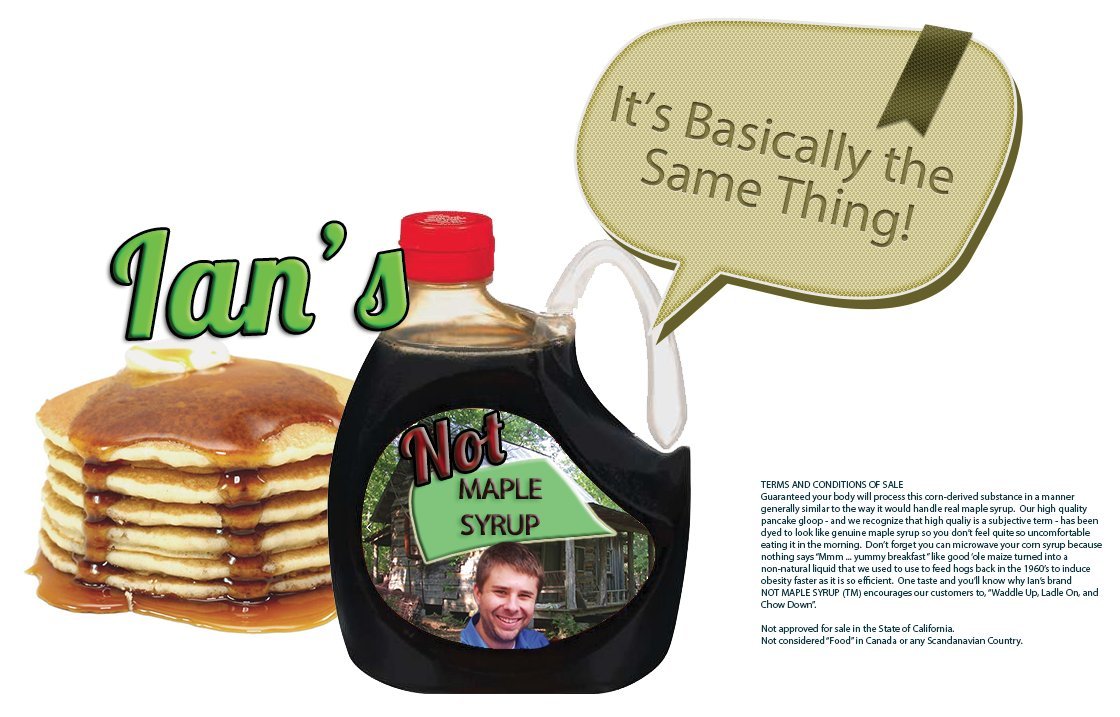 The problem? If we priced it cheaply enough, people would probably want to buy it. Then my inner investor would feel obligated to actually start selling it. We can’t have that.
I mean, doesn’t it bother anyone that Hershey’s doesn’t even sell chocolate in some of its candy, anymore? Milk Duds, Mr. Goodbar, Krackel, Hershey’s Kissables, and Whatchamacallit bars replaced the cocoa butter (you know, the actual stuff that makes chocolate real chocolate) with vegetable oil five years ago. Now it’s subtly been renamed “chocolate candy” since it isn’t even legally milk chocolate! As that article points out, if your favorite snack uses the words, “chocolate candy”, “made with chocolate”, or “chocolatey”, it’s not chocolate! They kept the package the same, hoping people wouldn’t notice and almost nobody did! Seriously, go ask your friends, family, and coworkers if they realize that a bunch of Hershey’s chocolate isn’t actually chocolate, anymore. I bet they don’t. I feel like Milton Hershey would be turning in his grave. This was a man who would purposely shrink the size of a Hershey’s bar to keep the quality consistent during times of high prices, expanding it during times of low prices, never adulterating his name. Part me rejoices in watching Lindt steamroll its way into the American market. I think they deserve to take the chocolate industry, but then again, I’m a purist.
Is it too much to ask that the United States at least meets Europe on its food standards? Half the cheese you see in poor and lower middle class grocery carts couldn’t even legally be sold as cheese – it would be “cheese product”.
Maybe it’s time for bed. I sound curmudgeonly but I’m actually in a great mood, just in awe that this situation continues not only unchecked, but getting worse. I also have now made myself crave a bit of real milk chocolate, which I have tucked away in the upstairs pantry … so … I might go sneak a few grams of it as a nighttime snack.
The whole thing reminds me of vanity sizing. If I could just take over the labeling laws in this country, everything could be fixed within 24 to 36 months. There are no standards. A size 32 or 40 pant should be the exact same at every retail shop in the same way 12 ounces is 12 ounces. A long while ago, Esquire looked at how bad it had become in the United States, with a totally unacceptable range based on the demographics of the retail chain itself (e.g., Old Navy caters to poorer, fatter shoppers, so a size 36 pant is really 41 inches while the opposite is true at H&M, where a size 36 pant is 37 inches). The same for women’s dress sizes; hat sizes. Then again, I’d probably force the country to the metric system since it is inherently superior. I wouldn’t rest until the United States rivaled Switzerland in our exacting standards of measurement.
Reader Comments (35)
Comments are presented chronologically, with replies indented beneath the comments to which they respond.
mikecrosby
September 11, 2014
Whoa! I didn't know any of this. And the maple syrup and chocolate. Excellent article.
Be careful though. If you read how that real beef, chicken and pork gets to your plate, you're liable to become vegetarian.
Tolstoy's birthday was yesterday. A few of his quotes:
"If a man's aspirations towards a righteous life are serious.. .if he earnestly and sincerely seeks a righteous life, his first act of abstinence is from animal food, because, not to mention the excitement of the passions produced by such food, it is plainly immoral, as it requires an act contrary to moral feeling, i. e., killing - and is called forth only by greed."
"It is horrible! It is not the suffering and the death of the animals that is horrible, but the fact that the man without any need for so doing crushes his lofty feeling of sympathy and mercy for living creatures and does violence to himself that he may be cruel. The first element of moral life is abstinence."
Tolstoy himself tells how he became a vegetarian :
"Not long ago I had a talk with a retired soldier," writes Tolstoy in Recollections and Essays, "and he was surprised at my assertion that it was a pity to kill animals for food, and said the usual things about its being ordained. But afterwards he agreed with me: 'Especially when they are quiet, tame cattle. They come, poor things trusting You. It is very pitiful.'
"Such a situation, is dreadful. Not the suffering and death of the animals, but that man suppresses in himself unnecessarily, the highest spiritual capacity - that of sympathy and pity towards living creatures - and by violating his own feelings, becomes cruel. And how deeply seated in the human heart is the injunction not to take life. But by the assertion that God ordained the slaughter of animals, and above all as a result of habit, people entirely lose their natural feeling
PARKER007
September 11, 2014
Replying to mikecrosby
Online jobs guys
I just got paid $8580 working off my computer this month. And if you think that's cool, my divorced? friend has twin toddlers and made over $9k her first month. It feels so good making so much money when other people have to work for so much less.
This is what I do--------warpjobs.Com
joe pierson
September 11, 2014
Replying to mikecrosby
Tolstoy didn't think this thing through, to survive something with parents has to be sacrificed, just the way it is on this planet.
Brendan
September 12, 2014
Replying to joe pierson
You can feed more people off an acre of land using plants, than you can using animals, since you lose a step in efficiency when using animals as an energy source. Maybe if we engineered a photosynthetic cow....
Tyler Phillips
September 11, 2014
Have you noticed the switch from Ice Cream to "Frozen Dessert" as well? I'm not sure if you have it in the States, but we do here in Canada. Even the expensive brands like Breyers and Nestlé are doing it.
Joshua Kennon
September 11, 2014
Replying to Tyler Phillips
Yep! That's another great example! Thank you!
There was an article about it in the New York Times. There is also a blog called Mouse Print that looks for this sort of thing - the tiny print hidden at the bottom of product offers, advertisements, food labels, etc. It's a great (though somewhat depressing) read. They put up pictures of the label difference for Breyer's when the former ice cream company converted many of its products to frozen dairy dessert.
I read something the other day - I have it saved around here somewhere - that we now live in a time where the affluent eat better than at any point in history; fresh vegetables, quality dairy, safe meat, more herbs and spices than our ancestors could have imagined, while at the same time, the poor have trained themselves, often unwittingly, to survive on frankenfoods that aren't even food in the traditional understanding of the word. They eat cheese product rather than cheese, frozen dairy dessert rather than ice cream, chocolate candy rather than chocolate, pancake syrup rather than maple syrup. It's just sad. As a lot of other people pointed out, the worst part is, the kids of the underclass are going to grow up and think that is how food should taste, developing a preference for it, not realizing how horrible it is. This is is no small way responsible for the obesity epidemic among the bottom 50% of society, which then has huge economic and health consequences. The whole thing is just ... sad isn't even the right word. I don't get it. If I ran an ice cream company, I would rather lose 30% of sales than lower the quality standard of my product because the sales will eventually come back, while you can't go back upstream after you've cheapened the brand.
Scott McCarthy
September 11, 2014
Replying to Joshua Kennon
Tell that to Luxottica. When they bought Ray-Ban from Bausch & Lomb, they stopped selling Ray-Bans for just long enough for existing retail inventories to sell off, and then immediately reintroduced the brand at 5x the price.
Joshua Kennon
September 11, 2014
Replying to Scott McCarthy
I find myself irrationally excited that you've provided an example that disproves the general rule, haha! That's a great counterpoint. Perhaps I should allude to Warren Buffett's quote on the matter, something like it can be "near impossible" or "very hard" to go back upstream. I'll change the wording. The qualifier makes all the difference, eh?
Funny things is, I don't remember Ray Ban ever being a cheap brand. They were practically non-existent when I was in junior high and high school, so I wonder if the secret to the relaunch was the fact it was practically a totally unknown label to a lot of younger people so it had no baggage or negative connotations of inferiority. That would be worth a case study. This seems like the sort of thing Harvard Review might have examined, I should probably look into it ...
Have an upvote and my thanks =)
Scott McCarthy
September 11, 2014
Replying to Joshua Kennon
Luxottica is quite possibly my favorite company in the world. I grew up learning about horizontal integration and vertical integration ... I always wondered "why not just do both?"
They actually do both! They sell you vision insurance, they own the optometrist you visit to get diagnosed, who then takes you into the retail shop they own where they sell you the frames they make - and they make nearly all the frames, too (prescription and non-prescription eye- and sunglasses). It's a beautiful, beautiful monopoly hidden in plain sight.
One of these days, they'll start making TVs or computer monitors that erode your vision quicker, or something. I love it.
As far as Ray-Ban specifically, they're Americana. Typing this out right now, the Ataris are singing Boys of Summer in my head, talking about Wayfarers. B&L did enough product placement over their ownership of the brand that it probably became Americana and nostalgia for many people. I mean seriously, go find a 1980s Tom Cruise movie where he's not wearing them (in fairness, I can only think of 2 1980s Tom Cruise movies, but he's got them in both Risky Business and Top Gun at least). And the fact that Luxottica also own Sunglass Hut (and basically every other retail chain...) means they don't get marked down if they sit on the shelf for a little bit.
Alex
September 11, 2014
Replying to Scott McCarthy
This is a good summary of the topic I remember watching weeks or months ago. https://www.youtube.com/watch?v=gDdq2rIqAlM. I have to give props to a monopoly so well constructed it gives consumers the illusion of choice.
Stephen H
August 7, 2015
Replying to Tyler Phillips
Tyler -
I know the DFC (or If I recall rather) made it clear that unless you are meeting the specific amounts of dairy/cream in your product you can't call it Ice Cream. Which I agree with. Companies are using the goodwill with the word while not even containing any actual cream. Not cool.
Rob
September 11, 2014
I was having a great morning until I read this and its actually something I noticed about a month ago (the maple syrup thing). I haven't had pancakes in quite some time but my fiancee wanted some so I ran to the store to grab batter and syrup...sadly it took me some time before I found a bottle marked 100% pure maple syrup. I had no idea there was a shift towards corn syrup.
I'm close to firing off an email to relatives in NH and VT asking them to tap maple trees in their backyard, bottling it, and sending it overnight to me in Texas. Although, sadly, I'd have to wait until next Feb/Mar when it's in season.
Austin from TX
September 11, 2014
Other annoying nominal measurements- In HVAC a 3 Ton unit is not necessarily 3 tons. I don't know the exact tolerance, but there would often be times I'd go against the competition and they would be providing a significantly smaller machine. This can have serious implications as the size of the units increase. A half ton difference can mean a world of problems if a unit is undersized and also over sized. I also recently learned that most shingle manufacturers short change consumers as well. They are sold in "squares" that are reported at 100 square feet. Unfortunately, all but two (that I know of) sell a full 100 square feet. When laid out on flat ground and measured, they usually come up to around 96 feet. With material costs being 60% of the roof, that 4% is not immaterial. One of our customers calculated that he has "lost" 275,000 dollars over his roofing career by using brands that don't produce a full square.
Exquisite Decay
September 11, 2014
I have known about the maple syrup substitute but not the chocolate. I would not be surprised that most people don't really think about the difference in words and would think it is just marketing and not that there is a legal reason for the difference in words.
Regarding meat: Just as bad is all the water/saline solution that is pumped into a lot of the meat these days. It is hard to get meat to brown; it just turns grey and throws off a lot of water. I have had to adjust the added liquid in some recipes because the meat gives off so much water.
innerscorecard
September 11, 2014
At least it's way better than China, where there's a high chance the food is literally poison.
Sigh. Can't wait to get back to the US, where even people making minimum wage can buy healthy and sometimes even organic food. Living in China - and earning an "ordinary" professional salary, not some huge expat package - has made me realize how good all Americans have it.
Andrew
September 11, 2014
Thanks for discussing this Joshua! I'm totally with you on this one. I disagree with Ian that all children would realize they aren't actually having maple syrup. You call this stuff "maple syrup" in everyday life. Even the fact they color the corn syrup is so misleading. They should have a label saying "corn syrup dyed a caramel color".
I'd consider myself fairly intelligent, went to a top college, and it still took me until my early 20s before someone opened my eyes to this.
It's amazing how far down this rabbit hole goes. Some other examples:
Atlantic (farmed) salmon isn't actually red due to a diet of corn. The salmon is dyed red, which is why it's a pink color instead of the deep red of wild salmon.
In Canada, some cartons of milk are labeled as Dairy Product (instead of mentioning milk). So you aren't even buying milk but some cheaper milk derived product. I was shocked to find one of these cartons in my own fridge after reading about this! They look identical and are placed right beside the real milk.
Also have you ever wondered why pure orange juice from Tropicana tastes identical? It turns out they remove all the flavor and then use a "flavor pack" to flavor the orange juice. But they don't have to label this even due to a loophole. See: http://www.foodrenegade.com/secret-ingredient-your-orange-juice/
I was shocked by this as I had been paying extra for this orange juice for years.
The chocolate one is new to me, but unsurprising considering how chocolate tastes so much different in Europe. I will have to watch out for this now.
The sad part is this behavior is incentivized due to increased profits and the old-school producers will suffer in sales volume due to their necessarily higher price.
One solution might be adding a specific label saying "unprocessed/whole food" which means that no dyes, no additives, flavor packs, meat glue, or anything can be used. Just the actual food that an ordinary person would assume to be in that packaging.
Joshua Kennon
September 11, 2014
I didn't know about dairy product. Wow. That one bothers me more than the others for some reason.
Funnily enough, I was talking about the orange juice thing a few days ago with the person who has cut my hair since I was a teenager. That one presents a real conundrum I don't know how to solve. People demand orange juice when it's not in season. The only way to store it safely, economically, and with as little change as possible is to vacuum it, which removes the flavor. The only way to add the flavor back is with the additives you mentioned.
If an orange juice company refused to do this, they would only be able to sell orange juice for part of the year. Consumers, though, get in the habit of buying their regular orange juice, which means in very short order, the company that insisted on staying pure would find itself losing most of its market share to the rival who provided orange juice throughout the year. Even when it came back into season, few people would bother to switch over to it short of psychological conditioning (e.g., a huge ad campaign selling folks on the superiority of the product and basically denigrating everything else as trash, which would then cause an all-out war among some deep pocketed food conglomerates). I cannot find a way to avoid it no matter which way I look at the business model. People want orange juice in December. They expect it as a matter-of-course.
It's the one industry where I don't think there is a solution given how in demand it is. I've thought about it off and on for probably a year or two, and I can't make the numbers work by using fresh orange juice alone. It's the only one where I go, "Okay, I understand ... but I still don't like it." I want to find a solution but it eludes me at the moment. It's so frustrating.
Gilvus
September 14, 2014
Replying to Joshua Kennon
Here's a solution.
Wait, you wanted a practical, cost-effective solution? I got nothing.
Jason
September 11, 2014
Why not mention MARS INC.?
They have held true to their values to keep their M&M's, Snickers, Milky Way & Twix Bars intact with REAL chocolate in time of difficulty.
Anon
September 11, 2014
Whole Foods
Rob
September 11, 2014
Just finished watching the documentary 'Fed Up.' Definitely worth the 90 minutes and very apropos to this post/discussion
joespr
September 11, 2014
I sure am glad (1) I no longer eat meat, for many years... and (2) do not eat candy, for many years.
Chris
September 12, 2014
The reason these foods are reformulated has to do with the availability of raw materials. Maple syrup is a perfect example. It takes decades for maple trees to be planted and then be mature enough to be tapped. Population growth in the US and exports to other countries create increase demand that cannot be met by quickly planting more trees. People still want maple flavored syrup on their pancakes so a product is created to meet those needs. Maple flavored corn syrup is the result. I'm 35 and as far back as I can remember our family has regularly used maple flavored (corn) syrup on pancakes. It was a real treat when we did get real maple syrup. The change to maple flavored syrup is akin to the post Joshua made about orange juice.
I have never understood why people want technology and advancement to improve their lives but look at advancements in food in such a negative way. Growing population and shrinking natural resources are going to create more changes like "chocolate candy" and "frozen dessert." For instance, the change in ice cream to frozen dessert is likely due to butter prices being at an all time high.
Obesity is due to poor math not processed foods. If you consume more calories than you burn, you will gain weight. It doesn't matter if you consume 3000 calories of organic, natural, whole foods or 3000 calories of processed junk, if you only burn 1500 calories during the day you will gain weight.
Kevin
September 12, 2014
Replying to Chris
I would suspect it is a hell of a lot easier to eat 3000 calories of processed junk by accident than it is natural foods, as the processed junk generally contains a far higher proportion of sugar (often in the form of HFCS) than natural foods. Of course, in the case of maple syrup or such like, no one really expects it to be a major dietary component, or anything other than a load of sugar. Here, it's more a matter of taste for the discerning customer.
It's when this stuff finds its way into places where it's not expected, and many people don't realise it's there - bread, cereal, yoghurt, pasta sauce and so on - that it causes a problem. Also, the large amount of sugar added to some of these things plays havoc with your insulin levels, sending them up and then crashing back down - which makes you feel hungry again, in a way you wouldn't if you had eaten a similar meal without the added sugar.
If you want a technological solution, there is actually a real, genuine, affordable alternative to adding this extra sugar to make poor quality ingredients taste good, which has been in existence for around 100 years and has never had a credible scientific study attribute any ill-effects to it. It's the flavour enhancer monosodium glutamate (MSG), and unfortunately it has been mistakenly demonised for decades. Try it yourself if you're curious, it's almost magical the way it brings out flavours in otherwise bland foods.
Brendan
September 12, 2014
Thanks for the article. Honey is another one of those things to beware of when you buy it, because many brands are either high fructose corn syrup (HFCS) or are stretched with it to create a cheaper product. Nutritionally, Honey and HFCS are nearly the same, but I buy honey for the same reason one buys maple syrup...for the taste. I was a bit surprised to read about the Hershey cocoa-less "chocolate" though.
Brendan
September 12, 2014
I just wish they weren't Whole Paycheck.
Anon
September 12, 2014
Replying to Brendan
They are not. I will never understand why people say that.
Brendan
September 12, 2014
Replying to Anon
I know its an image they are trying to change, but I worked adjacent to a WF in Alexandria VA and while the food was of good quality, it was very expensive. I used to go to them exclusively for fish and in season fruits that were on sale...but we simply couldnt justify paying a premium for most other food staples like beans, rice, veggies, and dairy.
Anon
September 13, 2014
Replying to Brendan
http://thebillfold.com/2012/04/is-whole-foods-really-that-more-expensive/
http://www.today.com/money/cheapism-25-things-are-cheaper-whole-foods-2D79503107
http://www.mothernurturedenver.com/2011/06/is-whole-foods-really-more-expensive-and-other-grocery-store-findings%E2%80%A6/
============================
Also, let me help you out with justifying shopping at Whole Foods. Think of it like this... if you have or intend to have children, feeding them Whole Foods will reduce the chances of them becoming mutants and experiencing poor health.
Is it worth saving 10-15% off your grocery bill if it means your daughter hits puberty at 10 years of age?
Is it worth saving 10-15% off your grocery bill if it means your child might be born with a birth defect?
Lastly, let me tell you the truth about "Whole Paycheck."
It's only whole paycheck to commoners with sloppy impulse control. Whole Foods stocks the best groceries out there and the commoners go hog wild and load up their tiny shopping carts and thus the bill is higher.
But most importantly, it takes the commoners more Whole Foods groceries (sans filler and glue at the like) to fill up their fat bellies.
The commoners would rather spend $4.00 on a product that is 75% animal and 25% filler and weighs 1 pound than spend $4.25 on 100% animal but only 0.75 pounds.
The commoners don't feel they're getting good value for their money because their fat bellies don't get full as fast. The poor bastards are still hungry. Instead they must spend an extra buck or so on top of the $4.25 to get that extra 0.25 pounds of product in their fat bellies.
Steven
September 16, 2014
Replying to Anon
Referring to people as 'commoners' doesn't garner much respect for your argument - no matter its merits!
Anon
September 17, 2014
Replying to Steven
I know, I know...
It was either that or "the 99%" (just kidding).
Connelly Barnes
September 29, 2014
Replying to Anon
I hate the local Whole Foods because everything is outrageously pricey (Charlottesville, VA). I didn't mind the one in Boston though. Maybe they mark up prices a lot for affluent neighborhoods?
Brendan
September 12, 2014
Excellent points. I've found, as most people do over time, that by and large you get what you pay for. I really don't like having more regulation, but I also don't like having to do the equivalent of a research paper when I go to the grocery store where extensive and careful reading of labels are required to make sure I'm getting real milk, real steak/chicken/fish, real cheese...etc.
No surprise to any of us, but its quantity instead of quality in 2014.
Connelly Barnes
September 29, 2014
Replying to Brendan
I find it hard to choose foods without corn syrup or other additives at many grocery stores. Now I only shop at grocery stores where the probability of getting foods without corn syrup, maltodextrin, or obscure ingredients is pretty low. Currently I mainly go to Trader Joe's. It's not perfect but I read all the ingredients, and research these things occasionally. So the probability of having bad ingredients is fairly low, to the point where I don't spend too much energy on trying to avoid crap when shopping.
I figure if a grocery store wants to sell "food items" with 50 long ingredient list, corn syrup, etc, then the store itself is to blame, due to selecting for bad food quality. The store then is wasting my limited time and cognitive budget by filling the shelves with harmful junk. Therefore I avoid such stores. I don't think it's really reasonable to shop at a store that sells 50% rat poison labelled as food, and 50% food.
I was aware of the maple syrup problem, but it's good to know about "chocolate candy," "dairy product," "frozen dessert," etc also.
Connelly Barnes
September 29, 2014
What a cool company! I didn't realize they owned all those famous glasses brands. Thanks for the video on Luxottica.