

It is January 15th, 1919. You’re in Boston, Massachusetts shortly before lunchtime. Sitting at 529 Commercial Street is a three-year old tanker owned by the Purity Distilling Company, a subsidiary of United States Industrial Alcohol. At 50 feet high, housed within the steel body of this five-story behemoth is 26,000,000 pounds of sticky, sweet molasses; one of the most popular sweeteners used in North America. The 2,300,000 estimated gallons of confectionary goodness mysteriously oozes from the container sides of the container to the point that families fill bottles to take home for personal use and children make their own candy, apparently not being concerned enough to question the implications of the bounty.1
[mainbodyad]
At half past noon, you hear a “dull, muffled roar” [pdf]. Then, it happens. Structural integrity fails. The top of the tank blows sky-high. The contents rush out at 35 miles per hour, destroying anything and everything in its wake. The torrent of sweetener reaches an estimated 25 feet high at its apex before falling to 15 feet, a veritable tsunami of sugar tearing entire a building off its foundation, crushing children to death beneath train cars, and throwing grown men like rag-dolls. Blood is everywhere. Unable to escape, horses struggle in vain against the liquid goo that now pulls them to their death; sucrose turned to quicksand. It’s total chaos, screams filling the air. By the time it all over, 150 people are injured, 21 dead. An entire section of one of America’s largest cities is leveled as if a bomb had been detonated. Some victims are buried so deeply it will take more than half a year, and 87,000 man hours2, to recover them from their now-entombed candy graves. The country wouldn’t see an engineering failure quite like it for another half-century when the Kansas City Hyatt Regency disaster changed the rules of modern architecture.
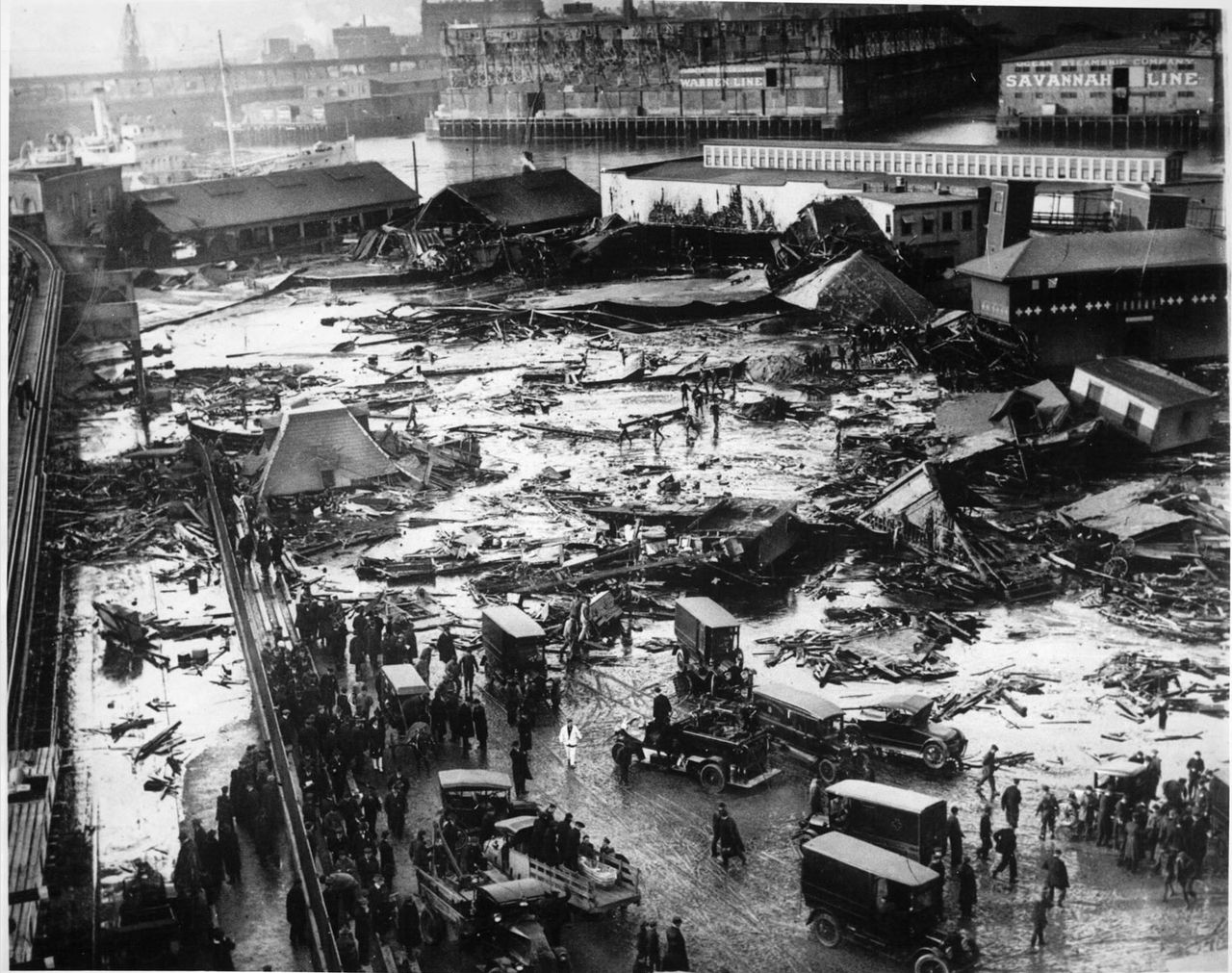
Aftermath of The Great Boston Molasses Flood Disaster of 1919, Globe Newspaper Co. (Boston Public Library)
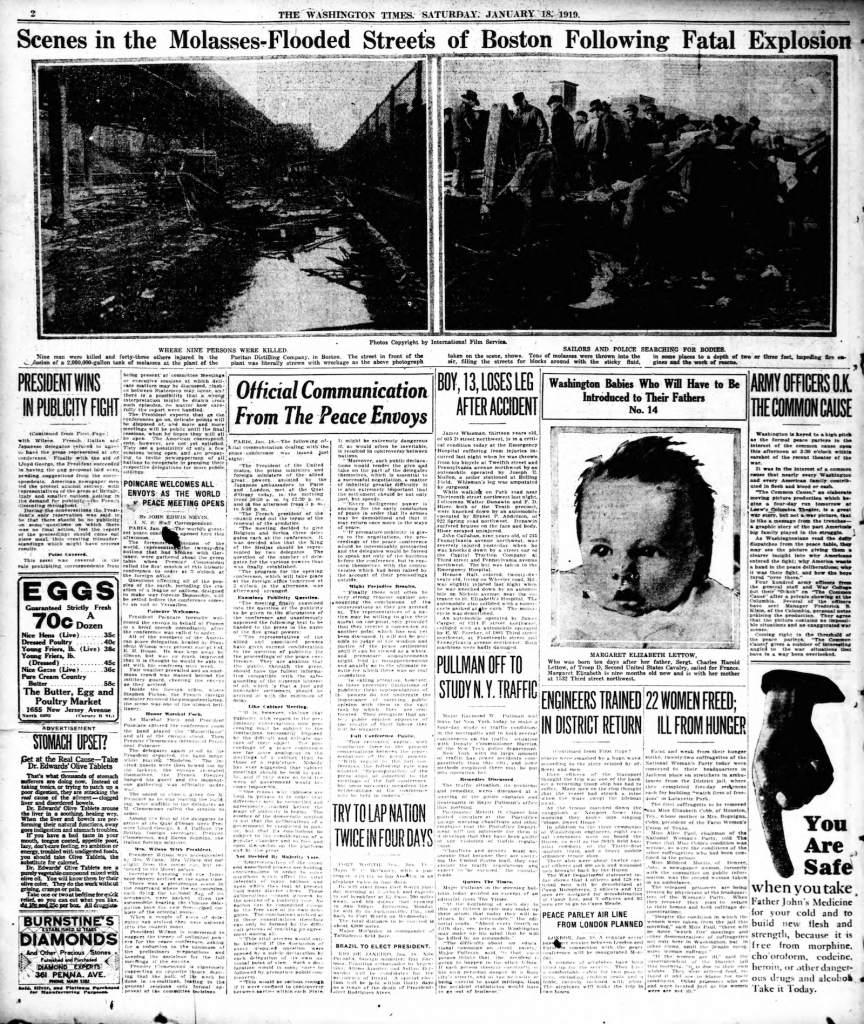
The Great Boston Molasses Flood was news around the country following the disaster …
By the time it was all over, in addition to the lives lost, inflation-adjusted property damage exceeded $110,000,000. The legal battle turned into one of the longest running court conflicts in American history with those deemed responsible ultimately paying out less than $12,000,000 in inflation-adjusted damages.
There is a lot of wisdom we can extract from The Great Boston Molasses Flood of 1919; lessons that can help us live better personal lives, protect our livelihoods, and keep the community more secure.
1. Don’t Cut Corners on the Important Stuff If You Want to Avoid Wipeout Risk
The entire molasses disaster happened because of a combination of impatience and attempting to save a few pennies. The tanker was built at an inflation-adjusted cost of $700,000. It was completed only a few days prior to the shipment of molasses arriving so the builders never tested it with seawater as the owner wanted to avoid paying to store the sugar in third-party facilities. Had they paid the relatively insignificant storage costs while the construction team checked the structural integrity, they would have ended up saving millions upon millions of dollars in purchasing power equivalent while simultaneously keeping their friends, workers, and fellow citizens alive and unharmed.
[mainbodyad]
I once had lunch in New Jersey with a man who built an insurance brokerage business that produced seven-figures a year in income for his family. To save on costs, he had no internal audit mechanism, preferring to attempt to do everything himself. One day, he woke up to discover a trusted employee had embezzled all of the firm’s cash, forged the bank documents, and there was no money, anywhere. This otherwise highly profitable enterprise, which could have survived just fine, was forced into liquidation. He was ruined. After many years, he rebuilt from nothing and once again reached the seven-figure per annum income mark, but he would never try to build a firm, again, as the experience left him bitter. A few thousand dollars a year in fees to a third-party independent auditor could have saved him tens of millions of dollars in foregone net worth that now exists in somebody else’s hands.
2. Bad Decisions Often Accrue Until They Result In Instant Catastrophe or Disaster with Little or No Graduation
The people of Boston walked past this container filled with molasses year after year. Each day, it was growing weaker. Every night, it was inching closer and closer to destruction. The corners that were cut during its construction no doubt faded in the minds of the people who built it; “it’s worked just fine all this time, why worry?” was likely their refrain. The universe didn’t care. Those bad decisions were accruing, building upon themselves. It was a case of physics; action and reaction, cause and effect.
For almost fifteen years, I’ve written in one form or another about how every decision you make will get you one stop closer to, or further away from, your goals; the person you want to become. With few exceptions, how you invest your two buckets is your destiny. To put it within the nomenclature of Charlie Munger’s writings, a big part of success is figuring out how to set off upward virtuous spirals, where all these good decisions start paying dividends, creating effects that feed upon themselves, paying their own dividends until you get lollapalooza. Simultaneously, you have to avoid vicious whirlpools; downward spirals where bad decisions create their own negative dividends that spur their own additional costs until you get negative utility lollapalooza. (It’s best to avoid the latter altogether because breaking them, while frequently possible, can be a Herculean task.)
What isn’t said very often is that when those payouts come – good and bad – they often arrive instantaneously, not in degrees of gradation. In the film, music, and business worlds, this phenomenon is joked about as the “overnight success that took a decade”. (Mistakingly believing that gradation always exists in a given situation is a cognitive error that shows up in all sorts of places; e.g., it is a well-known misconception for inexperienced investors to assume that if an asset is at $100 and it goes to $20 in an economic or market crash, he or she will have an opportunity to sell between $99 and $21. This is not true. The bid can, and often does, automatically reset at the lower price instantaneously with the middle numbers never being on the table. In other words, if you hold a stock at $100 per share and put sell order in at $50 per share, you very well could wake up to find the stock at $20 per share without your sell order having ever been triggered and/or your shares liquidated at $20 per share, depending upon how you structured the trade. There was never an opportunity to exit between the two numbers.)
If you’ve made bad decisions in your life that are currently still present, fix them now. Make it your highest priority. There is this general illusion that you’ll get to it someday when it is worthy of your time. That’s not how the world works. The molasses tank didn’t slowly start collapsing and gently ooze out of its boundaries. Rather, it built up over time until in one spectacular explosion, tearing asunder everything in its path.
- People go years building up credit card debt, slowly adding to their liabilities until one day they find that their payment is barely covering the interest alone.
- People go years ignoring their kids, putting other things first until they one day they discover their children have no time for them, the relationship non-existent.
- People go years neglecting or abusing their spouse, taking for granted that he or she will always be there until one day they find an empty closet and a note on the nightstand.
- People go years slowly putting on weight, a few pounds here, letting their waistline creep up until one day they fall over with a massive heart attack and die or find themselves in a doctors office diagnosed with diabetes.
- People go years without making small repairs in their home only to find that what were once easily fixable problems now require major corrective renovations.
- People go years taking their clients or customers for granted, offering sub-par service, and believing they’ll always be the only game in town to wake up and watch sales fall 80% in a matter of months when a better alternative comes along.
Maintenance is easier than course correction. Maintenance is cheaper in time, energy, and resource outlay than course correction. Fix the neglect in your life and then maintain or improve so you don’t wake up to catastrophe that could have been prevented.
3. Be Vigilant Because You Can Do Everything Right and Get Wiped Out Due to Someone Else’s Stupidity.
Pay attention to proximity and watch out for exposure to the mistakes of those surrounding you. If you had owned a shop across the street, you’d have lost everything, if not your life, because of someone else’s mistake. Had you seen the molasses tank leaking, and heard the “ominous grumbles” that were occurring from within prior to the disaster, you should have taken action. Move your business. Bring it to light so it can be corrected. Don’t just stand by and say, “Not my problem” because it very well could turn into your problem. Life is not always fair. The biggest defense you have is your own vigilance.
Do you have friends fond of keeping cocaine sitting out on their living room table? Family members who are felons but still carry a non-registered gun in their glove box? An Ivy League roommate who steals small items when the opportunity presents itself despite having no need for them? Colleagues who are constantly cheating on their wives? Extricate yourself from the situation and remove them from orbit. Their behavior will spill over into your own life, either directly or collaterally in the form of damage to your reputation capital via mere association.
4. Take Solace in the Fact That This Too Shall Pass
It’s sometimes hard to see the light at the end of the tunnel when you’re in the midst of personal or business disaster. Mercifully, things usually work out if you can manage to survive long enough. Start by making it through the day. Focus on doing the most intelligent things you can. Little by little, step by step, you make progress. It may be slow going at first, but recovery happens. There was a time when nearly every man, woman, and child in the United States knew of The Great Boston Molasses Flood of 1919 but outside of certain parts of the East Coast, the tale has largely been forgotten; a memory as distant and dream-like as the night black Wall Street burned to the ground. There’s comfort in that.
You might be staring down the barrel of a bankruptcy filing, a divorce, a health crisis, or some other disaster because you didn’t heed the earlier advice in time. Push through. Be productive, appreciate the good and know that time erases a lot.
Footnotes
1, 2 Source: History Today, A Sticky Tragedy: The Boston Molasses Disaster.
To learn more about the disaster, check out Dark Tide: The Great Boston Molasses Flood of 1919 by Stephen Puleo.
Reader Comments (12)
Comments are presented chronologically, with replies indented beneath the comments to which they respond.
Niket Dhruv
June 13, 2015
We had a similar National Tragedy / Disaster in India. The Bhopal Gas Tragedy, where The chemical, methyl isocyanate (MIC), that spilled out from Union Carbide India Ltd’s (UCIL’s) pesticide factory turned the city into a vast gas chamber.
It resulted into death of atleast 15,000 and the effect has ruined the health of generations thereafter.
A huge lesson can similarly be learn from it as you mentioned in the instances above.
Few Links to the Tragedy :
http://www.downtoearth.org.in/content/30-years-bhopal-gas-tragedy-continuing-disaster
https://en.wikipedia.org/wiki/Bhopal_disaster
Joshua Myers
June 13, 2015
Does anyone have any personal examples of "Overnight success ten years in the making?"
This might be a good place to share.
Gilvus
June 13, 2015
Replying to Joshua Myers
I doubt you'd find many humblebrags in a community of stealth wealthers and information asymmetry adherents. However, if you look at any famous person who is successful because of their prodigious skill, you'll most likely see that their talents were assembled, piecemeal and unglamorously, for tens of thousands of hours before their "overnight success." Some examples:
- Mark Zuckerberg hand-built apps for years before he started Facebook.
- Lady Gaga began playing piano at the age of four.
- Bill Gates spent years as a gauche high school student bashing his forehead against a keyboard before starting Microsoft.
- Warren Buffett was a shrewd, talented investor for half a century before he became a household name. He was more of an "overnight success fifty years in the making."
- You have to look no farther than the author of this blog himself. He was Scrooge-McDucking at ten years old. It wasn't until 10+ years later that he finally "made it."
"Overnight success ten years in the making" is another way of saying "luck is what happens when preparation meets opportunity." So...be prepared.
Mr.owenr
June 14, 2015
Replying to Gilvus
Long live the King! Scar, my only childhood hero.
This whole business of instant success or destruction reminds me of my job hunting. One small good decision, fix a resume, make a phone call, hand in an application, done over and over for the last 6 months. Then bam an interview! Maybe even bam a job!
Or maybe even brushing your teeth. One little bitty decision not to brush your teeth every single day over 30 years, and then BAM! in your face cavities.
Gilvus
June 13, 2015
One of the things I appreciate most about your writing is the extraction of common-sense lessons from every corner of the physical and virtual universe. None of the "here's one smart trick that will benefit you in some vague way!" type of sensationalized nonsense. Just "here's how to not be stupid in concrete, precise terms."
Wisdom in its purest form.
Bill Larson
June 17, 2015
Good stuff - enjoyed reading as usual.
FratMan
June 23, 2015
I think the Supreme Court will call bans on gay marriage unconstitutional by the end of the month. What is your prediction for the Obamacare subsidies?
Joshua Kennon
June 23, 2015
Replying to FratMan
I am literally, right now, writing about the Horne et al. v. Department of Agriculture decision involving the seizure of raisins. I'm so freaking excited about how it turned out in the end! It's a huge win for property rights against the government (and, hopefully, will also make civil forfeiture for law enforcement weaker as they have been horrifically abused in recent years with innocent people not getting their cash or property returned). Now, we just need Wickard v. Filburn overturned as I consider it one of the most fundamentally evil precedents ever handed down even though I understand the economic justification for it; the idea that a free man, living on property he owns, using his own labor, can be forbidden by law to grow food for his own personal, family consumption without any attempt to sell it because it removes him from the consumer markets and hurts other farmers seems ... I don't even have a word for it. It goes to the very core of human evolution, the concept of freedom, the nature of Earth itself. It's just ... wrong.
As for the health care subsidies: I normally feel fairly confident in how the court is going to rule on certain issues. When the first Obamacare ruling came around, I was one of only a handful of people who predicted Roberts would try to play Solomon and do a technical dodge through the tax code because I understood his psychology profile, his values, the incentive systems working on him. In this case, I don't have a clue what is going to happen. I have no idea what he's thinking, what he wants to accomplish, or what his values are as it pertains to the bigger picture (which is what interests him - he's always moving chess pieces on a board in a grander agenda than the specific case in front of him).
If the subsidies are removed and not patched somehow through Congressional action, it will hurt certain parts of the healthcare industry as billions of dollars are lost in sales and profits. In the long-run, I'm not sure it will matter. I think we're going to end up on a Canadian-style single payer system. How we get there, I don't know, but that's the end game. What we have now is not sustainable either economically or politically.
Re: The Marriage cases. The single biggest question is going to be whether the court uses this case as an opportunity to apply heightened scrutiny or whether they put that off for 3-5 years down the road. (One reporter described it perfectly: If marriage equality is the battle, heightened scrutiny is the war. Everything falls in the face of heightened scrutiny.)
Everybody knows it's inevitably coming, it's just a matter of when. The reality is - and the justices even discussed this during oral arguments with the government acknowledging the fact that it is probably unavoidable at some point - institutions will be required to treat marital status and sexual orientation as they do race or gender because there is no rational objection a person can articulate that justifies opposition. That means religious schools that ban gay students or children of gay parents won't be able to enjoy tax exempt status (they can believe whatever they want, they just can't expect everyone else to subsidize their hatefulness). It will be taken away unless they change their policies, as it was in the Bob Jones University situation when the religious school wouldn't permit interracial dating due to believing, as a deeply held, multi-century established core conviction that it was a sin. You want to discriminate? You have to be like Augusta, the famous club in Georgia that wouldn't let black members in until the 1990's; that would let Tiger Woods play on their course but never join their ranks for much of his career. Pay for it all yourself, as private property.
If you forced me to guess, I'd say they don't apply heightened scrutiny, yet, and Roberts joins in a broader, narrower decision that effectively removes the gender restrictions on some technical ground (he's probably going to pull a sly technical maneuver, too, and close the door to polygamy by saying something like, "You are restricting marriage rights based on a person's gender, which is unconstitutional under existing equal protection since you would grant it to them if they had the opposite genitals." Doing so kills any slippery slope argument, allows polygamy bans to stay in place as perfectly constitutional, and sidesteps temporarily issues such as private religious discrimination until the demographics make it effortless to do what needs to be done.
This approach would cause the last 13 states where it isn't legal to fall in line with the majority of the country and standardizes the law. People get used to having coworkers, friends, and family members who are married, raising kids, etc. while, simultaneously, "generational turnover" (which is really politically correct speech for "old people dying") works its demographic magic. Within a decade, you have a situation where a super, super majority of the country thinks anyone who opposes equal rights for gays is as fundamentally evil as the white supremacists; an absolute social, personal, and professional deal breaker that will destroy your life and livelihood. (In some parts of the country, we're already there.)
At that point, it the appellate courts will keep reiterating heightened scrutiny in a series of cases, just as one did in the Abbott Labs case where it wouldn't let jury members be screened by sexual orientation. The case that makes it up to the Supreme Court and wins the final victory will be something like a challenge to the recent anti-gay law Michigan passed quietly; the law that that allows religious groups to take taxpayer subsidies to run adoption agencies that explicitly ban married gay couples from using their services as if it were something straight out of the South's segregation era playbook. (Even though Aaron and I are going the biological route so it doesn't effect us, the animus of these people is so far beyond irrational, it's deranged because they would rather have a child sitting in an orphanage, alone, or being bounced from foster home to foster home than become our son or daughter. The disregard they have for the well-being of the kids is almost borderline sociopathic. And worse, they'll probably scream "religious persecution" when the courts tell them they can't use our money to discriminate against us! The entitlement is just crazy.)
Who knows, though? Kennedy might go for the gold and deliver the most famous decision of his lifetime, which puts him in the history books and effectively ends all sexual orientation discrimination, on par with Brown v. Board of Education. Stranger things have happened.
In the event they defy all expectations and decide against marriage equality ... it would be chaos. Utter chaos. Aaron and I were very calculating in that we chose to get married in a state where the ruling was based in local law, not Federal court, so it would be impossible to undo. Regardless, we'd jump ship ASAP. I'd probably never return to Missouri, even to visit family, for the rest of my life as I'd not want to give them a damn penny even in the form of sales tax. The house would be on the market, the businesses re-domiciled. We'd either run for the Illinois border or get on a plane and go to California (the former is more likely as the law recognizing marriage equality came from the state legislature, and was signed by the governor, making it rock-solid and beyond dispute). It'd happen within a matter of weeks, too, even if it meant we rented some tiny apartment somewhere while we figured out what the heck we wanted to do or where we wanted to live.
Kapitalust
June 26, 2015
Replying to Joshua Kennon
I'm sure you've already know this, but... US Supreme Court rules gay marriage is legal nationwide!!!
And just like you predicted with Justice Kennedy going for the gold!
Joshua Kennon
June 26, 2015
Replying to Kapitalust
I am speechless by the breadth and expansiveness of the ruling. The majority went straight-up across-the-board, Loving v. Virginia, immutable characteristic, 14th amendment equal protection guarantee, no-possible-rational-opposition-under-the-law-other-than-bigotry. It even clarifies that marriage must be offered on equal terms, referencing the right to determine family status, including raising children.
It was a total, complete, unrestrained victory that will all but guarantee any form of discrimination based on sexual-orientation is dead-on-arrival; equivalent to laws targeting racial minorities with nothing like this seen since the 1960's. Kennedy went outright Earl Warren, guaranteeing himself a place in the history books.
I'm ... a bit overwhelmed and unable to put my feelings into words.
Kapitalust
June 26, 2015
Replying to Joshua Kennon
Right after posting that I went and woke my wife up and told her that one of the most important US Supreme Court rulings of our generation just occurred today. We are both so happy. It gives me shivers just typing this.
Gilvus
June 26, 2015
Replying to Joshua Kennon
You don't have to.