

Is It Moral for Society to Protect Spendthrift Trust Assets from Tort Claims?
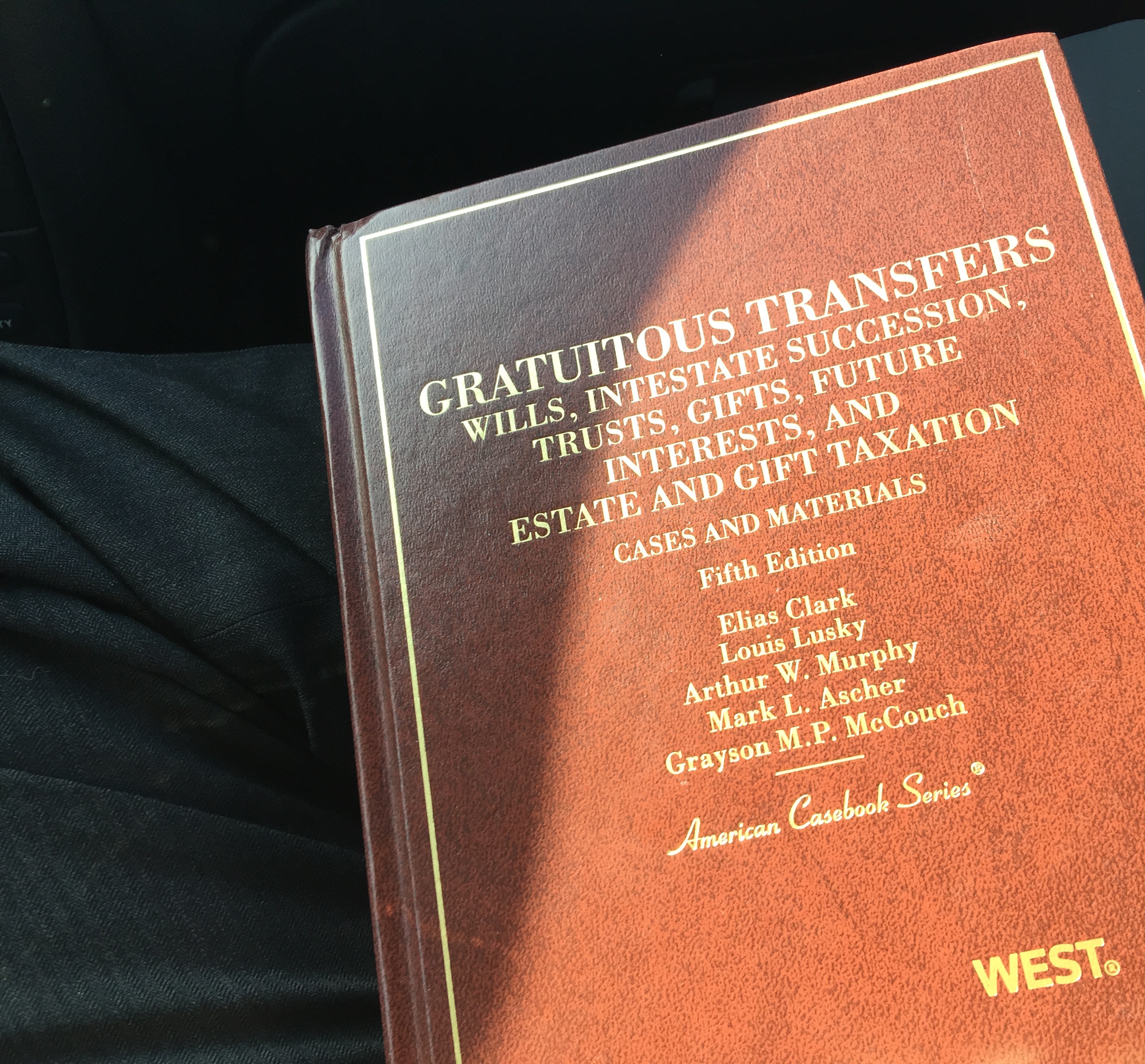
I told you two nights ago, in a post about digital price tags and retailing, that one of my cousins was getting married yesterday. On the drive to the ceremony, I was reading a book I bought sometime in the past few months (I can’t remember when or where I purchased it – it just showed up and was in one of the boxes that routinely pile up as I find things interesting I want to study and figure I’ll get to them someday). It’s called Gratuitous Transfers: Wills, Intestate Succession, Trusts, Gifts, Future Interests, and Estate and Gift Taxation Cases and Materials. It’s fantastic reading material to the point I’m having a hard time putting it down.
One of the things that has stuck with me, and I’ve been contemplating for the past twenty-four hours, is the passage on alienability of beneficiary’s interest, particularly as in regard to spendthrift trusts. Many of you do now, or will at some point in the future, have an interest in using spendthrift trusts given your demographics. The problem I’m having is coming to a conclusion as to the morality of tort claims against them. Should there be a public policy exclusion? I can’t decide. I might have to throw it on my “too hard” pile.
Let me backup for a moment.
In case you’ve forgotten: In plain English, a spendthrift trust is a type of trust fund in which you can place assets for the benefit of some third party, most commonly your children, grandchildren, nieces, nephews, friends, husband, or wife, that prohibits the person benefiting from the income and assets (the beneficiary) from touching the money itself, selling the right to the income stream, taking on debt against it, or in any way encumbering that flow of money since they don’t, technically, own it. For example, you could leave your three kids $10,000,000 worth of Coca-Cola stock, saying they are only entitled to the annual dividend income (in this case, $300,000 per annum), but can never sell or borrow against either the shares themselves or the future right to receive the dividend stream. Then, when your kids die, all of the money gets distributed to your ten grandchildren. That way, even if one of your kids turns out to be a bum, they aren’t homeless and the wealth still stays in the family tree, waiting to be passed on to the third generation.
The courts in the United States have generally, but not always, found that creditors are out of luck when they try to go after the money in a spendthrift trust because they never should have relied on it when extending credit in the first place. This protects the intention of the person who made the gift to the trust, ensuring their money is spent how they wanted it spent (e.g., paying for college, covering the rent, providing a grocery budget, establishing a regular clothing and automobile budget, et cetera). After all, if Great Aunt Bertie had known you were going to run up medical debt, she wouldn’t have gifted you money outright just so the hospital can turn around and take it. Instead, she would have paid your mortgage, bought you a car, or kept your pantry stocked with food. The spendthrift trust is acting in her place. It is not your money. It was never your money. If it weren’t you benefiting from the money, she never would have made the gift.
This can lead to ugly, seemingly unjust situations. On page 511, the textbook goes into the case of Sligh v. First National Bank of Holmes County, ultimately heard by the Supreme Court of Mississippi in 1997. The facts are laid out in the tome as follows:
On January 30, 1993, William B. Sligh was involved in an automobile accident with Gene A. Lorance, an uninsured motorist who was operating a vehicle while intoxicated. As a result, Will Slight suffered a broken spine and resulting paralysis, including loss of the use of both legs, loss of all sexual functions and loss of the ability to control bowel and urinary functions. Lorance was convicted of the felony of driving under the influence and causing bodily injury to another, for which he was sentenced to serve ten years, with six years suspended, in the custody of the Mississippi Department of Corrections.
Lorance had no real assets of which to speak but he was the lifetime beneficiary of two trusts, which “each have two remaindermen, Virginia Tate and William C. Bardin”. Meaning when Lorance died, the property that had been providing him dividends, interest, rents, and other passive income would actually be inherited by the other two people. The trusts were established by Lorance’s mother, and the courts interpreted them as having spendthrift protections based upon the intent at the time the were settled.
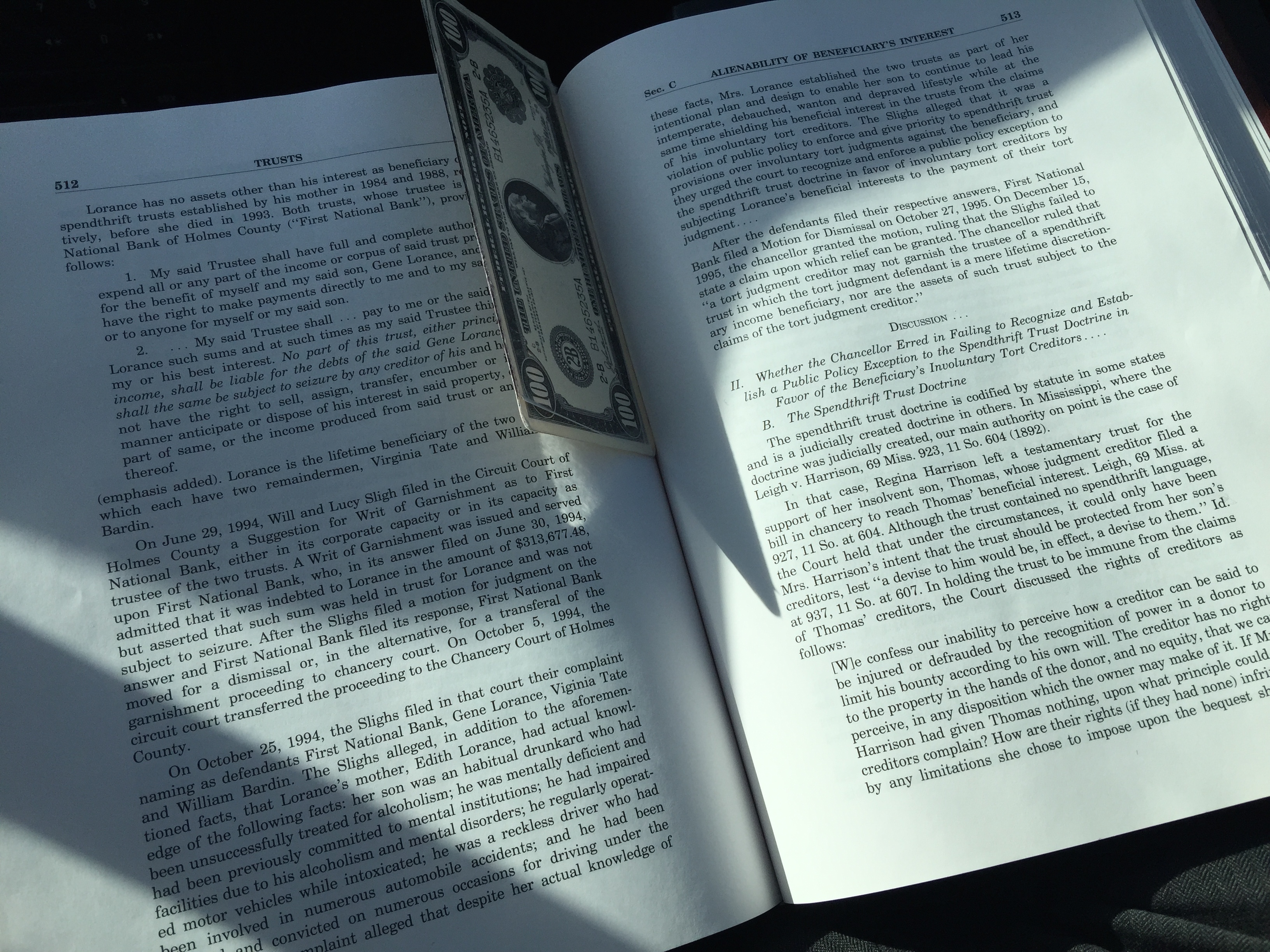
Attempting to recover the cost of medical bills and damages from this monster who destroyed their lives, Will and Lucy Sligh filed a Writ of Garnishment, trying to get their hands on the wealth held within the trusts. They alleged that “Lorance’s mother, Edith Lorance, had actual knowledge of the following facts: her son was an habitual drunkard who had been unsuccessfully treated for alcoholism; he was mentally deficient and had been previously committed to mental institutions; he had impaired facilities due to his alcoholism and mental disorders; he regularly operated motor vehicles while intoxicated; he was a reckless driver who had been involved in numerous automobile accidents; and he had been arrested and convicted on numerous occasions for driving under the influence. The complaint alleged that despite her actual knowledge of these facts, Mrs. Lorance established the two trusts as part of her intentional plan and design to enable her son to continue to leave his intemperate, debauched, wanton and depraved lifestyle while at the same time shielding his beneficial interest in the trusts from the claim of his involuntary tort creditors” [Page 512-513].
The question: What is the best, most moral outcome for society? I don’t mean in this particular case, where there are state laws involved so the question of justice might be different from the question of the right technical answer. I mean, in a perfect society where we were designing the best possible framework for the population, what leads to the least harm?
On one hand, Lorance does not own the money in the trust. It was the mother’s property and she intended for Virginia Tate and William Bardin to inherit it. However, in her absence, she wanted the trust be able to provide for her son just like she would have were she able to do so, paying for his living expenses and lifestyle even if he were effectively bankrupted by his horrible actions and terrible decisions. To say the victims in this case, the Slighs, are somehow harmed by the injustice of not being able to tap the trust assets seems wrong because the trust assets do not belong to Lorance. If the mother had been still physically holding the money, gifting it to her son regularly rather than the trust, they wouldn’t have had any opportunity to force her to hand over her wealth. She would have kept supporting him then left it all to William and Virginia after he son died. To demand the trust repay the Slighs is as immoral as demanding the government confiscate the money from the mother were she still alive. There is little difference.
On the other hand, as the authors point out by quoting other rulings, tort creditors, in this case the Slighs, did not choose to extend credit to Lorance. They were forced to do so by his actions and now he is in their debt. Quoting Austin W. Scott in The Law of Trusts, the textbook says on page 518, “… there seems to be something rather shocking in the notion that a man should be allowed to continue in the enjoyment of property without satisfying the claims of persons whom he has injured. It may well be that it is against public policy to permit the beneficiary of a spendthrift trust to enjoy an income under the trust without discharging his tort liabilities to others.”
(And it is shocking. In a New Hampshire trust case known as Scheffel v. Krueger, a convicted child molester, who was the beneficiary of a 1985 spendthrift trust established by his grandmother, was allowed to continue to enjoy all of the wealth produced by his trust fund after the courts denied his victim access to the money. Imaging the sense of injustice that must elicit. Someone does something so evil to you, then gets to go about their life living off this huge pile of money you can’t touch even though it has been awarded to you all because it isn’t, technically, their money. They just get to spend it.)
No matter how many times I go through the problem, I think I come down on the side that tort claims should not lead to a public policy exemption because the donors almost assuredly wouldn’t have gifted the property were the money going to go to the creditors. This not only undoes their intent, but deprives any innocent remainder or future income beneficiaries of wealth that was destined for their hands. Sure, you occasionally get an infuriating miscarriage of justice, but overall, the system seems to be better. If spendthrift trusts aren’t immune to torts, you’ll start seeing all sorts of other convoluted behavior to try and minimize liability, which isn’t particularly great for society, either.
In the Sligh v. First National Bank of Holmes County case, the trial court ruled in favor of protecting the trust, but was then reversed by the state high court, which allowed the victims to access the trust assets. However, the Mississippi legislature was unhappy with this outcome so to prevent it from playing out again in the future, it modified the statutes in 1998 in a way that spendthrift trusts were beyond the reach of tort claims under most circumstances. Since then, it has had a few schizophrenic developments as it seems to be struggling with the same question; e.g,. on June 30th, 2014, the governor of Mississippi, Phil Bryant, signed the “Mississippi Qualified Disposition in Trust Act” law that allows self-settled spendthrift trusts in certain situations, joining the handful of other states who have this relatively new creation. It means you can setup a trust fund for yourself, and put aside money beyond the reach of creditors provided it isn’t done fraudulently. However, it specifies that these self-settled spendthrift trusts are not immune from tort claims involving death, personal injury, or property damage. I’m not sure why anyone would opt for it, as there are much more attractive options in other states (particularly Nevada), but it’s interesting nonetheless.
Reader Comments (26)
Comments are presented chronologically, with replies indented beneath the comments to which they respond.
rgb
November 10, 2014
I am not at all an expert on the legal system, but would the Slighs be entitled to the profits Lorance was earning from the trust? You say, "Someone does something so evil to you, then gets to go about their life living off this huge pile of money you can’t touch"... Do they really get to keep the profits from this? Also, is anyone allowed to change the allocation of the funds in the spendthrift trust? So if it is all Coca-Cola stock, must it stay Coca-Cola stock? Or can a trustee change this? So if the Slighs were obtaining the profits from the trust through their settlement, could they control the allocation to potentially increase their profits from the settlement?
Joshua Kennon
November 10, 2014
Replying to rgb
There are attorneys here who are much more knowledgable than I am as this is their professional backyard, not mine. They might be able to add some thoughts.
If I'm not mistaken, in many cases, the person setting up the trust can override the trustee's duty to diversify by restricting the trust assets to a single stock or other investment. The American Bar Association has an interesting PDF document on their servers that briefly mentions concentrated stock positions as it pertains to fiduciary liability, saying a grantor can release a fiduciary from liability and require concentration. That sounds right, at least. Some of the trust companies down in Georgia still have huge portfolios of nothing but Coca-Cola passed down for a couple of generations and none of those shares are getting sold as the families hold to it with a religious devotion.
I do know from the investment side, absent some sort of mandate in the trust document requiring concentration, most, if not all, trust companies are going to diversify the trust property to protect themselves under the prudent man rule.
As for the other question, I think - again, maybe one of the attorneys will be able to correct me or add to the discussion - it comes down to how the trustee distributes the assets. I mean, if they turn around and dump $1 million in cash in the guy's account, yeah, it's now his property and they can go after it. But if the trust pays his college tuition bill by cutting a check directly to the school, how are the tort creditors going to recover that? If the trust pays a month-to-month car lease on a new Mercedes and car insurance by writing checks directly to the dealership and insurance company, what are the tort creditors going to recover? He doesn't own the car. If they do get a judgment against it, he can just go get a new one next month somewhere else. If the trust cuts a rent check for a fully furnished apartment on Park Avenue directly to the landlord, or to some luxury hotel where the beneficiary stays, what are the tort creditors going to recover? If it pays the salary of a gourmet chef to show up and cook for him every night, how are they going to recover that money? What, exactly, are they going to seize?
Practically, it'd be very hard because the beneficiary doesn't actually handle any cash or own anything. It's as if the trust is a rich relative following him or her around, paying his way but making sure no assets concentrate in his hands that could be taken. He could have the best of everything in life while still being bankrupt on paper so there's nothing to grab.
But, again, take all of that with a grain of salt as I'm not an attorney and I'm thinking about the bigger, moral question here to try and decide where I fall on the issue.
rob
November 11, 2014
Replying to Joshua Kennon
Like many areas an appropriate equitable remedy could be crafted, as long as you can get the court to accept it. Luckily in the case of a trust there is a point of control. One could imagine language, whose validity is wholly theoretical, that might accomplish such a goal: "Any disbursement from the Trust that inheres any benefit in the Debtor, other than the payment of government obligations, shall be made to the Creditor until the Debt is satisfied in full. In the event of any payment by Trustee not in compliance with this order, and/or any acquiescence by the Debtor in the same, an order to show cause why the Debtor and Trustee are not in contempt of court shall issue."
The debtor would likely then be looking for any way to voluntarily alienate the residual income streams so that they could simply get along with their life.
I share the instinct of others here, that it feels right for the trust assets to be protected, but that the beneficiary of such a trust should not be placed in an even better position.
Rooser04
November 10, 2014
Similar to what rgb said: it may be wrong to confiscate from the trust, but would not be to garnish the criminal beneficiary's income.
Put another way: Mom might not choose to let her money he taken, but if she chooses to give it, she loses that control. The criminal can protect the trust by not drawing from it, but the moment he chooses to profit, he must pay his debts.
He isn't forced to have money, it is his choice to take it.
Joshua Kennon
November 10, 2014
Replying to Rooser04
How, practically, do you enforce that?
If the trust writes a check directly to his university and pays his tuition, how can you seize the money? It is now the property of the school and you can't take his spot at college; it's non-transferable.
If the trust decides to work out a deal with a car dealership to lease a car on a month-to-month basis with the beneficiary, writing a check to pay off the debt at the end of every month for the amount due, what are the tort victims going to physically seize? There's still no asset.
If they pay his rent on a month-to-month basis by having the landlord submit a bill to the trust department, and he owns no real estate but only has a pile of debt, what will the tort victims take? He incurred a debt and the trust decided to pay off that debt. There was never an asset there.
If it reimburses his credit card for movie tickets, clothing, restaurants, etc., and he never actually physically has possession of any cash, what are they going to do? The court isn't likely to go in and auction off his suits or watches as long as he isn't stupid about it.
It would be entirely possible to give someone a 1% lifestyle while never transferring assets to them, never providing them with any cash, and making sure they were, at all times, bankrupt, would it not? It doesn't seem hard.
Rooser04
November 10, 2014
Replying to Joshua Kennon
Good, practical challenges, all. However, we cannot let the hope of the perfect prevent realization of the good. All the work-arounds that you describe sound to my uneducated ears like money laundering.
We have laws on the books limiting gifts, and outlawing the hiding of under the table income. Do people cheat? Sure. But if a guy has a lien against his income, and is claiming poverty while living a 1% lifestyle, then the IRS and justice system can exercise their power against this fraud.
Not a perfect system that will deliver 100% compliance, but neither are laws against murder. We just do our best.
Steven
November 11, 2014
Replying to Joshua Kennon
Joshua, how is the money actually getting from a trust to the lucky recipient of the funds? Does a trust fund actually write a check to their landlord, college, etc... or does a trust transfer x dollars to the person directly each month?
As an aside, I am not a fan of inherited wealth. It all seems very medieval - the aristocrats get to live high on the hog thanks to being lucky with their choice of parents. Have you posted any articles on the pros/cons on inheritances in general?
hansyrobinson
November 10, 2014
Want to make $5k Monthly Online?
WAIT! I Want To Teach You...
How YOU can easily earn an extra $3,000 this month!
How To Make $25, $100, $500, $1,000, and $3,000 per sale!
How YOU can start making money in the next 7 days!
How To Get Started Today, Risk Free, Guaranteed!
************************
➜➜➜➜➜➜➜➜➜ www.reviews-247.com
innerscorecard
November 10, 2014
The article which was dated two nights ago actually was just published now as well (according to my RSS feed). Just thought I'd bring it up in case it was due to a technical error you may want to know about.
Joshua Kennon
November 10, 2014
Replying to innerscorecard
Thanks for letting me know. It was my fault because I delayed making it public (it was set to private previously) because it and the article to which it was tied that mentioned the wedding gift we gave. I didn't want anyone to see it prior to the ceremony and reception, just in case.
I'm not sure why the RSS feed wouldn't reflect the change once the post went public, though. I'll need to look into that. It might just be how WordPress handles such things? I'm not sure.
Matt
November 11, 2014
Replying to Joshua Kennon
The Digital Price post shows up as from Nov 8 for me even though it only appeared to me today (along with this post) so whatever is happening here isn't happening uniformly for both posts.
Jay Tank
November 10, 2014
Replying to innerscorecard
I was about to post the very same thing; I also just got the previous post, as well as this one, on my RSS feed. Verily some cog needs oiling in the blogging/RSS apparatus.
innerscorecard
November 10, 2014
I haven't studied this specific area at all, but my inclination is that any injustice done is at least somewhat mitigated by the criminal penalties that occur in the most egregious cases, like the Sligh case. If the trust beneficiary is in jail, he can't really enjoy the income anyways, at least until he is released.
David
November 10, 2014
Joshua, could you please provide some detail (or maybe just a keyword) on what you are referring to in Nevada as an alternative to self-settled spendthrift trusts. From what I've read, most self-settled spendthrift trusts are not a very good option for protecting assets - especially now that bapcpa can look back up to 10 years at transfers.
Frankie
November 11, 2014
Replying to David
a quick google search bring ups "The Nevada Asset Protection Trust."
Brendan
November 10, 2014
I just finished reading "Those Protective Trusts Which Are Miscalled Spendthrift Trusts Reexamined" entitled to George P Costigan Jr, in the California Law Review from 1934. I hoped to gain some more insight into the issue but i still find myself on the fence. I'd prefer to cap the amount of money going into these trusts so that basic needs would be covered from interest and/or dividends, but nothing else (indexed for inflation). I'm just not very fond of the idea that anyone should have a vast sum of money that is untouchable even if they cause serious bodily injury or death to another person. However, I also think that these trusts can help shoulder the burden in "caring" for people who cannot otherwise be trusted to do it for themselves. Interesting topic. I'm looking forward to reading the comments.
Matt
November 11, 2014
I would agree that it is better to protect spendthrift trusts even if there is the occasional miscarriage of justice. Our sense of injustice at the situation presented here revolves a lot on the drunk driver's perceived ability to pay. Had the drunk driver been poor and have no assets, we would see the situation more as a tragedy than as an injustice, since after all, there is no money with which to compensate the wronged party aside from perhaps a minimal amount wage garnishing. Perhaps a jail sentence could pass for justice, but with regards to the trust money, I feel like our sense of injustice here is more of a visceral desire for revenge in an "eye for an eye" manner. Given that no money could have been won in a lawsuit if the defendant were poor and that the money technically doesn't belong to the defendant anyway, it seems like there aren't any good reasons to allow creditors to access the trust.
One question I do have about trusts though, is whether it is fair that the settlor can effectively extend their lives by using a spendthrift trust to control their estate from beyond the grave. The rationale for allowing trusts while the settlor is alive is well and good, but allowing for the use of trusts to control assets effectively out of the reach of creditors for perhaps generations after the death of the settlor seems to be a bad policy. Sure, there is the argument that the money was earned by the deceased and therefore some weight should be put onto their wishes when dealing with the disposal of said wealth, but what you end up doing by allowing these trusts is to effectively provide people with benefits without any of the responsibilities associated with it. All people who earn their money are liable for their torts that they commit. But somehow heirs are exempt from (monetary) liability just because of a legal structure put in place. The argument for allowing trusts makes sense if the settlor is alive and could theoretically perform the exact same duties as the trust without its existence. But if the settlor is dead, you are essentially giving the settlor's estate rights that would not exist otherwise, making it an artificial entity. I'm not sure how I feel about this one.
Tyler Phillips
November 11, 2014
Instead of placing a lien on the person's income, is it possible to place a sort of special sales tax on items the person will be buying?
For example, if the person's trust is covering their car lease payments, can a 20% levy be added to the lease payments, which could be funneled back to the victims?
Perhaps it would be limited to items that already have sales tax in the given jurisdiction, but surely the person will eventually want to buy something taxable. To me, it sort of forces a new expense on the person much in the same way inflation eventually would add to what they have to spend.
Arceris
November 11, 2014
"Having a hard time putting it down" was not said about any casebook, ever. Just kidding, I had the same experience while studying intellectual property in law school. If you like this material, you may also like Asset Protection, by Jay Adkisson & Chris Riser. It's more practice based than a casebook, and is a little long in the tooth now, but I enjoyed it. Even if some of the techniques they employ are stale, it gives you a good introduction to the mindset. Also, if I recall, they spend some time on the ethics of the field, of course from the practitioner's perspective.
Jennifer
November 11, 2014
There could be some workaround about tort claims that arise during the commission of a felony (obviously they would have to be found guilty in criminal court for this to apply), or under strict liability circumstances? I agree that that trust assets themselves shouldn't be touched, but the dividend payments are morally a different answer in my opinion. None of these are researched for feasibility, just my first instinct about the morality issues.
Aditya
November 11, 2014
In general, I agree with several others here in that I am not for intergenerational wealth transfers "of an excessive degree."
If I were a lawyer (which I am not), I would posit that the benefit earned from a trust, even if used directly for the beneficiary's benefit without the beneficiary's active involvement, would constitute as income; as an example, debt forgiveness is counted as taxable income by the IRS.
Bill
November 11, 2014
lol... I happen to have this very book on my bookshelf, along with The Complete Book of Trusts, per your recommendation to me when I was asking about trusts in the comments section of a past post a year or so back. I've read most of the second book (your recommended "introduction" before I crack open the above book in your post) but I haven't really looked at Gratuitous Transfers yet.
I don't really have an opinion on this matter (yet) as I don't really know enough about it to feel as though I should lean one way or the other on it... guess I should crack her open, eh? In any case, just wanted to say thanks again for the book recommendations!
-Bill
James Crooks
November 12, 2014
I'm not a lawyer, but from a moral standpoint, I'd argue no, we should not protect them from involuntary creditors (the Sligh case), at least not completely. Further, I'd argue that criminal proceedings have little to no effect on the morality of this, in contrast to innerscorecard's earlier post.
My premises:
1 It is more important to help the (innocent) injured than to exact vengeance.
2 The purpose of criminal proceedings is deterrence and vengeance.
3 Greater weight should be given to the needs of the living than the wishes of the dead.
4 Loss of current value is worse than failure to receive expected future value.
(1) and (3) should be taken as a sliding scale rather than absolutes, which somewhat muddies the issue, but reality is messy and I don't want to delve into dealing with the reductio ad communism type counter-arguments for reasons of length and sanity.
So then, with (1) and (2) I argue that only dealing with criminal proceedings and thus with punishing the offender, we have a moral failure. It is not just that a wo/man's livelihood and that of their family is deprived from them because of an imprudent act by another actor. While it is of course impossible to always enforce justice in these situations, in the particular case that the damage was caused by actor whom is the beneficiary of a spendthrift trust, we have both means and motive to provide for the injured party. Thus, in this case, it is moral that the imprudent actor be deprived of their benefits, and those given to the injured party.
I do not think the argument that we would not levy such a penalty against someone without the benefit of such a trust valid in this case, as while we might have motive to address the injustice of the situation, we lack the means (outside greater intervention, i.e. government benefits, which is a different can of worms). Furthermore, we would levy the burden against someone with the means, so there are similar-but-different cases on each side to point to.
From (1) and (3) I would argue that it is valid to slight the wishes of the deceased (assume for the moment that the creator of the trust is dead) in favor of the living injured. I take (3) to be sufficient weight that we do so when there is some direct line of responsibility. In particular, I don't take (3) to grant sufficient weight to the needs of the living so as to dissolve a trust (or trusts at random) for the general welfare of the needy, but rather in the event of a case like the Sligh case.
In my mind, this primarily leaves the issue of dealing with the innocent party who might inherit the trust when the imprudent beneficiary of the trust ceases to be the beneficiary. I see two primary options:
(1) Accept this outcome as a risk of the structure. This 'punishes' the innocent inheritor of the trust for being related (in however fashion) to the imprudent actor, however this seems a better outcome to me under premise (4). Further, I find it acceptable that this be the risk for the creator the trust when they choose to spend resources to supply an imprudent actor and to do so through a mechanical legal mechanism. That is, when the creator of the trust makes an imprudent actor (and implicitly known to be so by use of the spendthrift clause) a beneficiary, they accept some risk as cost for their responsibility in the actions of the imprudent actor.
(2) Levy the penalty against the income (in some fashion) rather than the capital. While this is trivial if the income is direct, there is the issue of having the trust pay bills, etc. rather than give money directly to the beneficiary. It seems, in this case, that this could be resolved by requiring some stream of payments be made from the trust's income before any other disbursement is allowed, with the possible exception of the trust's (presumably fixed at the time of creation) administration costs. There are details to work out, but I think a mechanism could be made, and attempts to weasel out of it could be caught sufficiently well as to make this a valid approach, even if it's not infallible.
The perfect, as always, is the enemy of the good, and I think this is a matter of choosing the lesser of problematic outcomes.
Whew, that was long.
Connelly Barnes
November 15, 2014
I like Tyler's idea about a lien being placed on the grantee's income in this scenario.
I also have difficulty understanding people who want to leave money for children. This may be because I was raised on the assumption that I would have to provide for myself and do something socially productive. If I had children, I would place an extremely high priority on showing them how to learn, develop socially useful skills, and make money from them, from a young age.
It would seem like if a person is not doing anything socially productive, and has no useful work skill, then they really don't deserve the money. What's the point of just letting them wander around, accomplish nothing for their whole life, and just throw away their potential? So I really don't like the idea of subsidizing laziness, lack of determination, or lack of long-term orientation. Of course there might be special exceptions like if a descendant is in old age and not capable of working easily, and has too high of medical expenses. Or if a spouse had taken time off from a career to raise a child.
By and large I think it would be much more productive to give the money to create some scholarship fund. Usually scholarships are competitive and made available to a wide pool of applicants, so those who get the money would actually have earned the right to it on the basis of demonstrated merit.
Out Of Bounds
April 1, 2017
Spendthrift clause allows trustee to withhold distributions to the debtor beneficiary (the drunkard here)
The distributions (here presumably nonexistent) can still be reached by the creditor, as well as the private property (here nonexistent). This cuts off the debtor from the fortune until he pays off his debts. That's how I thought the system works, and that would serve justice well. What am I missing here?
The alternative solution that you're offering here - piercing the trust veil, if you will - is horrible. Do you really believe it is just, contrary to mother's wishes, to disinherit the innocent beneficiaries (the grandchildren) whom the trust was constructed to protect? I hope I'm missing something important here. I'll pick up that book.
Jeffrey Benedict
September 12, 2022
Josh, as usual your logic is supremely spot on. The funders of the trust just wanted to give the drunkard enough money to survive, but no more. The rest of the money goes to the next generation. As you've so aptly stated, changing this basic "lay down" would add a whole host of unintended consequences, and costs that would just be inefficient. Bravo Josh. Well stated