

November Is for Buying More Nestlé Shares (… at least for the Kennon-Green Family)
It’s been a long time since I’ve talked really about Nestlé SA other than mentioning it in passing last week. It’s on my mind because this morning, I had my parents acquire some more in their personal portfolios, which I intend for them to hold for the remainder of their lives (which, unless something changes, should be at least another 30 years, God willing, as they are both in their early-to-mid 50s). It’s not much, just a bit of cash that had built up and needed to be put to use, but it adds to the collection of ownership in Switzerland’s most famous food company that they, Aaron and I, and nearly everyone else in our lives have have been acquiring over the years. Here and there, bit by bit, buying whenever the price is reasonable as it is one of the few businesses that we consideris worthy of a home in the permanent portfolio.
The dividend will be coming up in five or six months and, like almost every year for the past few decades, I expect we’ll see another comfortable raise as the board of directors passes on the profits from chocolate, coffee, ice cream, tea, water, infant formula, cereal, powdered milk, pasta, frozen dinners, nutritional supplements, and pet food. Look at the dividends (which do a nice job of tracking the trajectory of earnings for the underlying earnings in this case) in my lifetime alone. It’s a glorious sight to behold. There are multiple recessions, bank collapses, wars, oil shocks, Presidential administrations, technological revolutions, interest rate environments, and real estate bubbles in there, yet the Swiss Francs keep on getting sent out to owners. Some years the shares are up, some years the shares are down, but over time, owners make more and more money, which is eventually reflected in total return.
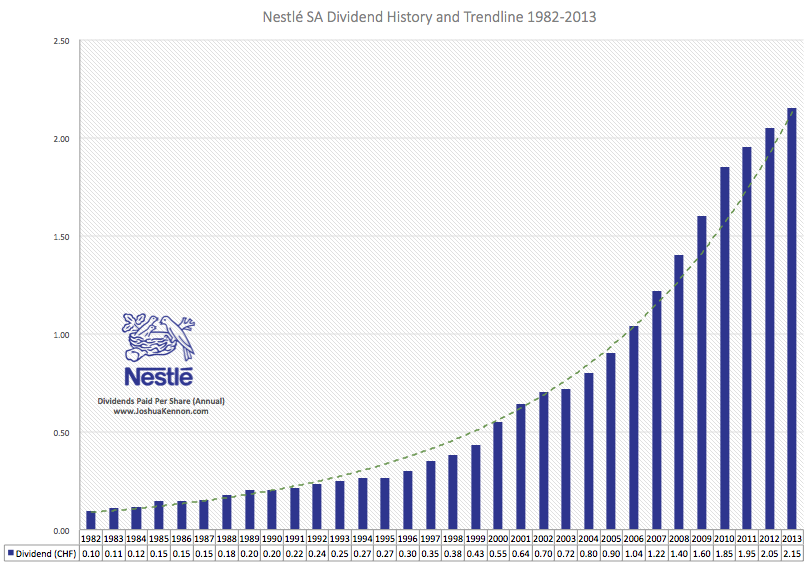
Of course, dividends alone are somewhat meaningless because what counts is total return. What does that total return look like? Prepare yourself. You’re about to enter the realm of investor nirvana.
A quick, back-of-the-envelope assessment shows that someone who bought 1 registered share the year I was born would have paid the split-adjusted equivalent of 2.30 CHF per share. That share is now worth 70.90 CHF, or 30.82 times what he paid for it. On top of that, the share has collected aggregate cash dividends of 21.60 CHF. This puts the total ending value at 92.50 CHF for every 2.30 CHF invested, a 40.22-fold pre-tax gain, assuming no dividend reinvestment. Had you plowed those dividends back in for more ownership along the way, you’d have made a lot of extra money.
I’ve said it before but it bears repeating: Despite these incredible results, you rarely hear people talking about Nestlé at cocktail parties. It’s never the hot stock tip hyperactive twenty-something-year-old recruits to the financial marketing machines of Wall Street tout to their clients. It isn’t the subject of magazine covers or dramatic corporate biographies the way exciting new technology firms routinely are. It isn’t the sort of company that makes people raise money and put a big chunk of their life savings to work. I suspect part of the reason is it is too simple. How would a broker put food on the table if he were to tell clients, “Let’s buy some more Nestlé and forget about it for the next 50 years?” even though that would be the best advice he could give to a lot of families, in my opinion, under present conditions and pricing.
To visualize how we, and we imagine all the other Nestlé stockholders feel about this chart, requires me to use my limited Photoshop skills …

Want some tasty DiGiorno pizza? How about a Butterfinger? Some Häagen-Dazs? Maybe some sparkling water? We have Perrier and San Pelligrino so take your pick. Some Gerber baby food for your little bundle of joy? Some Friskies for your cat? Chocolate? We have lots of delicious chocolate. You want some chocolate I can tell. Maybe some Toll House cookies? Some cocoa? Some cereal?
How about some cosmetics, perfume, hair dye, shampoo, conditioner, or nail polish? Nestle owns 23.29% of the shares of the nearly €70 billion publicly traded French beauty giant L’Oréal. Whenever you hear the jingle for “Maybe it’s Maybelline” you should change the lyrics to, “Maybe it’s mah monies”.

If I had to guess, I’d hope we see a cash dividend increase to at least 2.25 CHF per share when the Spring dividend day arrives. If that turns out to be accurate, and the shares at 70.90 CHF each as of this morning, it would indicate a pre-tax dividend yield of 3.2% per annum. Some analysts appear to be expecting more, which is fine by me. It partly depends upon how the board wants to return cash. There was an $8 billion share repurchase program that is supposed to be completed this year so they may want to reduce shares outstanding as a higher priority. Nestlé unloaded the guns and did long-term owners an incredible service by reducing total shares outstanding 11.78% in the years surrounding and following the Great Recession. That means each share of Nestlé since 2008 actually represents an extra 13.35% worth of equity.
General Thoughts on Nestlé Since It’s Been a Long Time Since We Last Discussed It
There’s a saying in the money management world that Nestlé is the “get rich slowly” company. As Warren Ackerman, an analyst at Société Générale put it, “The old adage – when the going gets tough, the tough buy Nestlé” is equally as applicable.
 This is not a business to trade. This is not a business in which to speculate. This is one of those rare gems of a company that you buy, hold onto for life, and pass on to your children and grandchildren (though some successful value investors do “trade at the margins”, meaning they are so familiar with its core businesses that they will tilt their portfolio to buy more when it seems undervalued and trim the position when it seems overvalued, retaining a core position that serves as a base; something most folks who are not professionals and who are not regularly examining the operating results should probably avoid). You pay a one-time commission and then have a near $0 expense ratio (unless you opt to invest through the ADR, in which case you’ll pay a somewhat inconsequential fee to the sponsoring bank for converting your Swiss Franc dividends into U.S. dollars). Like an oak tree, Nestlé has grown bigger, richer, and stronger over the years, rewarding its owners. Even the dividend is paid out only once per year, as a family partnership might do.
The recipe is simple: Management tends to raise prices by at least inflation, buys back some shares to increase EPS when the stock is undervalued, and adds a little organic growth through new product launches and acquisitions. It also has a lot of capital allocation discipline. For example, when the former Kraft Foods (it has since split into two different companies) sold its pizza business under incredibly stupid tax terms only to turn around and buy a chocolate business at a much higher price, drawing the ire of Berkshire Hathaway, the largest stockholder at the time, it was Nestlé that stepped up with the checkbook and effectively said, “Yes, we’ll buy those boring, highly profitable, slow growth pizza businesses you think are so beneath you so you can chase after high-profile, prestigious acquisitions to the detriment of your stockholders.” Management knows that growth only matters if it makes owners richer. As a matter of policy, it maintains one of the strongest balance sheets in the world and generates double-digit returns on capital. There is a reason it is a cornerstone of a lot of European index funds.
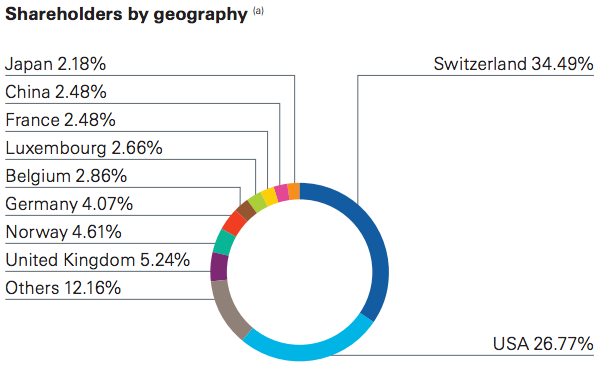
On that note, it’s not just Europeans who own Nestlé. Even though it isn’t a component of the major indices in the United States – despite its roughly quarter-of-a-trillion dollar market capitalization (yes, trillion with a “t”), it is not part of the Dow Jones Industrial Average nor the S&P 500 – a lot of Americans count it among their core holdings. Take a look at shareholders by geography at the end of the last fiscal year:
Given that Aaron and I modified our investment policy manual to treat Nestlé not as a stock, but as a private business that we hang on to as tenaciously as we do our operating companies, the key is to avoid paying too much. Once shares are on our personal family books, generally, we don’t envision them coming off again except under extraordinary circumstances. That means the opportunity cost of locking up the funds is high.
The good news? Overpaying doesn’t seem to be a problem at the moment no matter how you analyze the financial statements. If we think about Nestlé as a private business, it’s selling for around 15% under its intrinsic value for someone who had a long-term horizon and wanted to live entirely off the underlying profits of the enterprise even if the stock exchange were closed. That’s not a screaming bargain, but for what we’re getting, we’re happy with it. (To grossly oversimplify and avoid diving into complex discounted cash flow discussions, I wouldn’t want to pay more than twice the sum of the projected dividend yield + the projected 5-year growth rate in EPS (e.g., if the dividend were 3.2% and 5-year growth estimates were 7.5%, I wouldn’t want to pay more than 21.4 times earnings). In most cases, throughout most of the company’s history, that yardstick has been a sufficient enough gauge to do well. This is because the quality of the businesses is high enough there isn’t a sustained, huge disconnect between reported profits and true owner earnings (though, at the moment, reported profits are under-reflective of actual economic earning capacity). I wouldn’t be using the same metric to value a steel plant, telecom firm, or oil pipeline.)
I suspect a lot of inexperienced investors overlook Nestlé because they aren’t used to foreign currency adjustments or don’t know how to research international firms. In the past nine months, by way of illustration, it looks like sales have fallen by 7.5% but organic growth was so good, they were actually up by 4.5% despite a fairly challenging consumer environment. It’s just that the financial statements are reported in Swiss Francs and the CHF has appreciated considerably against many global currencies. As Nestlé makes a lot of money outside of Switzerland, the accounting figures take a hit but the money, in most cases, is still being used in their respective nations to build new factories and buy up competitors. Likewise, the ADS that trade in the United States, representing the foreign Swiss shares, are often incorrectly listed. Go take a look at Yahoo Finance’s website and it shows no dividend at all and a p/e ratio that doesn’t much reflect economic reality! It makes the stock look far more expensive than it is if you’re talking about 10, 20, 25+ years of ownership.
Maybe all this noise is one of the reasons the shareholder base tends to weed out the novice when, paradoxically, it is precisely the sort of enterprise that should hold the most appeal. Nestlé never looks like it’s going to be the best stock to own over the next 12 months. Ironically, it has almost always been one of the best stocks to own over the next 12 years. Life is funny that way. Of course that could change in the future – there are no guarantees in life or common stock investing – but it’s worse observing and noting.
Image Credit: kenary820 / Shutterstock.com
Reader Comments (59)
Comments are presented chronologically, with replies indented beneath the comments to which they respond.
James Crooks
November 12, 2014
"Nestlé never looks like it’s going to be the best stock to own over the
next 12 months. Ironically, it’s almost always one of the best stocks
to own over the next 12 years. Life is funny that way."
When I was an undergrad math student, I had a professor show me a brilliant, in my opinion, demonstration of how both expected value calculations and making the locally optimal decision can lead to bad (in fact, the worst possible) result. It's an artificial example of the sort that mathematician and game theorists are fond of, but illustrative none-the-less.
The game goes like this: You pay me one dollar and we flip a coin. If you lose, you get nothing, and if you win, you get three dollars and the option to flip again, where if you win, you get triple your previous winning amount. Repeat until either you lose or quit, and when the game is over, it's over with no chance to play again.
At each decision point, the expected value of winning is always significantly higher than the loss from losing, so the optimal choice is always to play again. Of course, the probability of winning n times in a row becomes vanishingly small as n goes to infinity, so by making the optimal choice at each step, you're guaranteed to lose, and thus get the worst possible outcome.
Obviously this doesn't account for a number of economic/psychological aspects of actually playing the game, but that's not really the point (you can easily rewrite parts to adjust that, too). Rather, we should really care about timescales and looking at the bigger picture of our ultimate goal, which I think is exactly echoed in a real world context in your point above. Also, don't gamble with probability theorists.
Tyler Webb
November 13, 2014
Replying to James Crooks
The St. Petersburg Paradox! I am more familiar with a different variant:
I invite you to play a game with me. I will flip a coin an unknown number of times; if it lands on heads, I will flip again; if it ever lands on tails, the game ends and you win the amount 2^n where n is the number of heads that had been consecutively flipped. What would be a fair value to pay in order to to play this game?
This was originally suggested to me to show the limitation of expected value calculations and diminishing marginal utility, but I can't help but think back on it frequently. This problem actually stumped some of the brightest minds of the 18th century--and was instrumental in developing probability theory.
James Crooks
November 13, 2014
Replying to Tyler Webb
Oh I quite like this version, and having a name to put to it, thanks!
Since this is calculable, I may have to play with this a bit before looking it up. It would be straightforward to run a Monte Carlo simulation for a fixed upper bound on n, or else assume a distribution on n and run the Markov Chain Monte Carlo to get some numbers.
Tyler Webb
November 15, 2014
Replying to James Crooks
Let me know if you come down on a single number! I would also be interested in the method that gave you the best approximation of a fair value.
James Crooks
November 16, 2014
Replying to Tyler Webb
Well of course, it occurred to me almost immediately after posting that I couldn't, in fact, calculate the value of the puzzle as posted. It's funny how we become biased by our training. In my head, I immediately assumed that there exists some probability distribution over the number of rounds that would be played, however, the implied distribution over n in your post is the uniform, which of course isn't a probability distribution over the positive integers since you can't make such a distribution that sums to one.
I know this, so I immediately discounted that possibility without realizing it, and this is actually the heart of the paradox: it does in fact describe an impossible game, because you can't sample uniformly from the natural numbers. It's funny to be confronted by one's unconscious biases.
Tyler Webb
November 16, 2014
Replying to James Crooks
Don't despair quite yet!
Daniel Bernoulli solved the St. Petersburg Paradox by assuming that the utility of income is given by u(I) = log(I)
In this case, utility is increasing with income, but marginal utility is decreasing in income. As such:
E[U(I)] = (the infinite sum from n=1 to infinity) of (1/2)^n*log(2^n) = log(4) = approximately .6. To convert this to a dollar value, we solve for log(I-bar) = .6, which is about $1.82.
About two hundred years later a couple smart guys named John von Neumann and Oskar Morgenstern wrote "The Theory of Games and Economic Behavior", which provided an axiomatic foundation for the expected utility theory that we used to solve this problem.
Having said that, we can have a good argument about the extent to which utility of income is well described by the logarithmic function with respect to income, but it seems like it's directionally correct. How I wish I could take this class again knowing the math I know now!
EDIT: I just saw the back and forth you and Connelly had. It seems I was a bit late to the party!
James Crooks
November 17, 2014
Replying to Tyler Webb
You're right, of course, but if we change the measure of the probability space (which is what the utility function does), then we're solving a different problem, since expected value and expected utility are, after all, different things.
I've read von Neumann and Morgenstern's book, it's a good book if a bit dated at this point. I took a graduate AI class at my current institution where we did some game theory and auction theory; it's quite a neat subject and I've been meaning to pick up Algorithmic Game Theory (Nisan et al.) for a deeper look. It's just hard to find the time!
Connelly Barnes
November 15, 2014
Replying to James Crooks
Fun puzzle! But I think the paradoxical aspect of it is due to trying to maximize return without also minimizing risk.
My solution would be to enumerate over all possible numbers of rounds n you could choose, and find the expected value and variance for the final payoff as a function of n. Then evaluate an objective function that represents one's personal risk aversion towards being bankrupt, and choose the best number of rounds and fraction of one's portfolio to bet given the previously calculated distribution of payoffs. For example you could maximize the logarithm of utility which yields the Kelly betting criterion.
My calculations (using a Taylor approximation for the Kelly betting criterion) show that it's best to bet 1 round, 22% of your portfolio, and then walk away. Of course you could then verify that the assumptions were valid, and ask whether the resulting utility and final distribution of wealth "feel" right and coincide with your actual happiness.
I think it's more of an illustration that greedy optimization of an intuitively plausible objective ("maximize money") may not actually maximize utility, and also may not achieve a global optimum.
As you go through more rounds even though each round is positive expected value, the risk to your portfolio increases. This is due to the "pot" of money risked in the game becoming a larger and larger fraction relative to your remaining safe holdings, which we can assume to be in cash. Thus it becomes rational for a happiness maximizing agent to exit the game in a finite number of rounds.
James Crooks
November 16, 2014
Replying to Connelly Barnes
Tyler's version shows a paradox (of sorts, it's not really one by modern understanding), but the one I presented is just an illustration of, as you say, failure by greedy (local) optimization.
You are correct, if we use a logarithmic utility function, we can find some reasonable solution. At this point, the expected value should work, and there exists a global maximum.
In both versions, the fundamental problem is that the expected value calculation is divergent. Using a logarithmic utility function changes that.
But what if we made the reward exponential instead of a polynomial? Indeed, we could choose the reward function to simply be three times the inverse of the utility function, and then we're back to the same problem! It's an amusing problem to think about.
Connelly Barnes
November 16, 2014
Replying to James Crooks
Good point James! I checked my math by writing a short Python code [1] to solve for the optimal utility numerically. It appears that the Taylor expansion I had before used gave an answer that was way off. For the original problem my code says the optimal solution is to wager 2% of the bankroll and play 4 rounds.
[1]. http://connellybarnes.com/dump/petersburg
The log utility agent will not wager more than 50% because that could cause bankruptcy, and log(0) goes to -infinity, so the agent is bankruptcy averse.
You are right that if you use a function that grows sufficiently rapidly you can "game" a log utility agent. For example in the problem version you proposed, the payoff if you win after n rounds was 3^n-1. But if you change this to 3^(exp(n))-1 then the solution appears to be wager 50% of the portfolio and play an infinite number of rounds. Because the expected value of utility diverges.
I don't think this can be used directly to make money because it's necessary to give the agent a positive expected value bet even to "game" it. So as a counterparty you have to be handing the agent free money to "trick" it. I think it can be used indirectly because some momentum investors strategies' are similar to the tricked agent which keep wagering forever. So if they sell off in panic after their strategy encounters some difficulty, that presents opportunity to patient investors.
I guess the modern solution would not be to maximize the expected value of utility, but rather a robust estimator that gives infinite penalty for losses over some threshold. This would intuitively correspond to demanding: "Not only do I never want to go bankrupt, but also under no circumstances is it ever acceptable to lose more than 40% of my portfolio."
Connelly Barnes
November 16, 2014
Replying to James Crooks
Oops I had a math error which I fixed in the linked code. It appears the Taylor expansion answer was pretty close which is more intuitive. The code now reports that for a log utility agent, 2 rounds wager 16% is the optimum, and if you decided to play 1 round you would wager 25%.
James Crooks
November 17, 2014
Replying to Connelly Barnes
Very nice analysis.
If we needed a formal way approach to solving the case of an exponential or faster payoff function, you could either deal with infinite penalties (with some more assumptions to ensure limit operations work properly) as you suggest, or just take the utility function to have finite support. This all goes away if the utility of a marginal dollar is eventually zero.
My real life solution, however, is not to play betting games with anyone who promises me such a payoff and claims to have an infinite bankroll. They're probably lying 😉
Connelly Barnes
November 18, 2014
Replying to James Crooks
@James: Good point about the real life solution. You can occasionally find such weird payoffs with reliable counterparties like the Options Clearing Corporation, but in most cases it just indicates your counterparty is a Ponzi operator.
Also due to the code error I mentioned earlier (since fixed) I incorrectly claimed that the log utility agent won't wager more than 50%. But actually it could wager up to 100%, if the payoff increases sufficiently quickly.
dave (nestle)
November 12, 2014
Holy Crap I can't breathe!!!!
This post was breathtaking.
Another masterpiece!!
Felipe
November 12, 2014
It begs the question... What do you prefer, the ADR, or the actual share in CHF on the SIX?
Joshua Kennon
November 12, 2014
Replying to Felipe
The real answer I want to give you is tied to the post I'm working on for you about currency considerations. I can't give it unless you understand my logic in that (still unpublished) post.
The short, general rule of thumb answer: In the case of a highly liquid, well-established ADR like Nestle's, I don't think it matters which you buy in most cases. Sometimes the ADR trade at a slight discount, which can give you a bit more ownership for a lower price, and they are (sometimes) more cost effective if you're making smaller purchases depending upon your brokerage firm.
I'm fine owning either and always make the decision on a case-by-case basis. This morning, I went with the ADR for my parents because it was easy, there wasn't much trade-off difference either way, and I didn't want to wait to convert the currency and have the global trading desk place the order on the other side of the world.
Off the top of my head, I can't remember the ADR exchange fees for Nestle if you wanted to shatter the security and take delivery of the underlying Swiss stock but I don't think it was terribly high. Don't quote me on that until I have time to look into it (unless someone has the filing on hand and can get to it for me first).
Felipe
November 12, 2014
Replying to Joshua Kennon
Wonderful! Thanks Joshua. My broker charges me 0,3% for the SIX with a minimum of 50 CHF, so smaller purchases are pretty much out of the question (however, my definition of a smaller purchase is likely a lot different from yours).
crispy
November 12, 2014
Replying to Felipe
For my holdings of Swiss securities I generally favor the ADR where available, although this may be broker-dependent. The advantages on my end are:
1. Significantly lower broker commissions. My broker charges a flat CHF25 per transaction on SIX, but $7.95 for U.S. exchanges (when they charge anything at all).
2. "Free" dividend reinvestment (qualified by the fact that the reinvestment price is not entirely transparent and my broker charges a relatively minor ADR fee for handling dividend distributions). My broker cannot provide automatic dividend reinvestment in SIX.
3. More graceful handling of dividends, period. My non-invested CHF sit in a non-interest bearing account. Converting back to USD costs. For my direct Swiss investments I accumulate these CHF and then periodically reinvest at a stroke with freshly exchanged USD, but this is not ideal.
4. They take care of negotiating the proper withholding under the tax treaties; with SIX they will fully withhold and then you have to take the credit back. This is not crucial, since you can always under-withhold somewhere else to get the money now, but I'd prefer not to have to think about it.
5. I'm much more likely to be awake when I want to trade shares.
When my volumes get large enough I may migrate everything over to SIX, so that it can be an independent and self-propagating dollar hedge, but at the moment the efficiency above is compelling.
My interest is piqued in the article Joshua is writing for you, though, so that may change my mind.
LordSquidworth
November 13, 2014
Replying to Joshua Kennon
"Yes, it is possible to convert the ADRs into the ordinary shares. This would be a cancellation of ADRs.
If you hold the ADRs in a brokerage account, you need to contact your broker to do this. The broker delivers the ADRs to Citi giving detailed instructions on where to deliver the ordinary shares, i.e. your brokerage account details in Switzerland. Your broker can contact Citi at +1 (212) 723-5435 to get further instructions.
If you hold a certificate, you need to deliver the ADR certificate to Citi, along with instructions on where to deliver the ordinary shares. You can contact Susanna Ansala if you hold a certificate. It should be noted that there is a $0.05/ADR cancellation fee charged by Citi."
Joshua Kennon
November 13, 2014
Replying to LordSquidworth
Excellent, thanks for saving me the time to look it up!
dave (nestle)
November 12, 2014
Joshua,
When you talk about putting Nestle in a class by itself in your investment manual, is it the only one? Would Berkshire Hathaway fit the same criteria? The reason I ask is from your post the other day. I am trying to understand why it was that you sold the actual first share of Berkshire that you ever bought. What position or type of account was that share in that it was on the chopping block, as opposed to other Berkshire shares that you might still own?
Thank you for any thoughts you could share on that!
innerscorecard
November 12, 2014
Replying to dave (nestle)
I'd also be curious about this, given that Berkshire (by Buffett's own valuation metric, price to book) hasn't moved that outrageously beyond the point where Buffett himself said he would buy, or above the point a few months ago where Joshua said Berkshire was undervalued. So this seems to imply that Joshua has a narrow range of correct valuation in mind. But that seems inconsistent about what Joshua says about not selling wide-moat stocks even if they're somewhat overvalued.
Dividend Growth Investor
November 13, 2014
Replying to innerscorecard
I think that Joshua is a little more active in his portfolio than what people assume. He sold most of his consumer staples in March 2013, then he sold some oil stocks a few weeks/months ago, and now he is selling DIS/BRK etc.
I would assume he is talking about buying and holding as a default rule, because this is the optimal method for 90+% of investors out there. Plus, the opportunity costs are different for everyone.
For example, I can invest a portion of my money in an ESOP plan where I can earn say 20%/year almost risk free. Some goes in a 401K, where I have a tax advantage and a match that guarantees I will do better than say invest my money in taxable account in the best companies. Or a Self Employed accountant/lawyer could go to a seminar in Hawai on how to better structure customer deals, pay say $2000 in total and get a tax deduction for it. But if they can get business worth $1000/year after the seminar, their ROI is better.
Eric
November 13, 2014
Replying to Dividend Growth Investor
When people make purchases to get tax deductions, they're typically spending a dollar to get 33 cents. Then if the residual value is only 50 cents on the dollar, he is spending $1 and getting $.83. With continued savings, the ROI might pay off after 2 years, but the seminar could also be a scam or a dud, resulting in zero residual value, leaving the lawyer holding the 33 cent bag that he paid $1 for.
Dividend Growth Investor
November 13, 2014
Replying to Eric
Debbie Downer alert.
Eric
November 12, 2014
I visited the Nestle headquarters in Vevey in September, and it is more than impressive. Everything is pristine, from the lawn, to the floor-to-ceiling windows, to the view out the back of Lake Geneva. The everyday ordinary workers were walking around in perfectly tailored suits. The front desk people I spoke with (en francais) were polite, intelligent, and understanding. There is a little store where you can buy chocolate, pasta, water, or whatever Nestle products you wish, and after a short walk along the lakefront in the direction of Montreaux (they give you a map), there is a Nestle Museum (closed Sunday and Monday).
Alex
November 12, 2014
Considering your affinity for Nestle, would you say it is the greatest company in the world? If not, which company would you consider to be the greatest in the world? I'm trying to discern the difference between the absolutely amazing and own until you and your children die companies and the absolutely amazing and own until the world comes to an end companies.
Steven
November 12, 2014
Always enjoy the Nestle posts, bought some more Monday and it's good to know you still find the price somewhat appealing!
Also enjoyed your artistic effort...thought I wouldn't take up drawing portraits as a day job:)
Muhammad
November 12, 2014
hey joshua, I was just going through my DCF analysis on Nestle, after having read your post, to make sure things were in order and I got down to thinking about what Alice Schroeder (the author who wrote a book on Warren Buffett) had said in one of her presentations about how much return Warren expects from all his investments. The exact number was 15% to be precise.
Being in Pakistan myself where the rate of inflation is astronomical (approx 8% over long preiods of time) compared to the U.S I myself demand a 20% rate of return from most of my investments UNLESS i like the company a lot. If i like the company a lot and i just have to have it even though the valuation is a bit higher than my valuation then I may take my required return down to 15%.
What i wanted to ask you was what rate of return do you use for your investments? to be more specific would you use the same required rate of return for Nestle S.A (with its different economic environment: different rates of inflation and discount rates) as, let say. you would for Berskhire (an American Company with a different economic environment)?
Im asking this cause I once read in one of your posts (the one about CAPM being crap, please excuse my French) and you said you would use the same rate of return for ALL your investments whether it was stocks, bonds, real estate or any other cash generating asset. Did you mean to include international investments as well? Please let me know. Thanks!
P.S: Love the post! 🙂
Joshua Kennon
November 13, 2014
Replying to Muhammad
I fall into the school of people who use a single discount rate (in this case, the risk-free rate, which happens to be the Treasury), modified by an inflation adjustment expectation, to value all future dollars regardless of whether they are generated by a real estate property, a private business, a publicly traded corporation, a bond, or even intellectual property. If a potential outlay is risky enough it requires some huge discount rate, it means I can't, by definition, determine the future cash flows with any reasonable certainty and it's a speculation, not investment. This approach makes it very difficult to delude yourself into justifying positions that should never be in the main portfolios.
If I were looking at a country such Pakistan, I would be using the best available risk-free rate I could, which is almost always the highest rated bond issued by the government possessing the highest level of taxing power. In this case, I'd still be using the U.S. Treasury yield adjusted for the inflation modifications. In some alternative universe where it wasn't available to me, if I didn't have any faith in the risk-free rate (e.g,. imagine the best risk-free rate are bonds issued by a government suffering hyper inflation, a non-stable political structure, etc.) I'd be following very different rules and just trying to capture as much of the buying public's output as possible under the theory that, at some point, even if we measured the currency in seashells, I'm going to have more seashells coming my way each year. For example, even with higher than average inflation, if I owned a chain of profitable restaurants and those restaurants kept expanding until they had a big percentage of the restaurant market share of the country, I'm going to be wealthier than everyone else. I'm providing something people want - food and drink - at a surplus for myself. The instability of the currency makes it a more difficult task but it can be done.
Or, I'd throw in the towel and put all of my money to work in safer environments; e.g., ship it all off to Switzerland and buy stocks like Nestle, Novartis, etc., for the rest of my life as part of a diversified basket of equities. If the home country currency continues to devalue, I'll get more and more purchasing power from the Swiss Francs coming in throughout the year.
Muhammad
November 13, 2014
Replying to Joshua Kennon
So you do, at any point in time, use the same required rate of return for ALL of your investment options whether they are local (US based) OR international. Got it!
I myself, however, used to apply CAPM to stocks till the day i read your article about CAPM being meaningless. I did a little more research and found out Buffett was using a, somewhat, similar method as you and i decided to jump the CAPM ship and onto the build-up-method ship i went.
Pakistan's long term PIB (Pakistan Investment Bonds) rate is somewhere around 12% while the long term inflation rate is 8%, hence my 20% required rate of return. This non CAPM approach is much more meaningful AND requires much less work as well! what more could I have asked for. Thank you for opening my eyes!
As for the two choices I have, as an investor, living in Pakistan, I would have to agree with you whole-heartedly. I mean the uncertainty under current situation does create some rough sailing every now and then but it is still possible.
I have been searching the KSE 100 Index(Karachi Stock Exchange 100 index) and from the 90 companies that ive searched so far i have only been able to find 8 to 9 companies which were even wroth a second look. My screening process requires a strong balance sheet, good top line and bottom line growth over at-least 8 to 10 years, a good dividend record, relatively lower payout ratios and of-course the mother of em all......positive, upward trending free cash flows over again 8 to 10 years.
Many people i know who are pros working in the financial industry, on hearing my demand for a long-term decent free cash flow record usually scream out "oh but that's asking for too much!! if we were to apply this standard we wouldnt have a penny under our management." to which i usually say " better safe than sorry."
I guess many of these people have this approach because the Pakistani market has been in a bull market for some time now and every tom, dick and harry is making money day in and day out! its pretty crazy here these days. I also believe many of them say so because its not their own money at risk here. if it were so, they just might have a softer spot for my rigidity.
As for the second option of throwing in the towel and just shipping away ones capital to a different country like Switzerland,honestly i think about that option quite a lot. Although I'm still in my capital accumulation phase and need to get my primary economic engine into high gear, I honestly cant deny not thinking of it often. Accumulating capital and shipping it off to a foreign environment just cause of the instability here at home can sometimes be heart wrenching. which bring me to my point: where does one even start to think about foreign asset ownership? what are the do's and dont's of it all? Ive been too busy for the last couple of years to get the hang of asset evalation. Now im realizing i also need to get to understand the dynamics of an international framework for investing if im to rest easy at night. what would you suggest on that front?
P.S: your point of a Pakistani investor getting higher returns from an international investment due to the devaluation of the Pakistani Rupee, which in my opinion is quite likely, is mouth watering!! yummy yummy yummy!
SixthCircuitBuffoonery
November 12, 2014
Why not just buy the Total European index fund and be done with it? 🙂 I agree that there are inefficiencies that value analysts can exploit with regard to foreign currency translations, but the problem is that neither U.S. GAAP nor IFRS currently compel companies to provide sufficient granular detail about their currency translations, so we can only go so far.
An appreciating Swiss Franc might lead to a net loss (whether unrealized through OCI or as floated through P&L) when a company has a net foreign asset exposure in a given subsidiary, but it also means that any foreign transactions paid for in Swiss Francs but deferred from an earlier or intra-year time period will report a gain. This is both an accounting and economic gain. I also tend to believe that although uncovered interest rate parity does not work very well in the FX markets (which explains the persistence of the carry trade), because it isn't directly enforceable by arbitrage, as an economic principle, the currency fluctuations represent unbiased estimators of risk premia. There are many studies suggesting that unhedged currency positions involving transactions between subsidiaries in non hpyer-inflationary economies turns out to be a wash in the medium term.
In any case, you've definitely piqued my interest in Nestle. I think it's going to take a bit for me to diverge from the Total European Index now. My only single stock positions are designed as hedges against unexpected inflation (which has not materialized so far), and I'm not sure Nestle will fit that bill per my IPS.
Matt
November 13, 2014
I've been looking through all your past posts on Nestle, and I'm curious as to your shift in attitude toward the company. In this post from 2011, you say that:
This is when Nestle is selling for 53 CHF and has earnings of 3.30 CHF from continuing operations (16x earnings). I understand that on an opportunity cost basis, there were probably many more attractive companies given that this is 2011 and many great companies were still quite undervalued. Yet you still say that on an absolute valuation it was too pricey. Compare that to today where Nestles earnings are not much higher (3.50 CHF for 2013) against a price of 70 CHF. Even if today's earnings were a bit understated because of currencies or the operating environment, why are you estimating that the shares are currently priced at a 15~% discount to intrinsic value when selling for roughly 20x earnings while saying they are overvalued at 16x earnings a few years ago? Has the discount rate dropped from a few years ago due to opportunity cost, or is something else causing this change?
Robert
November 13, 2014
Joshua,I read that the Swiss government withholds 35% of the dividend on foreign holders of stocks.Can you verify that? I also love Nestle but concerned about the Swiss withholding my dividend money!
I can hold the stock in a Traditional IRA or a regular brokerage account.Any thoughts on which account to hold the stock in would be greatly appreciated.
Thanks in advance and Kindest Regards,Robert
PS---recently bought DEO,UL,and GSK
Sam
November 13, 2014
Replying to Robert
yes , that is correct. 35%. Incredible. And where I live (Belgium) another 25% is deducted again from the 65% that is left from the dividend. This is only thing holding me back from buying more shares of Nestle. Eventhough I bought some last year to hold forever as well.
Rob
November 13, 2014
Replying to Robert
I'm sure Joshua or someone else can speak to it more empirically, but my understanding is that you can get back some, if not all, of the dividend tax when you file your annual tax return in the form of a credit. (I also believe the government holds 15%, not 35%). However, this may not be in the case for tax-sheltered accounts (IRA, etc) so your best bet would be to hold the ADRs in your taxable brokerage.
Joshua Kennon
November 13, 2014
Replying to Robert
1. Contact your broker and have them elect the 15% withholding tax available under the U.S./Switzerland treaty. You may or may not be required to fill out some paperwork. This will allow you to have 15%, instead of the default 25%, withheld.
2. It almost never makes sense to hold shares of Swiss-based companies in tax-advantaged U.S. accounts because you have to pay the foreign tax and can't reclaim it on your U.S. tax filing. That means any Swiss based company would have to be selling at a substantial discount relative to an U.S. (or other country with which the U.S. has a 0% withholding agreement, such as the U.K.) to justify inclusion in a tax shelter such as a Traditional IRA as your share of the bottom-line total return is smaller than a comparably situated domestic firm.
Robert
November 13, 2014
Replying to Joshua Kennon
Thank you for your reply to my 2 questions.
Regards,Robert
SJDenver
December 14, 2014
Replying to Robert
I'm a little bit late to the discussion here, but nonetheless...
the following is what I have experienced, it may or may not be useful to you..
I have NSRGY held at Fidelity brokerage (taxable), they do NOT allow re-investment back into the stock, but they will pay you the dividend out in cash (May) and the tax rate is %15 withheld from them..
I also hold NSRGY in taxable accounts at Vanguard brokerage. they DO allow either re-invest back into more share or pay out as cash in May. I have them held also at CapitalOne Sharebuilder. they, like Vanguard, allow either option..
i also have them via computershare.. but that is a bit of a different beast for this particular stock.. although all the costs are FREE to reinvest and DCA, and so forth..., with the exception of a $5.00 one time cash option purchase.
Fidelity is fine, the divvies can pool up.. best I can tell, that is just their particular policy on any pink sheet securities, as the do re-invest for free my other stocks...
Best,
Seth
jack's smirking revenge
January 6, 2015
Replying to SJDenver
Hi Seth, I want to invest in Nestle but I'm losing my mind trying to pick the best option. I have accounts at Vanguard and Computershare - can you recommend between them for buying Nestle and doing dividend reinvestment? And, specifically, does Computershare only charge $5 you on the first purchase? Or every non-dividend purchase? Thanks!!
--Charles
SJDenver
January 7, 2015
Replying to SJDenver
As far as Computershare goes, The $5.00 is, I think, the cash purchase fee for 'one-time' (voluntary cash contributions)
purchases of Nestle.
Dividend reinvestment is no charge at either place, or if it is, it is minimal...maybe 10 cents per share or something small..
you just have to state which option you want in your profile page...paid as cash or reinvest, partial - reinvest, etc. ,
just like you have to do for all the positions that you have there. I set up all of mine at Comp.Shre for reinvest only though.
Vanguard might be cheaper to actually 'buy' upfront, as far as NSRGY goes, depending on what tier account you have at VG. But, I have never been charged by either company for the actual 'reinvesting' of divvies.
The Computershare setup, for 'Nestle' I have there is mostly for custodial agreements for my kids. at the time, that I just how I did it.
I only make purchases for most of those accounts once a year on their Bday, so its not a major issue. (the $5) for Nestle, that is...
I don't plan to ever sell it at either place, so I guess I don't think about which is better too much.. no issues with either Vanguard or Computershare...I suppose it depends on your situation.
Not to complicate things 🙂
but, if you plan to hold for along time, you may want to check out the "escheatment" laws for your particular state....some state laws and/or regulations do not consider dividend reinvestment to be a communication with a shareholder and they are more 'active' in regards to this matter as the years pass...
this may be less of a concern at the bigger brokerage houses like Vanguard or Fidelity (I may be wrong) but if you do have any DRIP(S), then you should be probably be aware of them..
I had some XOM and PFE held at a broker (Not a DRIP), broker not to be named (it wasn't either of the aforementioned places) in 2002, and I forgot about it for a few years. actually about 8-9 years. I ended up getting the $ back eventually, but it wasn't a pleasant experience. and of, course the shares were liquidated. live and learn.
Best of luck to you.
nobodyspecial
November 13, 2014
Hey Josh,
Just a lurker on your blog. I was reading about some controversy surrounding Nestle yesterday, and I'm surprised to see that you speak very highly of it. It seems that the company has some ethically questionable practices, especially concerning baby formula, which resulted in an ongoing Nestle boycott.
Perhaps the report of its human rights violation is blown out of proportion, and I'm definitely going to look more into it. I'm just wondering if you take company practice and ethics into consideration or if it is only numbers and profitability. What do you do in a case where a company allegedly violating human rights is highly profitable? I'm feeling very torn.
Joshua Kennon
November 13, 2014
Replying to nobodyspecial
Someone asked me about this a few years ago and I wrote some of my thoughts in this comment. Nothing has changed so I'll largely repeat, almost verbatim, what I said then.
You're largely asking me about concerns that arose from a boycott launched seven years before I was born, resulting from a written work published almost a decade before I took my first breath, and for which Nestle won a libel lawsuit in 1976 (and after which, the judge rightly urged Nestle to modify its advertisements).
Nearly all of the managers involved are either dead or retired.
Do I think the current advertisements are deceptive, claiming things like infant milk is the new "gold standard"? Yes. The gold standard is breast milk; a fact about which there is little debate, and which Nestle acknowledges. For those who are unable or unwilling to breast feed, high quality, nutritious infant formula produced in sterile factory environments is the next best option. The problem, of course, is that when dealing with poor, rural consumers in third-world nations, the proponents of breastfeeding say that the marketing creates a desire for them to westernize their children and break the family's budget, or worse, do something incredibly stupid like dilute the infant formula powder 2x or 3x as much as it should be with sewage-filled or contaminated water. So when a child dies, Nestle somehow gets the blame, rather than the parent, who even bother to boil the water before using it.
Part of this is driven by the almost religious-like belief in breast milk. Personally, I prefer for kids to be breast fed, yet this isn't always possible. For example:
1. Many of the countries involved in the scandal are found in Africa, with HIV infection rates that are off the charts. The Centers for Disease Control states that these women absolutely should not breastfeed their infants as they risk passing on the virus to them.
2. Some women are incapable of producing milk. Coming from a huge family on both sides, and being in the Midwest, there are babies being born all the time. Most moms can breastfeed. I know one woman who tried so frequently, and so obsessively as she was an advocate for breast milk, but her body just wouldn't do it. She was bleeding all the time and her doctor finally yelled at her and told her to put the child on infant formula. Though it was normal throughout history, even 100 or 120 years ago, there isn't a snowball's chance in hell that women in wealthy countries are going to hire "wet nurses" given what we now know about biology and disease. Those days are long gone and not returning.
3. According to the Williams Institute at the Law School at UCLA (PDF), there are a whole lot of people in the United States who were raised by same-sex parents, presumably half of whom were male-only couples. Not to be flip about it, but male lactation, while is entirely possible, is not going to happen. (Thank God - I think males generally won the lottery on this one. Imagine going about your business then suddenly springing a leak. Coming from a huge family, I've seen how much of a hassle it is.)
Between all of these situations, you have millions of children that, quite literally, need infant formula to survive.
4. People forget how high the infant mortality rate was before Nestle introduced his baby cereal, which was designed to help children survive who weren't strong enough to feed naturally or weren't getting enough nutrition in the conditions that we now think unimaginable today; life really has progressed miraculously in the past two centuries. Though there were other factors at play, I think the evidence shows having sufficient calories for an underdeveloped child certainly improved probabilities for reaching adulthood compared to the alternative.
I think the current scandal with PepsiCo mis-labeling its Naked Juice as an "All Natural" product when it was not, in fact, all natural, leading to a large financial settlement, is much more problematic because it indicates that Pepsi, a trusted name in food and snacks, lied to its customers.
As far as historical scandals within Nestle itself (which are always going to happen when you're talking about a firm measured in centuries, with subsidiary companies located in countless countries across the planet), I think Nestle's supply relationship with the Nazis, and use of slave labor during the war, was a much greater sin. Again, nearly everyone involved with that is now dead, and large financial settlements have been made.
P.S. If you are interested in the actual article that started the boycott, and that Nestle won its libel suit against the author for publishing, you can see a PDF scan of it here.
nobodyspecial
November 13, 2014
Replying to Joshua Kennon
Hey Josh,
Thanks for the reply! While controversy surrounding Nestle's baby formula started a long time ago, I think it did continue well into the twenty-first century. The latest information I could find on the issue is about Nestle's alleged aggressive promotion of breast milk in Laos in 2011, supposedly against the local's best interest: http://info.babymilkaction.org/sites/info.babymilkaction.org/files/Aid%20Agencies%20in%20Laos%20refuse%20to%20apply%20for%20Nestle%20cash_30%20May%202011.pdf
I think a lot of activists accuse Nestle of fabricating a need for baby formula by "buying out" local doctors, aggressive advertising campaigns, and providing enough free samples to local mothers such that their milk production would stop early (from lack of breastfeeding) and they would be forced to buy and dilute expensive baby formula.
A more current issue would be the company pushing to privatize water (2013). While I agree with tighter control on water as a resource, I am apprehensive about turning the rights to water over to the control of a few. There has also been a documentary on Nestle bottling well water to sell to locals as bottled water. (Claims which were denied by Nestle) There seems to be a lot of accusations going both in either direction, and I'm not quite sure whom to believe. Either way, opinion on the company seems to be very polarized!
Joshua Kennon
November 13, 2014
You got it: Opportunity cost.
The most intelligent way to behave is for an investor to measure all potential uses of cash against his single, best opportunity, adjusted for risk (one example: You wouldn't put 100% of your net worth into any single opportunity once you were already rich because the disutility of wipe-out, even if the odds are remote, is more important than the utility of additional dollars you do not need).
When you read through some of the other posts from around that time, the valuation on other opportunities were, both relatively and absolutely, far more compelling. That means Nestle, while attractive, wasn't nearly as attractive as other really great businesses that promised much higher value. For example, throughout most of the year, one of the biggest, strongest banks in the world, Wells Fargo, was trading at an 11% base earnings yield with 10%+ projected growth in a world of negligible inflation. Everyone was terrified of the banking sector but the probability of the bank being worth substantially less 10 years out in the future was almost non-existent. At the same time, Berkshire Hathaway was trading at its lowest valuation in a decade, so attractively priced that the shares we purchased back then now have a cost basis below book value and the market has become more rational, bringing the stock quotation within orbit of intrinsic value as the shares doubled in price. Both of those companies, which were a big part of our purchases, did far better than Nestle. We were buying more earnings, and more growth, for a lower price, while still getting our hands on very good firms.
In the case of Nestle, we finally decided that because it has certain characteristics that make it ideal for a multi-generational holding, whenever shares are added, they effectively become like a private business to the point we would almost never sell them to fund more attractive opportunities even if that means we accept a lower compounding rate in the short-term. It would have to be part of a family restructuring on the same level as if we were selling one of the operating LLCs. There are only a handful of businesses in the entire world that rise to that level of quality, Coca-Cola being another one of them and, if I can ever get my hands on it, Brown-Forman.
Right now, looking at the opportunity cost, Nestle ranks favorably for a long-term owner compared to a lot of other stocks, including other blue chips in things like the S&P 500 or the FTSE 100.
To put it more directly: Even though it's objectively more expensive than it was a few years ago, it's relatively more attractive than the alternatives and it still offers a decent rate of future compounding on absolute terms.
Joshua
November 13, 2014
Replying to Joshua Kennon
"There are only a handful of businesses in the entire world that rise to that level of quality, Coca-Cola being another one of them and, if I can ever get my hands on it, Brown-Forman."
I'm surprised that Disney and Berkshire Hathaway didn't make this short list given the amount of praise you've given them over the past few years.
James Crooks
November 13, 2014
Replying to Joshua
Joshua is talking about companies worthy of multi-generational holdings here, which requires a certain stability in both market approach and management, particularly in the way new management rises in the company (among other things that I'm sure I'm missing).
I would speculate that Berkshire Hathaway doesn't make the cut on the basis that it's driven primarily from the top by Warren Buffet, which makes it unsuitable for a multi-generational approach for the mere fact of human mortality.
Eric
November 13, 2014
Replying to Joshua
Didn't you just post about buying Disney for one of your nieces/nephews? That would imply it has multi-generational qualities, right?
Joshua Kennon
November 13, 2014
Replying to Eric
If you meant to pose those questions to me [Joshua Kennon, the owner of the blog] and not the other Joshua to whom you wrote this comment, then the answers are: 1.) Yes I did, and 2.) Yes, it does (at least in my opinion).
It would be a mistake to read into a decision to sell a relatively small amount of stock, mentioned in a throw-away line on a recent post, as part of a much larger allocation change in my household, especially since I have not, and do not plan to ever, share enough information to provide the entire picture and, thus, context for it to make sense. For example, I'm (at this point) almost certain within the next 12-18 months, Aaron and I will be developing at least one trial real estate project. I have a lot of other uses for money that I don't discuss on the site and a lot of unique tax situations that arise which most people won't face.
Under the right circumstances, I'd buy an enormous amount of Disney and lock it away for life. I'd have no problem with it becoming 10% of my net worth.
As for Berkshire Hathaway, as much as I love it, I don't feel the same way. The balance sheet is extraordinarily complex and it requires a level of "smartness" that simply isn't necessary with a business like Coke. I'm happy with it being one of my largest holdings as long as I'm alive and able to go through the 10K, as well as the statutory / regulatory filings with the various agencies involved (railroad, insurance, utility, etc.). If I weren't able to predict who would be analyzing the firm (e.g., I left a trust fund with shares of stock for a family member and it was being managed by someone on payroll at a major bank), and the business itself were being run by someone completely different (as most of the board of directors and upper management will be dead by then), no, I would not consider Berkshire on the same level as Nestle.
It won't happen for awhile, but I'd wager at some point, maybe 10, 20, 40 years from now, Berkshire will be effectively broken up, which would lessen the risk in the same way Standard Oil being broken up now results in a huge portfolio of diversified stocks had your family passed the stake down through the generations. I understand the argument that the cost of capital is lower because of the conglomerate structure, but when you're one, two, three generations away from the genius who ran it, and the management team doesn't own 30% to 40% of the shares (and is thus unable to insulate themselves from short-term unhappiness by effectively controlling the board), I think it's the most optimal course of action. My family and I will continue to own it as long as I feel comfortable with it but it's not something that can be put on auto-pilot to the same degree you can if you were buying a huge block of Nestle.
Joshua Myers
November 14, 2014
Replying to Joshua Kennon
"If you meant to pose those questions to me [Joshua Kennon, the owner of the blog] and not the other Joshua to whom you wrote this comment"
This has happened more than once in the comments section here. I've changed my profile name to avoid any further confusion.
Eric
November 14, 2014
Replying to Joshua Kennon
Thanks for the response, and sorry for the confusion - meant for you, J. Kennon, but more or less jumping on the back of the comment J. Myers made about Disney making the short list of multi-generational companies.
Jay Mack
November 13, 2014
I feel like an idiot for asking this but I don't know the answer to this but can you buy these shares on the US market? What do the stocks NSRGF and NSRGY represent? I'm very interested in Nestle as I've read several of your opus' to them but certainly don't have the investor knowledge on opening up foreign accounts. If I could buy these shares in the US that would be ideal. Again, sorry for the dumb question but any help from any of you saavy investment folks is appreciated.
Rob
November 13, 2014
Replying to Jay Mack
Yes, you can buy Nestle on the US market using American Depositary Receipts (ADRs) NSRGY is the ADR that you're most likely going to be interested in. Per Nestle's website, 1 share of NSRGY = 1 Swiss share (Cusip 641069406). I personally have never seen NSRGF so I am unsure if it is different multiple ADR or something else...perhaps someone else can shed some light.
This may help:
http://www.nestle.com/investors/faqs/adrs-faqs#tickers
Dan
November 19, 2014
Replying to Jay Mack
NSRGF is the local share. NSRGY is the ADR.
Jay Mack
November 13, 2014
Many many thanks to you and everyone who posts on this site. This place is an amazing repository of information for investing.
dave (nestle)
November 13, 2014
Coca Cola was mentioned in an above response.
I just got back from Shoprite and they had a new floor display of a new Coke product, "Life". Sweetened with cane sugar/stevia. Looked great with green labeling. Has anyone tried it?
Funny, I went to Walmart next and was thinking the whole way that I have to try that new Coke and I should have bought it at shoprite!! Walmart did not have it yet. I am sure I will go back and buy some tomorrow.
Now that is the alluring power of such a brand. Almost unexplainable.
Dan
November 19, 2014
Replying to dave (nestle)
It's good, although I still like Mexican Coke better. For 2/3rd the calories you have to compromise.
The Fresh Market initially had an exclusive distribution agreement for Coca-Cola Life, so you can find it there. I'm not sure if the distribution channel has widened yet from the September US product launch.
Steven
January 15, 2015
Joshua, would love to hear your thoughts on Switzerland abandoning the currency ceiling and how it relates to Nestle as an investment for those us in the US.
As of now the USD price is up around $5 per share, while the CHF price is down about 6 francs.
I'm definitely holding, but want to hear your thoughts on what this means for Nestle as a prospect for further investments.
Connelly Barnes
August 31, 2015
Nestlé is in the news recently for causing protests due to trying to bottle water in Oregon (the state where I grew up):
https://community.sumofus.org/petitions/stop-nestle-from-sucking-my-state-dry?sp_ref=145201686.99.15516.f.64058.5&
https://keepnestleout.wordpress.com/2015/08/21/courageous-native-american-woman-goes-on-5-day-fast-to-protest-nestles-water-bottling-proposal/